
Like a growing number of Christians in the modern world, I grew up without liturgy. By liturgy, I do not mean a vague outline of a worship service--maybe written down or maybe not--whereby the service can get from point A to point B. That can be liturgy, if by liturgy we mean merely order of worship.
If I meant merely an order of worship, no Christian would contend (with exception of the Quakers). Even in raise your eye-brow, shout until your throat hurts, camp-meeting revival-thons there is some type of order. I preached a revival or two in my day, and the method was always very similar yet it always reached the most awkward moment where everyone kind of did this:
 |
| "Watcha gonna say?" |
What I am getting at is something very different.
Throughout my journey, I came to these moments where something I didn't notice before emerged on my radar in such a way that I couldn't ignore it. Like a German panzer, Truth can be a clear and present danger especially when it threatens to terminate what you held previously as a sacred cow. The sacred cow for me was the vestments of the low-church. I was one part John Wesley and two parts Billy Sunday and Hillsong United. Then the thought occurred to me:
How is it that every Christian community that claims antiquity for its origins worships the same way? not like me!
By the same way I mean, of course, in a manner unfitting for the times, un-fad like, timeless, always beckoning to a time gone past yet radically contradicting the fleetingness of the present. More specifically, all of them possess an internal logic and rythme that bespeaks of a common origin.
Quiz: Which of these doesn't fit?
 |
| Maronite Liturgy-Syria |
 |
| Eastern Liturgy-Greece |
 |
| Coptic Liturgy-Egypt |
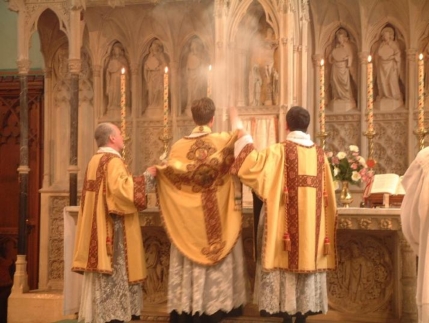 |
| Latin Liturgy-Rome |
 |
| ???-USA |
Yet this new sense had stirred something in me much more than any antique could. It caused me to ask some tough questions, most obviously...
Was the presence of Divine Liturgy on the earth: in Egypt, the Middle East, Russia, Jerusalem, and so on evidence that before there was the written word, worship existed--not just any kind of worship, but worship taught by our Lord? Was the liturgy the protoevangelium (first gospel)?
This portended so much, but I had to retain some modicum of skepticism. If the Divine Liturgy preceded the written word, and was in someway contradictory to it, wouldn't it be reasonable and consonant with the Scriptural witness to either (a) find a place in Scripture that contradicts or undermines it as a false practice or (b) upon the Church receiving Scripture, these novel innovations of worship (or at best local adaptations of man's effort to worship "Christian-style") would become obsolete?
Yet we possess Scripture and neither Scripture denounces it nor the emergence of Scripture made it extinct. Startling.

The Divine institution of the liturgy makes it, like the Gospel, indestructible. To war against it, to seek to subdue it, will be the cause of one's own inevitable destruction. If the Gospel is the good news of salvation to humankind, and the Divine Liturgy is the protoevangelium, then in the words of Father Z:
"Save the Liturgy, Save the World."

