
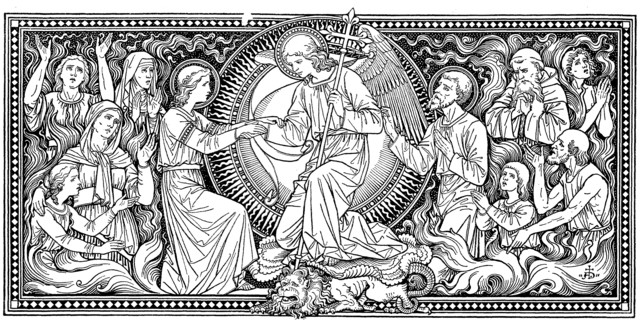
When I was studying the doctrine of purgatory, one of the most interesting facts that astounded me was just how explicit this notion was in the early Church Fathers. More than infant baptism or original sin, the notion of a coming purgation for the elect was eminent in their writings both East and West.
In my previous post I explored whether or not this doctrine made sense generally as a Christian. Despite what I will convey here and my growing conviction of the apostolicity and orthodoxy of the doctrine during my studies, I still couldn't make the heart movement which I explained in my previous post. Before that movement, I had given assent to the doctrine per my understanding of (a) the authority of the Catholic Church to teach it and (b) the witness I noticed in Church history and Scripture that attested to it.
In the The Passion of Perpetua and Felicity we are introduced to a "place of punishment". St. Clement of Alexandria in the dawning of the third century describes this place saying:
"Accordingly the believer, through great discipline, divesting himself of the passions, passes to the mansion which is better than the former one, viz., to the greatest torment, taking with him the characteristic of repentance from the sins he has committed after baptism. He is tortured then still more--not yet or not quite attaining what he sees others to have acquired. Besides, he is also ashamed of his transgressions. The greatest torments, indeed, are assigned to the believer. For God's righteousness is good, and His goodness is righteous. And though the punishments cease in the course of the completion of the expiation and purification of each one, yet those have very great and permanent grief who are found worthy of the other fold, on account of not being along with those that have been glorified through righteousness."-StromataSt. Cyril of Jerusalem in the fourth century about five hundred miles away from Alexandria writes:
"For I know that many say, what is a soul profited, which departs from this world either with sins, or without sins, if it be commemorated in the prayer? For if a king were to banish certain who had given him offense, and then those who belong to them should weave a crown and offer it to him on behalf of those under punishment, would he not grant a remission of their penalties? In the same way we, when we offer to Him our supplications for those who have fallen asleep, though they be sinners, weave no crown, but offer up Christ sacrificed for our sins, propitiating our merciful God for them as well as for ourselves.”-Catechetical Lectures 23:9,10St. Augustine of Hippo a few decades after St. Cyril writes:
"For our part, we recognize that even in this life some punishments are purgatorial,--not, indeed, to those whose life is none the better, but rather the worse for them, but to those who are constrained by them to amend their life. All other punishments, whether temporal or eternal, inflicted as they are on every one by divine providence, are sent either on account of past sins, or of sins presently allowed in the life, or to exercise and reveal a man's graces. They may be inflicted by the instrumentality of bad men and angels as well as of the good. For even if any one suffers some hurt through another's wickedness or mistake, the man indeed sins whose ignorance or injustice does the harm; but God, who by His just though hidden judgment permits it to be done, sins not. But temporary punishments are suffered by some in this life only, by others after death, by others both now and then"-City of God 21:13At the Twenty Fifth Session of the Council of Trent, the Church affirmed:
"The Catholic Church, instructed by the Holy Ghost, has, from the sacred writings and the ancient tradition of the Fathers, taught, in sacred councils, and very recently in this oecumenical Synod, that there is a Purgatory, and that the souls there detained are helped by the suffrages of the faithful, but principally by the acceptable sacrifice of the altar; the holy Synod enjoins on bishops that they diligently endeavour that the sound doctrine concerning Purgatory, transmitted by the holy Fathers and sacred councils, be believed, maintained, taught, and every where proclaimed by the faithful of Christ. But let the more difficult and subtle questions, and which tend not to edification, and from which for the most part there is no increase of piety, be excluded from popular discourses..."The Catholic Church continues to proclaim this doctrine of purgation that affirms the dignity of the individuality of the human person and that is copiously present in the writings of the Church Fathers. What I found is that a lot of the historical and theological objections to purgatory had to do with the "difficult and subtle questions, which tend not to edification (or)...increase of piety." The Church certainly had in mind some of the late medieval nominalism that was marked by the most peculiar and subtle questions regarding theology. For example, "If the Eucharist falls on the ground and a mouse picks it up, does the mouse consume the Sacramental species of Christ?" The answers did little more than satiate the inordinate obsession of nominalists with the unending possibility of making language a game. Nevertheless, when the doctrine is understood in its Biblical, historical, and sensible context, it is quite manageable to understand.
Moreover, as the Council of Trent illumines, the doctrine of Purgatory compels us to a life of holiness and penance here on earth. When we sin we not only injure our relationship with God but also our relationship with ourselves and others. Purgation is the process whereby we make right the later two and will make it right either in this world or the next (Matt 12:32).
(Next: Purgatory in Scripture)

