
 |
| The Council of Constantinople |
"May God by the prayers of the Saints, show favour to the world, that you may be strong and eminent in all good things as an Emperor most truly pious and beloved of God." Letter of the Second Ecumenical Council of Constantinople, A.D. 381
Such is the sentiment of those ancient Christians as they emerged from the waters of persecution for over three centuries. Having spent those years meditating on the mysteries, protecting them through codified language, symbolic gestures, and hidden meeting places, the Church could now shine forth like the sun to a world that had given up its pagan dark day.
One can argue that there is not explicit teaching in scripture admonishing one to ask the Saints for their prayers. We will examine this Biblical claim in my next post. However, I think it is foolhardy to put forward a view of a stale Christianity, shackled by a primitive intuition, unable to learn anew what exactly this new Kingdom means particularly as it unfolds.
That is why there is evidence from the very beginning, even when writing was suppressed for lack of time and resources that Christians knew that those who passed through the veil from life to death were not separated from us; that Christ's victory meant a communion whereby "death has lost its sting." Here are just a few examples of this primitive Christian belief:
"[The Shepherd said:] ‘But those who are weak and slothful in prayer, hesitate to ask anything from the Lord; but the Lord is full of compassion, and gives without fail to all who ask him. But you, [Hermas,] having been strengthened by the holy angel [you saw], and having obtained from him such intercession, and not being slothful, why do not you ask of the Lord understanding, and receive it from him?’" -The Shepherd, A.D. 80
"In this way is he [the true Christian] always pure for prayer. He also prays in the society of angels, as being already of angelic rank, and he is never out of their holy keeping; and though he pray alone, he has the choir of the saints standing with him [in prayer]" Clement of Alexandria, Miscellanies, A.D. 208
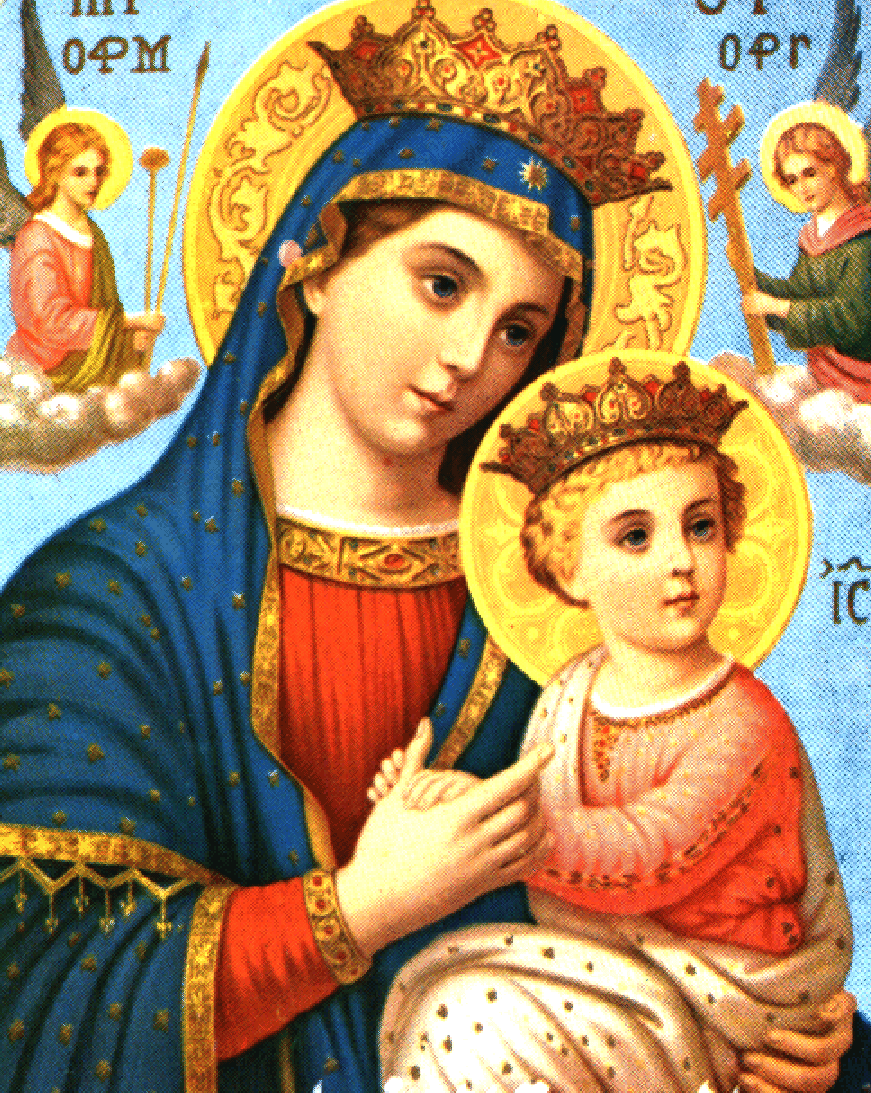
"Beneath thy tenderness of heart
we take refuge, O Theotokos,
disdain not our supplications in our necessity,
but deliver us from perils,
O only pure and blessed one."
Egyptian Liturgy for the Nativity of Christ, 3rd Century A.D.
"Then [during the Eucharistic prayer] we make mention also of those who have already fallen asleep: first, the patriarchs, prophets, apostles, and martyrs, that through their prayers and supplications God would receive our petition . . . " St. Cyril of Jerusalem, Catechetical Lectures, A.D. 350

Their prayers as the "righteous" were most "effectual" for them and are most effectual for us. May we not be ignorant that they see face-to-face the One our hearts long for (Benedictus Deus) and whose prayers, as we rely on them, glorify God who comes to make all things new. May all Christians, whether militant, purging or glorified be One, even as the Holy Trinity is one. And that all God's people would say, "Amen" in the company of so great a cloud of witnesses. But let us remember that it should not be that they gaze at us as if we were their terrestrial witnesses, but that they are, rather, our heavenly witnesses, and that we must turn to them as such guides who have gone before us to enter into their rest in the Holy City.
Amen.

