
No one can object to the development of doctrine. Our mind will not allow us to do it. What someone rejects is a mutation, fissure or outright divorce of a new concept from its predecessor. That is not development. As a Catholic, I reject that type of change as well.
On second thought, it is possible to reject development of doctrine. Though, the two alternatives to development of doctrine are fundamentalism and liberalism. Let me explain.
 |
| "It's okay little guy. You are safe from development of doctrine here." |
Similarly, liberalism also makes it to where an idea is incompatible with itself. It is precisely because it considers all ideas as equally valuable that it casts some idea in such a way as to make it untenable. It, too, is a compelling local-view, and I use "local" because liberalism is not a worldview. It can never have the world in mind because the moment it does it retreats into itself because, by their nature, ideas are competing and contradictory. Liberalism is epitomized by our world of mass isolation. Thus, fundamentalism diminishes the value of truth due to a dogmatic adherence to one truth at the expense of all other truths. Liberalism diminishes the value of truth due to a leveling of all truth statements in such a way as to empty all truth statements of their import.
Development of doctrine, on the other hand, operates under the principle that "all truth is God's truth". That a sunset in all its radiance and the birth of a child in a poorly lit alley are compatible with beauty. That just because prima facie (on the face), I do not understand how two truths fit together--they do. In this way, development of doctrine is conservative. By taking in the one good, it preserves the other.
Many contend that Blessed John Henry Newman's idea of development was far too influenced by the intellectual soup du jour. Particularly, this non-argument connects Darwinian theory to Newman in such a way as to prey upon the fundamentalist tendencies of some Christians (to throw out babies with some bath water). If Darwin thought it, the meme goes, then it must be wrong. Ergo, if Newman was influenced by the "spirit of Darwin" his theory must be wrong.
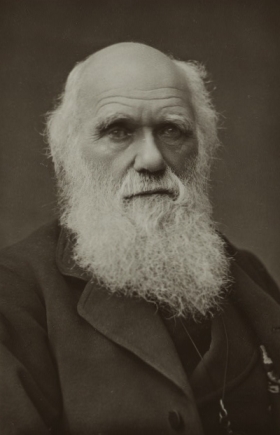 |
| He looks too much like Newman... |
Here is a brief sketch of what I mean by development of an idea:
- Call idea "A", where A = {1- 7}; { } = some set of cohering propositions
- We can know {1- 4} by observation, reason (act of intellection) or by revelation
- If we know A and we learn B, where B = {4 - 12 }
- and the propositions in B cohere differently than A
- then if A and B are true
- We should expect, where A and B are coextensive, they are compatible
- One consequence of their compatibility is a new set "C", where C is a new { }
- C, if it is to be a development, cannot be either (1) identical to A or B but also (2) cannot be "repugnant to the being" of A or B (to borrow a scholastic axiom)
 |
| Doctor Subtilis: defender of the "Immaculate Conception" and user of the phrase "repugnant" |
However, we do not have a ground for a prima facie intuition of theology. In fact, an intuition (from the Latin intueri) implies a relationship between the knower and the thing known. So, it is rational that we can have a prima facie intuition regarding knowledge that comes to us by observation or an act of the intellect. Theological truth (revelation) comes to us not as an act of observation or intellection, but via divine accommodation and condescension. Accommodation meaning that God uses language that is meaningful to us correlative our cognitive abilities and relative experiences, and condescension meaning that for God to even speak to us to begin with is pure grace (analogia entis).
Thus, we can have no real prima facie intuition of theology. We can come to a conclusion by a process of analysis, but we should not think about that as an intuition--because frankly we have no "insider track" to theology--like observational or intellectual knowledge. Which leads to my final two questions: (1) What motivates or grounds the development of doctrine in theology? and (2) What mistake is made when one prima facie rejects theological development?
(1) What motivates or grounds the development of doctrine in theology?
The motivation and ground of working the brief sketch outlined above (set A, B, C) is an act of the will in obedience to our first principles (intellect). These principles can be articulated as a commitment to trusting the reliability of our senses (observation), affirming universals or basic causality (intellection) or to faith (divine revelation). In the case of theology, faith animated by agape causes the individual to submit their intellect to that which is higher than it--namely, God. Therefore, the history of Christianity is truly the history of the Church articulating the truth of revelation progressively and dynamically in relationship to the necessity of her contemplation of the ideas present in revelation.
For example, we might say that the Council of Nicea was of necessity the Church's contemplation of
various ideas present in the deposit of faith (revelation), but her articulation was something both different from any one particular idea already present (to the mind of the Church) but not against the existence of any one idea already present. Thus, if A and B exist, and the Council articulates C, C now becomes a part of the deposit of faith, if and only if, that Church is guided infallibly by the Holy Spirit. If not, C cannot be a theological development, but only an intellectual development (theologoumena). The distinction is important, because if C is not a theological development, I have no reason to of necessity submit my intellect to it. If it is an intellectual development, then it is possible that I have a ground to either prima facie reject it or upon analysis reject it. Assuming C is an intellectual development, than C would be as open for debate and tenuous as any conclusion of any science. However, if C is a real theological development--vis-a-vis a work of the Holy Spirit in and through the Church--then it is worthy of the full powers of my intellect to figure out how the propositions cohere, motivated--of course--by faith.
For example, we might say that the Council of Nicea was of necessity the Church's contemplation of
 |
| Sorry about all the philosophy |
(2) What mistake is made when one prima facie rejects theological development?
The question still lingers as to whether a Church promulgation is either (a) a theological development, (b) an intellectual development or (c) a novelty or innovation of either. The question regarding (a) or (b) comes down to how faith informs one's understanding of the role of Church in understanding divine revelation. In fact, one might say that to a Protestant, theological development is impossible if Church councils are subject to the motives of intellectual scrutiny of non-theological (i.e., of divine origin) texts. On the one hand you would have Scripture (revelation), on the other hand intellectual opining. Thus, the efforts of the later would never bring to bare authoritatively or definitively on the former (this, in effect, will result in the absolute primacy of the will--something I will write about later).
How we consider a Church promulgation in relationship to a development is also informed by faith, but can be corroborated by the work--not intuition--of the intellect. This is simply to say that theological truth is not against or contrary to intellectual or observational truth (the later of which being the most tenuous). Therefore, it is reasonable that we would do the work of comparing those propositions and asking ourselves the question:
"Is this idea repugnant to the being of this other idea?"
Considering the motive and/or ground of this act, we find that when considering passages of Scripture in relationship to each other--most Protestants are apt to do this kind of work. They will work very hard to see how the propositions are compatible--and the result is good work evidencing the wisdom of God. Thus, the theologian notices the unfolding nature of God's wisdom in relationship to our limited vantage and the internal logic of God's communication in relationship to his unfolding plan of salvation in history. So, I ask: Why can't these same powers be exercised on Catholic dogma? I argue that it is motivation that is at issue not content. The same reason the atheist rejects the Bible, the non-Catholic rejects Catholic dogma. At least that is my prima facie intuition. Well, then again, maybe I have thought about it a little.
Because everyone really believes in development of doctrine.
They just don't want to.
Because everyone really believes in development of doctrine.
They just don't want to.
 |
| "Development of doctrine is from the DEVIL!" |

