June 29, 2011

Why All Christians Believe in the Communion of the Saints

I have been reading Jimmy Akin's book The Fathers Know Best where he catalogs many quotes from the Church Fathers regarding various doctrines taught by the Catholic Church. I am having a hard time getting the impetus to finish my series on Confession, despite Akin's section in the book on it, since the practice is both not against Christian sensibilities and has a direct scriptural reference that is undeniable. Nonetheless, I will try to do more on that post (when I write it) than merely say "see" and point to the obvious historical reality that Sacramental Confession is practiced in all the apostolic churches of antiquity among the other venerable things they do.

For now, I wanted to share with you something I was thinking about and get your feedback. Last night while eating dinner with my culinarily gifted wife and 4 rambunctious and talkative children, I had an epiphany.

Every Christian practices a belief in the Communion of the Saints whether they want to admit it or not.

Maybe their understanding isn't robust, maybe they fail to appreciate what they are doing or maybe they even ignore a vast segment of the saints...

Yet they still act like they believe.

What do I mean? Well, the example is so obvious that when I thought of it, I laughed inside.


In ANY church, the pastor will pray in front of the congregation. When the pastor prays, the congregation generally takes a position like this, especially when the stage is elevated and you have to hold your head at an awkward angle.

The point is that at the moment of the prayer, everyone joins their hearts to the pastor's prayer. They rely on his prayer to be effectual. They come into agreement with what he is praying. The pastor becomes a type of mediator between the congregation and God.

Aren't these all the reasons why Protestants object to the Catholic view of the communion of the Saints? We ask for their prayers as participators in Christ's mediation and we rely on their intercession and join our hearts with theirs in agreement that God's will be done on earth as it is in heaven.

I wish every Christian would just admit it. It would do a lot towards Christian unity if we would stop hiding behind the firing lines of anti-Catholic rhetoric and really consider what we ALL do as Christians. Even if a protestant doesn't understand that this is what she or he is doing or ad hoc ignores those Christians in heaven, it still holds that we all rely on our communion with each other in our spiritual life.

Someone might deny what I've written. But to do so, they would have to go to their church this Sunday and do something like this:
(In front of the congregation)

[Pastor] "Dear God..."

(In the silence of her heart)

[Sally] "You know God that although my eyes are closed while that man prays, I am the one coming straight to you. Hear me oh Lord as my heart leap frogs the man talking out loud right now"

[Pastor] "...we all love you so much and are glad we can gather to worship this morning..."

[Sally] "God, despite his use of the pronoun we, I am singularly before thy throne in need of no other but you."

[Pastor] "...Lord, we especially ask for your help for Sister Betty as she goes into the hospital this week...

[Sally] "despite what it appears, that I am entrusting Sister Betty to the prayers of pastor, in my faith alone I confide in alone to touch your heart for the benefit of Sister Betty. It is mere pageantry that Pastor speaks on our behalf."

[Pastor] "As I preach today, open the ears of the people that they may hear the word of God and change their lives for your glory. In the name of Jesus we pray, Amen."

[Sally] "Please know Lord that I, not like the pagans or Catholics down the street, know that only my prayer directly to you oh Lord doth benefit my soul. In this moment, while I acknowledge the kind but misguided gesture of my pastor, my trust is directly in you to bring about my conversion. I am but an island on which for you to live. Amen."
NOT SO MUCH...
Not a scary picture
Saints of God...Pray for Us!

June 27, 2011

4 Reflections On My First Traditional Latin Mass

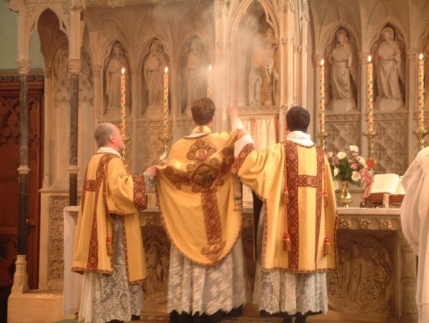
I attended my first Traditional Latin Mass this last week while on pilgrimage in St. Louis, MO. I'm still reflecting upon the experience but wanted to share with you a few reflections I've had so far.

1. A church can be beautiful

St. Francis de Sales Oratory is breathtaking. I also had the fortune of spending time in the basilica in St. Louis which is incredible in its own right. But, the three-dimensional art in the Oratory still has me scratching my head. Beauty communicates Truth in a way that indelibly leaves a mark on the soul, not just the intellect. 

Both in the oratory and the basilica, I was moved by the appropriateness of the response to the holiness and grandeur of God. If God came to us in the flesh and comes to us in the Eucharistic mystery, let's respond to that love with a church that celebrates just how amazing God's grace is.

2. Ad Orientem makes a lot of sense.


As Mass started at St. Francis de Sales Oratory, tears welled in my eyes because I understood something I had never understood before. We, with the priest, come to God to offer our lives to the Father through the Eucharistic sacrifice We are not mere witnesses to the Eucharist, we are participants. The Eucharist is our prayer.

Ironically, when the priest faces the congregation that important truth can fail to take hold. What can get unintentionally communicated is that the priest is putting on some type of show and that the direction of the Mass is toward the people. Ad Orientem reminds us that it is toward God. The movement of the Mass is vertical, the paschal sacrifice is for the Father, and the Eucharist is our prayer to God and His answer to that prayer.

That all said, I had the honor of being at Mass with Cardinal Burke on Sunday--Novus Ordo--that was celebrated with the solemnity appropriate the Holy Eucharist.

3. I still appreciate the vernacular.


My friend and I commented to each other after our time at the Oratory, that the Latin Mass without catechesis is a recipe in the modern world for a loss of faith. (I also think that with catechesis, the resurgence of the Latin Mass is the recipe for a resurgence of faith)

The fall-out post-Vatican II had little to do with the new Mass and mostly to do with poor catechesis. Leaving the Church isn't an option if Christ has "the words of life", but if the faithful don't know those words it can be difficult to remember why we linger with Him through this life of suffering. Moreover, behind every Mass innovation is a failure in appreciating the Truth of the Mass--a failure of catechesis. We doctor up what we think is broken.

We are in the era of the New Evangelization. I believe the vernacular Mass serves two purposes. One, it calls all men and women into accountability for their faith. No one can say, "I didn't know because I didn't understand". When we profess our faith or when the priest says "The Body of Christ", we are left without excuse if we respond in lifeless apathy or disbelief. Christ said His Father would separate the goats and the sheep. He's doing that.

Two, it opens the door to bring unity to the Church--particularly amongst the separated brethren in the protestant communities. Mass being in the vernacular was essential to my conversion to the Catholic faith. If for not that reason alone, I will always be endeared to it.

4. Why did we get rid of communion rails?

This is absolutely one of the most beautiful parts of our faith. The imagery is of a wedding feast. The linens are pulled out. We kneel as beggars. We, poor banished children of Eve, receive the Fruit of New Eve's womb.

Restore communion rails and dignity for the Eucharist will be restored tomorrow. It seems just that simple.  Further, this seems a rather uncontroversial reform. Right? Isn't everyone interested in the Eucharist being treated with respect? Too many times, I've witnessed our Lord being treated carelessly--communion on-the-go or our Lord shuffled around in the hand as if He were a pocket candy. Surely these displays do not increase our faith in the Eucharistic Mystery. Let's pray that we see a reform to these irreverent practices.

Ave Maria!

June 23, 2011

On Pilgrimage: Thursday in St. Louis

My morning started out here (first TLM):

St. Francis de Sales Oratory
Spent the afternoon here...

Cathedral Basilica of St. Louis

...talking Theology with
Bryan Cross

It was a good day!

(Not to mention it was with my best friend David)

June 20, 2011

Divine Liturgy as the Protoevangelium

Like a growing number of Christians in the modern world, I grew up without liturgy. By liturgy, I do not mean a vague outline of a worship service--maybe written down or maybe not--whereby the service can get from point A to point B. That can be liturgy, if by liturgy we mean merely order of worship.

If I meant merely an order of worship, no Christian would contend (with exception of the Quakers). Even in raise your eye-brow, shout until your throat hurts, camp-meeting revival-thons there is some type of order. I preached a revival or two in my day, and the method was always very similar yet it always reached the most awkward moment where everyone kind of did this:

"Watcha gonna say?"
Eerie.

What I am getting at is something very different.

Throughout my journey, I came to these moments where something I didn't notice before emerged on my radar in such a way that I couldn't ignore it. Like a German panzer, Truth can be a clear and present danger especially when it threatens to terminate what you held previously as a sacred cow. The sacred cow for me was the vestments of the low-church. I was one part John Wesley and two parts Billy Sunday and Hillsong United. Then the thought occurred to me:

How is it that every Christian community that claims antiquity for its origins worships the same way? not like me! 

By the same way I mean, of course, in a manner unfitting for the times, un-fad like, timeless, always beckoning to a time gone past yet radically contradicting the fleetingness of the present. More specifically, all of them possess an internal logic and rythme that bespeaks of a common origin.

Quiz: Which of these doesn't fit?

Maronite Liturgy-Syria
Eastern Liturgy-Greece
Coptic Liturgy-Egypt
Latin Liturgy-Rome
???-USA
My dear undergraduate mentor, Dr. Daniel Thimell, had in a conversation mentioned that liturgy was a way that we showed deference to our forebears. They died for the faith we enjoy. That seemed reasonable, and at that time gave me a nostalgic affection for liturgy in the same way one might have affection for an old photograph.

Yet this new sense had stirred something in me much more than any antique could. It caused me to ask some tough questions, most obviously...

Was the presence of Divine Liturgy on the earth: in Egypt, the Middle East, Russia, Jerusalem, and so on evidence that before there was the written word, worship existed--not just any kind of worship, but worship taught by our Lord? Was the liturgy the protoevangelium (first gospel)?

This portended so much, but I had to retain some modicum of skepticism. If the Divine Liturgy preceded the written word, and was in someway contradictory to it, wouldn't it be reasonable and consonant with the Scriptural witness to either (a) find a place in Scripture that contradicts or undermines it as a false practice or (b) upon the Church receiving Scripture, these novel innovations of worship (or at best local adaptations of man's effort to worship "Christian-style") would become obsolete?

Yet we possess Scripture and neither Scripture denounces it nor the emergence of Scripture made it extinct. Startling.

What we do have is the Divine Liturgy--East and West--proclaiming the Gospel in sight, sound, smell, touch, and taste. Sensuous creatures that we are, equipped with reason whose faculty accesses only those things which are first in the sense, receive in the Divine Liturgy incarnational worship--Christ's worship. Thus, it will not acquiesce to any movement to supplant it because it's origin is Divine.

The Divine institution of the liturgy makes it, like the Gospel, indestructible. To war against it, to seek to subdue it, will be the cause of one's own inevitable destruction. If the Gospel is the good news of salvation to humankind, and the Divine Liturgy is the protoevangelium, then in the words of Father Z:


"Save the Liturgy, Save the World."


June 14, 2011

Liturgical No-No #2: Guitars in The Mass

Ibanez S-Series, Floyd Rose tremolo with
double humbuckers (custom)
I am not the official Mass police nor is there such a thing. This post is a follow up to "Liturgical No-No: Applause in The Mass" where I considered whether or not it is appropriate to laude praise upon Mass participants during the occasion when the Creator of the Universe gives Himself to us--Body, Blood, Soul and Divinity--under the humble species of bread and wine.

I think it is providential that God would call Protestants of all stripes home to His Church. I am constantly overwhelmed by the feeling of being a poor beggar who by a graceful chance stumbled upon an invitation to a Wedding Feast. Yet on another level, God always acts not just for our own good but in His inestimable wisdom and power orders our actions toward a kind of cosmic good. This was a profound insight that was influential in the conversion of Edith Stein (who became St. Theresa Benedicta of the Cross--see Finite and Eternal Being). Our past, both good and bad, is not a dull tool in the hands of the Master. Instead, former Protestants are witnesses to those who have always known Mother Church as their own of the road too broadly traveled. So to speak, we have been there and done that.

Taylor 410-CE:
 Another one
of my beauties
The picture above is of one of my guitars. I've been a musician for 22 years. I've played in front of thousands of people, had a demo CD and recorded in studios. I've put on massive productions for Easter and Christmas. I even played in a black-gospel group that covered songs from musicians like John P. Kee and Fred Hammond. During one of my pit stops in Protestantism, I was the lead guitarist at a huge mega-church. You can see their stuff here. I mention this so as to eliminate the possibility in one's mind that I have no idea what I'm talking about or that I cannot relate in the least to what it means to play the guitar in a Christian worship setting. 

Clue: If it becomes a
popular console game
it probably wasn't ever
suitable for Holy Mass
Let me lay to rest a myth. The guitar is not as popular as it is today because Michael the Archangel appeared to Elvis Presley tapping out a previously unknown arpeggio. No. The guitar as we know it today provides us with entertainment because Jimmy Hendrix had inordinately large hands and Kurt Cobain made the grotesque grotesquely popular. It is a part of what our Holy Father calls the "cult of the banal"--the industrialized world of ever churning and burning fads.

I realized this 12 years ago.

Why?

You are some kind of prude, aren't you?

Not at all. I've just been there and done that.

Pay attention. Next time you hear music, especially next time you are in the presence of live instruments watch for the guitar. You can't miss it. It wasn't made nor has it evolved to its place within the family of instruments to be ignored. I'll never forget when I had a gentlemen come up to me after a "praise and worship" service. He was "blown away" with how awesome the worship was. Yet what had been evoked wasn't worship of God but rather the "elemental passions" of self-affirmation: he had boots on and I played a country rift in the bridge of a Delirious? song.

Navel gazing. Catholics, we don't want to go there.

The Holy Mass is God's descent upon us. It replays salvation history and then, unlike it's impotent Old Testament forebear, brings salvation to us--the sacrifice of Calvary via the Eucharistic sacrifice. The bloody tree is now our bloodless gift. 

Bottom line, if you wouldn't do it at the foot of the Cross, don't do it in Holy Mass.

*For more on Pope Benedict XVI and liturgy go here or you could buy his book The Spirit of the Liturgy. 

UPDATE: Due to a comment made, I want to be clear that this is a reflection and not my canonical decree. Since I am incapable of the later, I want you to know that I'm not flying solo on the former. Cardinal Arinze made a similar observation here.

Want me to deliver my posts to your digital doorstep? 

Your wish is my command. Enter your email here to win!

June 13, 2011

Why St. Rose of Lima is the Patroness of My Family

This is a picture of St. Rose of Lima--the patroness of the Americas. I would like to share with you the special story that explains our decision to entrust our family to her prayers. If my last sentence makes you uncomfortable, I recommend you read this, followed by this, and then this.

An Oklahoma sunset--A metaphor
for our life at this point
Two years into my marriage with my amazing, wonderful and adorable wife Danielle, we found out she was pregnant. We were so excited! About 3 months into the pregnancy, we went into the doctor to have an ultrasound. I'll never forget that day or the days that followed. When we looked at the ultrasound screen, we could see a beautiful little body. The only problem was that there was no pulsing heart beat. Our daughter was dead.

Without trying to write a book in this post, let's just say that the next year was the darkest of our life. A few days after the horrible news, my wife had to undergo a procedure to get the baby out (D&C). Sadly, the doctors refused to call our baby a "baby", but rather "products of conception". The culture of death does not let life even have a cameo appearance.

I'll never forget when I went to pick up the remains of our daughter, I came to a room in the hospital where it was obvious they kept biological waste. The technician knew why I was there, but looked at me as if I were from another planet. No one did what we were doing.

I drove to the funeral home, my daughter sitting in a white container next to me in the driver's side seat. Dead. I was numb. I'll never forget the feelings I had that afternoon, and even as I sit here and type this now a little tear wells in the corner of my eye.

We had a funeral. I wrote a song. We passed out roses to everyone; even bought a rose covered gravestone. Her name was Grace Elaine and she lies in a plot in Broken Arrow, OK.  I can close my eyes and vividly imagine being there, with her, amongst all the other little fallen angels. I love her. I will always love her for she is a part of me. Due to the stress of the situation, I contracted shingles (a more painful version of chicken-pox for adults), not to mention that the whole scenario plunged my wife into a mild depression.

Even worse, now we were afraid we would never have children again...

Almost two years later, Leah Elaine Stubbs was born, and everything changed. If you've read my conversion story you know that it was when Leah was born that my spiritual journey that led us to the Catholic Church began. In some sense it began when Grace died because it was around that time that we began questioning the licitness of birth control. When we came into the Church in 2008, Danielle and I decided to give our already born children their own special saint. We prayed about it, and Dean, our second child, was given to the care of St. Sebastian. Leah received St. Rose of Lima.

Fast forward 3 years. Our dearest friends, David and Kendel Williams, are visiting us for the baptism of our daughter Gemma (child number 5--living child number 4). The kids are in bed, and we are about to present them with some godparent gifts. I have a knack for the theatrical aside, so I begin to express to them both how much they meant to us and how much it meant to Danielle and I both that they cared so much about our children. Specifically, I reminded them about how 3 years ago when we visited them in Oklahoma, they still had the rose from Grace's funeral up in their house. That meant so much to us that our daughter's memory was alive somewhere.

Suddenly my wife jumped out of her seat and dashed into the kitchen--pale faced. When she came back, she had this look like she was going to say something important and her countenance was almost eerie.

"Brent, do you remember when Grace died?", she asked.

"No, I can't," I replied (I'm awful with dates just awful).

"August 23," she said adamantly, "The Feast of St. Rose of Lima".

And then I knew. Our little rose--the one whose grave we had adorned with roses 3 years before we even knew a St. Rose of Lima existed--Grace Elaine, had made it before the face of God. St. Rose of Lima, the patroness of the Americas, had met my daughter maybe even held her in her arms. I'm not sure. Either way, God had assigned her a task. Bring them home to His Church. What had seemed so meaningless now had meaning. We already believed that our daughter was in heaven praying for us, but now we knew.

August 23 was a date that had been shrouded in tragedy and heartache. Somehow by God's amazing grace, it is now a day that is adorned with the glory of God. Isn't that just like the Good News?
"The Spirit itself bears witness with our spirit that we are children of God, and if children, then heirs, heirs of God and joint heirs with Christ, if only we suffer with him so that we may also be glorified with him. I consider that the sufferings of this present time are as nothing compared with the glory to be revealed for us." -Romans 8:16-18

St. Rose of Lima, pray for us!

June 12, 2011

Why Catholics (Can) Love Mary

You will hear people claim that Catholics spread the love around too much. Their love for Mary, the Saints, the Pope, etc., gives them a spiritual handicap in their ability to love Christ. Yesterday, during Holy Mass I was reflecting on how the flesh of Jesus is the very flesh that Mary gave to Him. 

So I thought to myself, in a way, partaking of Christ is partaking of Mary. Then I had another thought along those same lines. The Saints that are in heaven are now mystically incorporated into His Body, and so in a way I am partaking of them as well. 

[Insert faith police]

See! You cannot even have an intimate moment with Christ without Mary and the Saints. You have made them into idols that divide your time and affections.

[Politely asking faith police to sit down and listen]

And then it occurred to me that this dilemma is a false dilemma. In fact, it assumes a kind of grocery store view of love and the faith. 


Like in the picture above, this view of love and the faith envisions Jesus as 'Aisle 7' at the grocery store of Christianity. Catholics, according to this view, spend too much time going down other aisles and therefore neglect the "Jesus Aisle".

The problem with this view is manifest in the analogy. Let's consider just a few Biblical examples.

Jesus taught that some people wouldn't even know they had loved Christ as much as they thought they had. "When did we love you?" they will ask. "When you did it unto the least of my brothers you did it to me" (Matt 25:40). 

In another place, a zealous persecutor of the Church learned that when he persecuted the Church, he persecuted Christ (Acts 26:14).

Apparently, even while still on earth and imperfectly united to Christ, the Church and Christ share a unique relationship whereby when one is effected the other is also. When one of the least of his brother's wound is washed, somehow the water makes its way to glory. When his sister is visited in jail and momentarily healed of fear and loneliness, somehow Christ is the object of that encounter.

Yet, in heaven, we share even more intimately with this very purpose of salvation. Yes, Christ came to save us, but not simply to sanctify us on aisle 9 reserved for humanity while holy ping-pong gets an end-cap. No, Christ came to incorporate us into the very life of the Holy Trinity--the life of Love.   

The epistle of Love, 1 John, talks about this mystery of our identity in Christ. The author introduces the third chapter by reminding the reader that God's love has made us children of God and that the world rejects us because it rejected Him. The letter goes on to teach us that when we attain to the beatific vision, we will understand this relationship--that we are like Him. Yet no longer through a glass dimly, somehow while gazing upon our Lord we will see our true eschatological ontology. This is the mystery of the Body of Christ and that which the Saints have already obtained!

This dynamic infusion of God's love in our hearts, the righteousness won by Christ, empowers us to act for "no one who remains in him sins" and "the person who acts in righteousness is righteous, just as he is righteous". 

What might be these "works of righteousness"? 

One word: LOVE

It's time to get Mary out of the shopping cart, out of aisle 12 or out of the tub of Christmas plastic statues you have buried away in a storage bin.

Catholics can love Mary, the Saints, etc., because the love of God has been shed abroad in their hearts by the Holy Spirit. Catholics can love Mary, the Saints, etc., because in them they recognize the mystery of the Body of Christ. Marriage is an analog of this mystery, and the oneness and newness of that relationship portends only a glimmer of the reality of its spiritual analog. Thus, to love The Body of Christ is to love Christ. Therefore, let us throw aside the pagan and secular view of faith in the image above, and instead turn our eyes above and strain to see the heavenly vision in which by God's mercy and through our sure hope in Christ we can obtain to that fraternal and filial love that will sustain our very being for all eternity.

Amen.


Happy Feast of Pentecost to you all!
(when this whole thing started)

June 9, 2011

Do Catholics Practice Vain Repetitions?


A common objection you hear regarding Catholic prayer of the Holy Rosary, the Our Father and other prayers is that these prayers are "vain repetitions"(KJV). 

"Why don't Catholics pray off the top of their head?" one might ask.

"Do they even have a relationship with Jesus?"

"They seem...so...religious..." [insert face full of fear]

Dear Mr. Bible-Out-of-Context Man:

I want to cover your concerns in a few numbered items so none of us get lost.

1. What do you pray when you eat? Do you use the same prayer? Hmmm...you mean you don't make it up every time? 

Day 1: "Dear God, thank you for this food, Amen."
Day 2: "Dear God, I know you are getting bored with "thank you" so like, yeah this is great. Amen"
Day 3: "I'm really, really thankful for this food, God." [I didn't say Amen to show how spontaneous my relationship with You is]

2. Have you ever read the Psalms? Yes? No?

Example 1: "Blessed be the Lord" -Psalms 28:6
Example 2: "Blessed be the Lord" -Psalms 31:21
Example 3: "Blessed be the Lord" -Psalms 41:13
Example 4: "Blessed be the Lord" -Psalms 68:19
Also see Psalms 148 and 150.

This kind of repetition reminds me of the Litany of the Holy Name of Jesus, a beautiful prayer I prayed before I came into the Church.

3. Have you ever read the Scripture passage you are quoting?

"In praying, do not babble (NASV version of "vain repetitions") like the pagans, who think that they will be heard because of their many words." Matt 6:7

Here's the really interesting thing. If Catholics tend to only use a few words when they pray because they say the same thing, and a non-Catholic asserts that he or she is more religious because they use more of their own words than a Catholic when praying, they in fact prove--by that argument--just the opposite according to the passage (Matt 6:7) that is used to confront the Catholic.

It is precisely because a Catholic uses so few words, that she proves herself not to be pagan.

Well, why do you say the prayer over and over again? Isn't that vain?

A. It could be...depends on the person's heart (Isaiah 20:13). I tell my wife I love her over and over again, but it doesn't follow...

B. Jesus said, "Ask, Seek, and Knock". The Greek verb tense implies that we should "keep asking, keep seeking, and keep knocking." This imagery is very close to what Moses tells the people when he says "be still" and see the salvation of the Lord (Ex 14:13). The Hebrew word implies not an end of action, but rather a continuation of one's persistence in the present.

Thus, Catholic prayer is grounded in both the simplicity of the Gospel and the humility of the one praying who like a child asks, knocks, and seeks--standing still in the presence of God.

"Let us pray to the Lord."

And we humbly ask.

"Lord, hear our prayer."

Do you think that when Jesus was
a child He was God? If you do, then
this picture shouldn't offend you.

Book Review: If Protestantism Is True

Devin Rose, the author of If Protestantism is True, is a former atheist, turned evangelical, turned Catholic apologist. He is a remarkably charitable gentlemen who now uses his website to disseminate free articles and podcasts in an effort to defend the Catholic faith.

If Protestantism is True is Devin's first book of Catholic apologetics. I had the opportunity to read the Kindle version, but there is a paperback available now. Devin also has another book coming out called The Roman Road (title may change) which looks like it will be of equal interest. Without any further Devin-love, here is my review:

"Eminently readable...a teachable rhythm...end notes to take up your next few months, Devin Rose in If Protestantism is True has written a fine book and a wise gift to anyone interested in Catholicism and why a Protestant might convert. Devin prods his reader to consider the beliefs and state of Protestantism today and what that implies to its logical end--converting his insights into a useful rhetorical strategy the title gives away. Part high-brow theology and part anecdote from his own personal experience, Devin offers a reader from any background an opportunity at engaging the concerns that any serious convert to Catholicism takes up."

Buy the Kindle version of the book or the paperback. NOW! Support a Catholic brother, father of 4, and nurture your faith all in one shot!

June 6, 2011

Confession in the Bible: 4 Replies to 4 Theories


We will now pick back up the topic of the Sacrament of Confession. Previously we considered whether or not Confession is a Christian-kind-of-thing to do. Now we will consider a seminal passage in Scripture regarding the Sacrament of Confession:
Jesus said to them again, "Peace be with you. As the Father has sent me, so I send you." And when he had said this, he breathed on them and said to them, "Receive the Holy Spirit. Whose sins you forgive are forgiven them, and whose sins you retain are retained." - John 20:21-23
Honestly I feel like just stopping right here and opening up the comboxes. As a protestant and someone who studied the Scriptures ardently, studied theology professionally, and had an active prayer life, I did absolutely nothing with this passage.

Nothing. Zilch. Zero. Nada. It was like a bad birthday present from your estranged Aunt who was coming to dinner--you don't know what to do with it but you're afraid to throw it away in case she looks for it when she visits. So some grotesque looking gnome sits in your bedroom for the rest of your life. When you get married that's an awkward conversation. That was John 20:21-23. Especially verse 23 (you can read a sermon that does just that here). For other examples of a gloss of this passage see Matthew Henry's Concise Commentary, John Darby's Synopsis, or the Geneva Study Bible.

Let's imagine for a moment what one could do to hack--I mean interpret--this text in order to achieve at some level a meaning that could contradict the Catholic position regarding the Sacrament of Confession.

Theory One: The Apostles had now been given the power to forgive people who offend them
Before Jesus breathed on them, no one could forgive anyone. Forgiveness in general is only a Christian behavior.

Reply to Theory 1
Even if one could only forgive if they were a Christian, it would still not follow that this passage is about that. Nowhere does the passage reference that the sin is against the Apostles. Rather, in most translations, the word "of any" describing the "who" is included which implies that the Apostles had the power to forgive or retain the sins of anyone. Since every sin is not a sin against the Apostles per se, this passage is not about sins against the Apostles.

Theory Two: The Apostles could forgive sins, but only the Apostles. It ended after they died.
Classic cessationist argument whereby the Apostolic Church and post-Apostolic Church are night and day different. The Holy Spirit is given to them in unique and miraculous ways, but after the Apostles there were no more miracles since the Gospel had already been delivered. I call this the Humean-hide-and-seek move. John Gill's commentary says so much and Matthew Henry agrees in that they believe Catholics who try to imitate the passing on of this gift to be in error. Henry goes as far as to say that even though St. Peter had this gift, it did not vouchsafe his infallibility in any way of using it.

Reply to Theory 2
In the next post we will consider in Church history how in fact the Apostles handed off their divine ministry to their successors. Scripture also motions at the necessity of the continuation of the Apostolic Church in both the narrative dynamic in Acts (the story doesn't end) but also by the multiple allusions to the ministry of the Church existing "until the end of time". Even more, the classic use of 1 Corinthians 13 by cessationists fails because it assumes what it argues: namely that what is "perfect" has come and so the Apostolic ministry passes away with the coming of the Gospel. However, this type of realized eschatology goes against a basic protestant hermeneutic (that eschatology is not realized) and more importantly implies that Christ's life was somehow less than the "perfect" which 1 Cor 13:10 references. Yet, both readings of the passage are wrong, and what we do know from the passage is that the dynamic ministry of the Church will end, but that end is not arbitrarily at the death of the Apostles but at the glorious return of Christ--yet even then the Church will rule and reign with Him.

Theory Three: This is some type of quasi summary of the Gospel.
(From the Gevena Study Bible) The publishing of the forgiveness of sins by faith in Christ, and the setting forth and proclaiming the wrath of God in retaining the sins of the unbelievers, is the sum of the preaching of the gospel.

Reply to Theory 3
That's a whiff t-ball style.

Theory Four: The Apostles never used this power
This is John Wesley's argument. Despite the fact that, (a) this is one of the few acts Jesus does after his Resurrection and (b) has a Biblical significance of gigantic proportions given its direct parallel to God breathing into Adam's nostrils in Genesis, Christ's act here is some type of cosmic theatre meant to be read about like Odysseus or Macbeth. ["Wasn't that so awesome! All right, time to go home the movie is over."] While it happened, it never happened, and though we read about it, the Church never experienced the ministry.

Reply to Theory 4
(a) There is no other parallel to this in scripture, (b) it makes Christ impotent or at least the Church a type of window-dressing, and (c) wreaks of anti-Papist filth doing damage to the scripture no matter the cost.

What do you do with this passage?
spurious passage of Scripture
that doesn't fit my paradigm

June 2, 2011

Blessed Pope JPII, Curious George and Love

I need to take a break from blogging to finish up a book proposal I'm putting together. I'll talk more about the book at a later time. However, after experiencing a few unique moments with my children I couldn't stop this particular strand of thought from making it out of the insta-press that is blogging (or what I like to call "instant-printification"--actually Mark Shea has the best blog tag line along this theme).

I have always been the master of putting my children to sleep. No matter the age of the child, my presence and mad-daddy-skills brings calm and peace to my children, and upon a few minutes (or more than a few) of my firm yet delicate hand they are off in la-la-land. More than once, upon coming home from work only to find my wife searching for answers to a cranky child, I have deployed these skills which produce a secondary positive effect of a venerating spouse.

The other night while I was doing a very awkward dip and twist technique, trying to get my over-tired 6-month old beauty Gemma to bed, I had a realization about love. This epiphany was reinforced just two nights later as I sat in a rocking chair and--with a Thor-like aura--calmed my 2-1/2 year old son simply by being in the room. To keep myself occupied while he drifted away to dream about dinosaurs and candy, I grabbed the nearest book available and pretended to be as interested as possible. My take away: a refresher course on my A-B-C's under the tutelage of my childhood friend Curious George.

In both of these experiences I was reminded about the real meaning of love. Love is not about what we get. Love is about the other. Blessed Pope John Paul II in his teachings in Theology of the Body defined love as the "willed good of the other." I like this a lot. Love is not a feeling but a choice. Further, it is not a choice to get but rather to give and to give something in which you receive nothing in return.

As my precious daughter drifted away in my arms and my son snuggled into his sports themed blankie while I remembered that Zebra starts with Z, I was struck by how much I loved both of them so much. I could have cared less that my injured knee hurt or that I already knew Zebra started with Z, all that mattered is that they were loved. That is love.

Be back in a few days...

Reason #5171 Why I'm Catholic

A Believable Historical Narrative

St. Jerome trying to figure out protestant history...
When I was growing up, my Church history narrative went something like this:

Story A-
  • Jesus came
  • Jesus left
  • 2,000 years of messing it up mostly
  • Pentecostal/charismatic renewal brought the Church back
  • It's all good!
Then I went to college and studied Church history. Story A = Fail. I did realize that there were a number of competing narratives, especially as I focused my attention on the history of the saga popularly known as the "Reformation". Which brought up a few other competing stories:

Story B-
  • Jesus came
  • Established a Church
  • Church went apostate early on
  • Wandered in darkness
  • Reformation happened
  • It's all good!
or Story C-
  • Jesus came
  • Established a Church
  • Things were going well until the "dark ages"
  • Luther, Calvin and the rest of the R-Team threw down
  • It's all good!
Then of course there are other stories like:

Story "M"-
  • Jesus came
  • Established a Church
  • It went apostate in like 3 weeks
  • almost 2 millennia later Jesus appeared to a guy in Ohio
  • He re-founded the Church and said it was okay to marry a lot of women
  • It's all good!
and Story "O"-
  • Jesus came
  • Established a Church
  • The boys couldn't get along because one said he wanted to be the manager of the team
  • Something about images
  • The rest is foggy because nobody speaks the same language anymore
  • ...
What are we to make of all of this? What does the world think of us? We have to seem like one of the most dysfunctional religions in the world. If you look at organized Christianity before the "Reformation" and then after, it looks like a time-bomb went off. I thought the word "reform" implied some type of intelligible shape of the object after it has been reformed. Just open up a phone book and look under the word "church" to debunk that myth. But truly, Jesus prayed that we would "be one as He and the Father are one (John 17:21). Unity implies coherency, and in light of the Incarnation we would expect that the narrative that proceeds from the Ascension, the one whose stories start in Acts but never finish, would be at least as coherent as the history of the Hebrews. Let's not over-sell this, but at least the Hebrew people were always identifiable as the people of God. Nobody walked away from Scripture wondering, "I wonder if the Kushites are the people of God?" Yet, for some reason I think it really isn't that hard, or as St. Paul says that God's household is built upon the prophets (O.T.) and the apostles (His disciples and those in succession--Eph 2:20) and that in Christ "you [ὑμεῖς plural] also are being built together into a dwelling place of God in the Spirit" (v.22). Could it be that this plural entity is what our Lord is talking about when he said he would build a Church?

Then there is the Catholic Story-
  • Jesus came
  • Established a Church
  • And the gates of hell have not nor will they ever prevail against her


<--------------A, B, C, et al.


END OF STORY.

June 1, 2011

No Bible, No Problem? St. Justin Martyr and Sacred Tradition


When I came into the Church, I took St. Justin Martyr as my patron saint. I did so because I felt drawn to him during my conversion. In fact, I truly believe I felt his prayers. It was at a pivotal point in my studies when I stumbled across a quote from him regarding Sacred Tradition. I've looked for it over and over again and still cannot seem to find it, nonetheless; his message is still clarion clear in my mind and it was and is still chill rendering.

St. Justin Martyr writing in the second century had the audacity to claim that if not one single drop of ink had been spilt on the New Testament the Church would not be without recourse to the knowledge of the Truth. Why? Because, She has the Sacred Tradition. Straight from the mouth of Christ, the early Church understood how to worship and what Christ taught particularly and primarily through the Holy Tradition.

The Marriage Bed
of the Church
It was at that point that I understood "why". Why the Catholic Church wouldn't just "give up" what I thought was extraneous to "Bible" Christianity. What I had was a book. What this Church had was the Incarnation. I had propositions. She had a Person. Why would a Bride enraptured by her Groom let even one word of Her lover be forsaken? No, this is the Catholic Church, and she is the Bride of Christ. She is intoxicated with her Lover, and had He not jotted one note to her in the day, She would but cling to the ever word whispered in her ear in the night. Like a Jewish Bride, the Church has passed through water and has partaken of the Cup, and now she ever waits for the return of the Bridegroom.

Yet in a beautiful and unexpected way, this waiting for the Groom is not a hope deferred that only makes ill the heart of the lover. No. It is precisely through water She comes and at the Table she partakes not of the meal of mortals, but rather of the Bread of Heaven and receives into Her the fecundity necessary for Her very eternal rebirth.

And so, on this great Feast of St. Justin Martyr I will fet with the best of em as I, for another day, anticipate the return of the Groom--hanging onto His every word whether written or spoken (1 Thess 2:15).

St. Justin Martyr, pray for us!