Showing posts with label journey. Show all posts

April 1, 2011

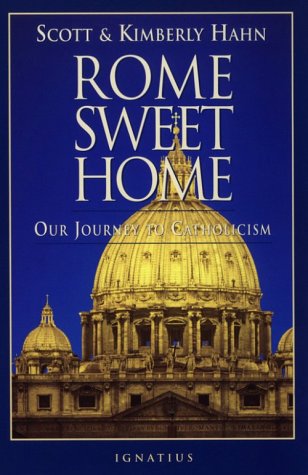
Rome Sweet Home and How the Catholic Part of My Journey Got Started


I wish I could say I was unique in how my journey kicked off. Like I was reading Hegel and all of a sudden St. Thomas came through my window saying "tolle lege" with a copy of Summa en tote. That would have been cool, but that didn't happen.

Actually I was going through a phase of trying to figure out what God wanted to do with my life. I had been a Bible teacher/coach/athletic direct/preacher/lecturer and had left that to work in business. Clear the air. In an effort to get counsel (plans fail for a lack of it), I decided to meet with three different Christians I knew: a non-denom pastor, a Baptist pastor, and a Catholic friend who I knew loved the Lord. I got some good advice. However, from the Catholic I got Hahn's book. He said, "Read it and tell me what you think." So, I thought, "What's the harm in that?"

Taking the book from his hand, I guess I imagined that Mr. Hahn's journey would center around his love of architecture, aesthetics, or maybe detail some actual trip he took to Rome that spurned some type of spiritual renewal. That would be interesting. I will admit that at this point I did know quite a bit about Church history, St. Thomas, St. Anselm, and others like them. I wasn't immune to the possibility there was some type of intellectual argument in the book that might be persuasive. I had been using Catholic arguments in my Bible classes for some time. Yet, by God's grace, I took the book from my friend's hand like a large Easter Peep not knowing that it was more like a ticking time bomb.

I read the entire book the next day. Let's mark the wreckage:

  • Sola scriptura
  • Ecclesial Deism
  • My continued sense of comfort thinking I was okay where I was
  • My hope that I could simply became Episcopal and everything would be okay
  • Mary's less than prominent role in my faith for about a week at Christmas

When I got in bed that night with my wife, I whispered to her, "What if we became Catholic?" She mumbled, "Anything but Catholic." And so it began. It was time to buy some books. Mr. Hahn had laid a time bomb in my theology. Somehow my entire life of Christian study had been undone in one day. That felt bad. So, naturally I logged on to Amazon and ordered books. That's what we can do now. No excuses. Here's what I started with:

  • Catechism of the Catholic Church
  • Calvin's Institutes
  • Luther's Catechism
  • The Bible
  • My Brain
  • Prayer

It was a start, and I thought it would be fun. I hadn't allotted time for this kind of intense study since when I was writing my senior thesis in my undergrad. I was a bookish kind of person anyway, so I figured that I needed to compare what the Reformer's said to what the Catholic Church teaches and compare both to the Bible, after which I could consider the historical aspects of the Reformation in light of the Catholic narrative, and then particular doctrinal issues as they arose. Good enough. And, so, I drifted off to sleep. Ah, sleep, the only time that the anxiety of this journey would acquiesce to my desire for peace. Instead, I laid in bed tossing and turning, thinking about all I had just read and all I had seemingly just lost, but most importantly that night I began turning to God in prayer. It would begin a prayer I would pray everyday for three years; sometimes while clutching my face in tears. 

"God, if this is not of you, throw me off this path. I beg you. Amen."
-little ol' me


March 31, 2011

My First Mass

After my first Mass, I'll never forget sitting in the coffee shop with my friend. I was staring out a window, sipping some coffee and thinking about what I had just experienced. Tears welled up in my eyes and I asked in bewilderment, "Why are we separated? That was the most Christ centered 'service' I have ever been to."

I remember thinking that this whole Protestant/Catholic thing was a big sham. I grew up my entire life thinking that Catholics were unbiblical, disregarding Jesus, and instead worshiped idols, Mary, and worked their way to heaven. I was expecting something foreign at Mass. But what I got went something like this:
  • Prayer and repentance (to Jesus)
  • Old testament reading
  • Psalm
  • New Testament Reading 
  • Gospel (we stand up because Jesus is talking)
  • Prayer
  • Partake of Jesus in the Eucharist
  • Prayer
In 155 A.D., St. Justin Martyr describes something eerily similar here. I had read that before, but it didn't click; but it would make sense when I would read it later. In Luke 24, after the Resurrection, Jesus does something very similar to this with his disciples.

A question that emerged for me on my journey was "Why do all of the ancient churches practice a somewhat similar liturgy?" Was this a novelty or was it something that Christ taught them? I think the logistical limitations of early Christians make it being a novelty quite impossible. Rather, what makes a lot more sense, is that Jesus taught his disciples how to worship and that they went out and established communities who worshiped within those liturgical frameworks. I think we get more than a shadow of it in Luke 24. What this conclusion also bears is the reality of extra biblical tradition. I will talk about that on another day.

When I considered the Mass, I also noticed a beautiful narrative that unfolds. The story of salvation history. As I started to understand the Mass as heavenly worship brought to earth and as the priest operating in persona Christi (because there is only One High Priest), the procession into the Church of the priest only made sense. When we stood we were acknowledging Father Neff not qua John Neff, we were acknowledging Father Neff qua Jesus Christ. This was his time. And, what the brief run-down above shows is that all of us must enter into the historic unfolding of salvation in time and space to understand the The Good News: The Gospel. However, that is not enough. 

Like the disciples our hearts are "burning for him" (Luke 24:32), but even when Christ himself preached the Gospel to them, their eyes were not truly open until he "took the bread, blessed it ("this is my body"), and gave it to them" (Luke 24:31). At their realizing he vanished from their sight. That morning I will admit that I did not see Jesus in the flesh kind of like the disciples who in receiving the Blessed Sacrament looked up to find their Lord disappeared. However, I was certain that He was there. Somehow, Christ was with us that morning. To the side of the altar was a place where they put the communion that was not consumed after the consecration. Because Catholics believe that it is truly Jesus and no longer bread, they could never disgard it like a common piece of trash. Instead, left over "hosts" are put in a tabernacle. As I peered over in the direction of the tabernacle, I asked myself, "Jesus, could it be YOU?"

If it was, I knew how this story would go.


March 30, 2011

The Angelic Salutation


"Hail Mary full of grace, the Lord is with you." I will never forget the first time I ever really "heard" those words. I was outside the doors of St. Mary's of the Lakes about to go to my first Mass. They sounded like a cultic chant; some type of Christian prater. Was this really where God was calling me? I opened the door and peered in and then closed it quickly afraid of what might happen as if their words might cast some spell. "Breathe", I told myself as I paced outside the parish doors, now perspiring as I waited for my friend Dominic to arrive.

Why would I have such a reaction to these words, especially hearing them in prayer? 

Why would I have both an intellectual and visceral reaction that was so negative?

What is the Angelic Salutation?
The beginning of the "Hail Mary" is taken right out of the Angel Gabriel's mouth. We know that angels are messengers for God. Therefore, we know the words in Gabriel's mouth were straight from God's mouth. Why does he send the message and what does it perform?

St. Paul reminds us that God "sent" His son "in the fullness of time" (Gal 4:4). How did he do this sending? It was done by none other than Gabriel and through Mary's fiat ("be it unto me, according to your word") that salvation came into the world. So, there are two hinges to the door of salvation opening to humanity: (1) the word of the Lord and (2) Mary's free response to it.

The Angelic Salutation, St. Louis de Montfort instructs us, "is so heavenly and so beyond us in its depth of meaning that...no mere creature could ever possibly understand it, and that only Our Lord and Savior Jesus Christ Who was born of the Blessed Virgin Mary can really explain it" (The Secret of the Rosary). What this great saint and millions of others (including those praying in St. Mary's of the Lakes that morning) find in these words is the entire Gospel, the entire Good News. What is this news? It is that God has sent his Son and that mankind can accept the gift and be saved. This hope is found concomitantly in the Annunciation (Gabriel's message) and the Incarnation (Mary's fiat). When Gabriel announced salvation to the world, creation stood still awaiting humanity's response. Would salvation come to men? 

IIn very much the same way that the serpent's offer to Eve awaited her response and so fell mankind, God's message through Gabriel awaited Mary's response. What would men say? Would this woman make the wrong choice again?

And creation rejoiced! She was The Woman who had been promised in Genesis. Salvation has come to men! In the Angelic Salutation we find the true inbreaking of God's salvation. It is what, since the beginning, has been anticipated. In this moment, the door to the Tree of Life is being granted access again. What the Angel in Genesis guarded against our entry, now the Angel was offering for our salvation. In Mary's fiat, the door was swung wide open! Come, all you who are weary and heavy laden. Come the poor, sinner, broken, and sick. Come and be refreshed. You banished children of Eve, as children of the New Eve, salvation has come to your house. The Virgin predestined about from the beginning has come and she is bearing a "seed" that will crush Satan, death, hell, and the grave.

Be not Afraid
How could it be that the very words that bring me salvation made me pace in fear? Who else do these words make tremble? As I reflect upon this, I can clearly see that the serpent, the one who was anticipating this moment of failure, this moment of defeat, hates to hear those words, hates to see Christians praying those words especially with Mary. Why with Mary? Because, it is with Mary that Satan cannot question the fruit of the Angel's words. Mary is the instrument of God who "watches over" His word to perform it (Jer 1:12). Could Satan be the father of lies that makes men so hardened to the "Hail Mary" since it is such his enemy?

Yes, he is the father of lies. Yes, the fact that I was so afraid of those words that morning shows that somehow I had bought a lie. But there is hope.

Although you may find the words "Hail Mary" troubling, you are in good company. At first, Mary was also disconcerted by what the Angel said. However, Gabriel continued, "Do not be afraid, you have found favor with God."

I walked into the parish that morning. Somehow, the Angel's words reached my ears. When you hear the words "Hail Mary", do not be afraid as well. The door to the Tree of Life has been opened, salvation has come to men!


March 25, 2011

Good things about the Emergent Movement


On my journey to Catholicism, my wife and I ended up in an emergent church for a few months. It was a natural stop for any white, college educated, 20-30's something who lives in a semi-urban location. Really, I want to talk about the good things in the movement. My next post will be about some of the problems.

1. They get that protestant Christianity has a historical disconnect.
Where did the fog machines, 30 minute slow song interludes, and Super Bowl themed sermon series come from? Oh yeah, and by the way, the 16th century don't count for historical.

2. They notice there isn't any REAL authority in protestantism.
Sola scriptura. How is that working for you? Let's rethink Christianity, what the Bible really means, and get all Incarnational. They also get that a lack of authority has led to a perception of a completely divided Christendom; and that's a problem for them.

3. They get that "seeker sensitive" means "say nothing".
The gospel is intrusive.

4. They know how to ask BETTER questions than a lot of Christians.
WWJD? Nay, rather, "How would Jesus handle the prostitutes in downtown?" They also ask the question "why" incessantly which I think is a good thing.