 |
| Emmanuel! |

December 25, 2012
December 23, 2012
Protestant Idolatry
No, I'm not talking about Bibliolatry. I'm talking about that time of the year when almost every Protestant goes into the woodshed and retrieves this:

 |
| "It's Christmass. The time of year when we all get to act like Catholics." |
And this collection of plastic statues will be placed directly in front of the protesters home or place of worship. Some even put them in their place of worship. And, to all shock and astonishment, this is less offensive to the Protestant sensibility than this:
 |
| Scary Catholic Statue |
Think about it.
God -- Creator, Healer, Omnipotent, Holy... -- came to earth in the womb of the Blessed Virgin Mary. In your view, which of the two portrayals is more fitting? I know, I know. Catholics, also, whip out these plastic renditions of the Holy Family. Sure, we do. But, ignoring those criticism for a moment, the point is what we keep up all year, and what is not kept up all year.
Why, pray tell, is it okay to banish all statuaries, but during Christmas accept a plastic nativity of our Lord, His Mother, and St. Joseph? It is like passing over crème brûlée for a Twinkie and then lying on your weight-watchers e-report that you were "disciplined". It is not so much the plastic in general that bothers me, but rather the plastic in total. In other words, and in the slightly altered words of the cashier at Walmart, "(why) is plastic okay?"
Please understand that this small rant does not come from a foreign place, but rather a place I, too, have lived. At Christmas, before I was Catholic, I somehow glossed over my disdain for statuaries -- my sensibilities slightly dulled by the proximity of the Incarnation to my mind. I allowed the Holy Family to join me en sculpture, and I was never the worst for it. In fact, I hope you did not just miss my words there. "The proximity of the Incarnation to my mind" is precisely what changes everything. The prohibition against "graven images" had to do with the Image-not-yet-come. It was about keeping us reliant upon His salvation, not ours (see: golden calf). But when He did, send The Image, the world was forever marked, our imagination forever incapable of not copying the Masterpiece that dwelt among us.
Why?
Because we beheld His glory.
And so, in the form of our art, we declare that Image until the end of time.
Amen.


December 17, 2012
Love & Newtown: A Perspective
I'm over here contemplating what good we can learn, as parents, in the face of senseless tragedy.
December 12, 2012
I Agree, Let's "Stand to Reason"!
A kind reader wrote to me recently:
So, I replied:
If I do work, I will be qualified.
I don't work, therefore I'm disqualified.
This formulation shows how sophistic the original construction was. If "works" are not qualified, then the premise above must be true, but it is not true. Let me explain further:
If not-A, then not-B.
Not-A, therefore, not-B.
However, that is not the same thing as saying:
If A, then B.
Just because "not-A, then not-B" tells me nothing about A. Which demonstrates why Koukl's original construction is simply incomplete. And that, my friends, is "standing on reason".
Note: A modus tollens would look like this:
I do not resist grace, I work.
I do not work, therefore I resist grace.
I understand that in Catholic teaching one can't work their way to salvation, however on Greg Koukl's radio show podcast, "Stand to Reason," on 10/15/2012 at 24:40, he and a caller talk about how "modus tollens" proves that the Catholic view of justification is "justification by works." They assert the following based on 1 Corinthians 9:27:
source

If I do not work, I will be disqualified.
I don't work, therefore I'm disqualified.
My question is, are they using "modus tollens" appropriately and if they are using it correctly, how is it not justification by works? I know from reading that initial justification can't be had by works. However, after initial justification we have to do works, but if we are still being justified then how isn't it "Justification by works"? I hope this makes sense and doesn't take up too much of your time.Good question, and graciously put.
So, I replied:
There is nothing in the Catholic position that denies the force of a valid inference (modus tollens). Moreover, Koukl's argument is not modus tollens. It is modus ponens. And the conclusion does not follow from the premise, because "I will be" is future tense and "I am" is present tense (ht: Bryan Cross). Therefore, what is wrong is his formula, because it is an incomplete formula.
"If I do not work, I will be disqualified.
I don't work, therefore I'm disqualified."
This construal would be to make the Catholic position Palagian. Which would seem to construe all theological positions that required works to be Palagian. However, that is not true. What is missing is the kind of works. Without grace, no work can be efficacious and no failure to work would disqualify you. However, when one has grace in his soul (i.e., participation in the divine life of God through His Son, Jesus Christ by the Holy Spirit), one must respond to that grace. In the words of Sacred Scripture, you show me your faith, I will show you my works.
So let's consider a new argument:
If I do not work, I resist grace.
If I resist grace, therefore I'm disqualified.
What would have to be shown is that there is no special, qualitative, difference between works of the flesh (i.e., simple human effort) and works wrought by the Spirit. Of course, there are.
If X, then Y. Y, therefore, X. This is true. What Greg is missing is the syllogism that arrives at the premise. In this case, if one has works he does not ipso facto have grace. Therefore, the thrust of his argument fails because he fails to make a crucial distinction between different kinds of works.Consider the inverse of Mr. Koukl's argument:
If I do work, I will be qualified.
I don't work, therefore I'm disqualified.
This formulation shows how sophistic the original construction was. If "works" are not qualified, then the premise above must be true, but it is not true. Let me explain further:
If not-A, then not-B.
Not-A, therefore, not-B.
However, that is not the same thing as saying:
If A, then B.
Just because "not-A, then not-B" tells me nothing about A. Which demonstrates why Koukl's original construction is simply incomplete. And that, my friends, is "standing on reason".
Note: A modus tollens would look like this:
I do not resist grace, I work.
I do not work, therefore I resist grace.
December 9, 2012
Blessed Scotus, You da man!
Did you know that Blessed John Duns Scotus made a lively, erudite and simple defense of the Immaculate Conception?
So there, Faber.
If you would like to read more about his arguments, I've found a well documented piece here.
 |
| Doctor Maria |
If you would like to read more about his arguments, I've found a well documented piece here.
December 2, 2012
Do You Worship The Child?
 |
| Infant of Prague |
It is not too difficult for me to travel back in the not-so-distant-past and remember. Remember when I did not worship The Child. Many do not worship Him. I am ready to admit that it is not some deep theological insight that keeps so many Christ-lovers from loving Him as The Child. They simply do not. Don't search for a significant reason. It is liking asking why a man in Madrid does not eat apple pie. He does not eat it because it is not of the local fare.
So as we enter this season of Advent, I stop and pause to consider why I spent most of my life not worshiping The Child. Even three pagans, the three sages we all sing about this time of year, understood the basic premise that compels one to bend one's knee:
Jesus is God.
 |
| That's me up there |
Crazy.
Yet this is how traditions of men work. They rob our plate of what is natural to it. Which explains it. It explains how a Christ-lover could hold back his affection for The Child -- The Creator-come-down and made helpless for us. As we are warned in Sacred Scripture, traditions of men make the Word of God of no effect. And during this season, as you travel around the cornucopia of Christians traditions, you will notice that such traditions have made The Child glaringly absent. He is in the manger, but no one cares. No one worships. There is no effect.
And no one cares enough to worship, because the local fare simply does not offer Him on the spiritual plate. God is with us is great consolation, but seeing Him in The Child requires that faith to exercise its muscle. Rising from the tomb, even some of the scoffers were willing to admit there must be something to this Fellow, but it is in the manger that we are required to truly believe.
But even more, will we act like Elizabeth in the presence of The Mother of Her Lord and proclaim "Emmanuel!"? Will we? Will we worship Life itself in utero.

In the mind of God before all ages, prophesied about in the beginning, Mary was perfectly, immaculately, set apart to carry within Her none other than God. The Holy of Holies would become a womb -- and God was better than the Israelites in preparing a place for Himself. And at the words of an angel, all of creation cried out in exultation that their Savior was close. Yes, the words of Emmanuel ring true on the day of His birth, but they ring true, all the same, the day He was conceived. For if you have ever been party to the intimate news of conception, you will know that there is a similar joy like the delivery room that sweeps over the heart upon hearing the words, "I'm pregnant."
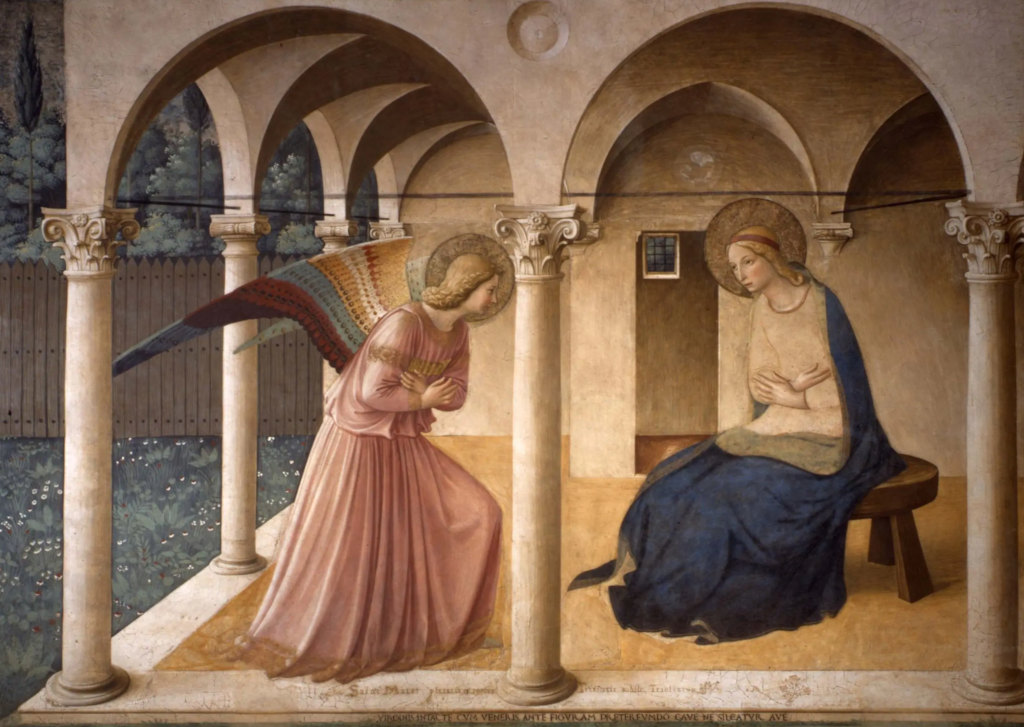
For it was for love that He came down. So amidst this news, caught up in the mystery of it all, nine months pass so quickly. And He is born. And what do we do? What do you do? Do you pause? Are you confused? If so, why? Why, in the presence of or thought of the King of the Universe qua child do you hold back your worship? Even as you hesitate, the three wise men -- maybe only wise because of their appropriate response -- pause on that eternal evening and worship The Child.
"Come, Lord Jesus. If only as The Child that I might love and worship you. Amen."
Subscribe to:
Posts (Atom)