Showing posts with label sola scriptura. Show all posts

June 3, 2012

There Will Always Be Snake Handlers

I read this story and had to share it with you all.

Andrew Hamblin is "certain" he has a "real faith"
When Christianity seems like a farce, and when there is no credibility to the doctrinal veracity of a given position since there is no principled method for sifting through the various opinions, men will go to extremes to make sure they are still alive. They will even put themselves in harm's way just to pulse-check their commitment to their belief system. Doubt will make you mad. Madness makes you doubt your existence.

As my last post noted, Protestantism cannot provide certainty for a believer. This lack of certainty forces man to live below the standard of what it means to truly be human. It might explain, in part, the death of natural law in our society (or maybe another unintended effect of the Reformation). Not sure. Either way, when man lives in this way, he will act in other ways below his humanity. When man has given up on religion that is in accord with reason, all options are on the table.

Copperheads included.

Let me just say, that to be fair, all religions have their kooks. However, one must ask themselves, "Is a religion's kook the fruit of the system or in spite of it?"

When one thinks of the kooks of Catholicism, one immediately can identify that such a person is abusing a given teaching or practice. The "world-view", so to speak, of the Catholic in no way births the snake-handler. The moment he picks up a snake, the Church says, "put that down silly", and the second time might sound a little more serious. In other words, there is a Matthew 18:17 "ecclesia", and even a Protestant will admit that the Catholic Church would lay the smack-down on the snake handler.

I will also admit that most Protestant communities would reject this practice. The question, nonetheless, is why? Why should we reject this practice? On what grounds? Because a particular Protestant denomination says so? The Bible says so? When Brother Dale of LaFollette, Tennessee "takes it to the ecclesia", Brother Dale finds Pastor Hamblin with a chest-full of rattlesnakes. He did what his Bible said, and the word was confirmed in the mouth of two or more witnesses. Let it be established, alleluia! Plus, Pastor Hamblin will just ask Brother Dale to look in his Bible:
"And these signs shall follow them that believe; In my name shall they cast out devils; they shall speak with new tongues; They shall take up serpents; and if they drink any deadly thing, it shall not hurt them; they shall lay hands on the sick, and they shall recover."-Mark 16:17-18
Delivered from heaven in 1611
In the hills of Tennessee, I do not think a discussion about textual variants, monastic additions, and alternative endings to the Gospel of Mark is going to go very far. "My sheep hear my voice", and no Bible scholar is going to tell a "true believer" that a part of their Bible, which God has given them as the holy oracle in their night-stand is irrelevant. In their mind, either you believe the Bible or you don't. If you don't, of course, you could just find another church in LaFollette.

The point is that either you pick up snakes and trust God, or you are simply playing church.

Pastor Hamblin isn't playing.

As Hamblin said in the article, "The same man that walked upon the water said, 'They shall take up serpents.' There's a realness in the signs of God."

Like Luther, Pastor Hamblin received his anointing directly from God, and he thinks he has the Bible on his side. He is a priest, prophet and king, and the signs and wonders that follow his ministry confirm his inclination that he is on a holy mission from the Holy One. He has the keys of the kingdom, and nobody is going to shout down the devil louder than him. If placed before the Diet of LaFollette, Pastor Hamblin would no doubt fail to recant, claiming that he was excommunicated by them because he believed in the "real" Gospel. They, not him, believe in something less than the fullness of the faith.

One problem is that Tennessee outlawed snake-handling in 1947. Bummer. However, it appears that Pastor Hamblin will not be giving up snake-handling. He is willing to die or be imprisoned for what he perceives is the "apostolic" faith. This mental state, I will argue, is the direct result of the Protestant Reformation. This, of course, will not make friends or influence people, but it sticks, and it sticks for three reasons:
1. The primacy of the individual conscience demands that Pastor Hamblin follow his conscience. The Protestant thinks the Catholic is a cultist because he "blindly" follows the Catholic Church. In reality, the Protestant is always and everywhere one step away from creating their own cult. Of course, we do not call them cults, we call them sects, but the personality-centric nature of many of them cannot help but cause pause for reflection.

2. This story brings to light the unworkability of Protestantism for the average folk. If Protestantism is True, then Christ clearly built an "ecclesia" for two classes of men: the learned and the unlearned. Not a gift from God, Christianity is a religion for the intelligent, and the dumb and simpleton should just fall in line
3. It blows up the notion of essentialism. As the saying goes, "In essentials unity, in non-essential liberty, in all thing charity." Is "snake-handling" an essential doctrine? If it isn't, then there is no reason we should reject it. It is just a part of living in the almost-not-yet kingdom of Protestant Christianity. Oh, how snakes have their way of ruining an Edenic view of this Protestant idea.
For another good take on the topic of snake handling, check out this post by F. Longnecker. 

October 31, 2011

Is Pope Benedict A Protestant? And Other Silly Things One Could Try to Prove

In the book to your left, the author--in three volumes nonetheless, seeks to *prove* from the witness of the early Church Fathers the Protestant doctrine of sola scriptura. I've seen this before and will see it again. It's rather tiresome, and three volumes of it would be grueling: clipping, editing and airmailing quotes to make them fit whatever you are trying to prove. Exegeting stuff to death until it renders the meaning you intend. Stringing out arguments long enough to distract the average reader from the validity of the conclusion. Not to even mention that none of these "Church" Fathers come to any of the theological conclusions regarding the Real Presence of Christ in the Eucharist, the Eucharist as a Sacrifice, Confession, Purgatory that the average Protestant would, we are still challenged to believe that they believe in sola scriptura. What's funny to me is that this position would in a way evidence the possibility of arriving at all kinds of un-Protestant doctrines using a Protestant method. Hmmm. To demonstrate just how ridiculous this claim is, I will now prove to you that Pope Benedict XVI is a sola scriptura Protestant. The following are some quotes from PBXVI:
"Above all I think it is this: to love the word of God in sacred Scripture. St. Jerome said, 'To ignore Scripture is to ignore Christ. That is why it is important that every Christian live in contact and in personal dialogue with the word of God, given to us in sacred Scripture."
"We must also keep in mind that the word of God is given to us in order to build communion, to unite us in the truth along our way to God."
"Human opinions come and go; what is very modern today will be old tomorrow. But the word of God is the word of eternal life, it carries within itself eternity, which is always valuable. Carrying within ourselves the word of God, we also carry eternal life."
"The study of the sacred page should be, as it were, the very soul of theology"
"the centrality of the divine word in the Christian life"
“Are we truly pervaded by the word of God? Is that word truly the nourishment we live by, even more than bread and the things of this world? Do we really know that word? Do we love it? Are we deeply engaged with this word to the point that it really leaves a mark on our lives and shapes our thinking?"
"You must know how to translate the indications of the word into daily witness, allowing yourselves to be formed by the word which, like seed sown in good soil, brings abundant fruit. Thus you will remain docile to the Spirit and grow in union with God, you will cultivate fraternal communion among yourselves and be ready to serve your brethren generously, especially those most in need."
Let's recap. According to Pope Benedict:

  • We should love the Word of God above all
  • The Word of God unites us
  • The Word of God bring us eternal life
  • The Scriptures are the soul of theology central to the Christian life
  • The Scriptures should "shape our thinking" and form us

Wouldn't we expect a Roman Catholic to say that we should:

  • Love Christ in His Church above all
  • That the Pope is the principle of unity not the Scripture
  • We receive eternal life through the Church
  • The soul of theology is the Church, which is the ground and pillar of the truth
  • The Church should shape our thinking since it is the authoritative teacher
Since Pope Benedict said the former, he is not a Roman Catholic but a Protestant. Specifically, he is clearly a sola scriptura Protestant. 

One could also try to prove that the Church Fathers were sola scriptura Protestants as well. Oops, I think that already happened.

FULL STOP

On my journey to the Catholic Church, books like King's were discouraging. Arguments like the above read disingenuous at their core. As a semi-anti-Catholic, I could still see the Catholicity and papal tendencies of the epistles of Clement during my research on my undergraduate thesis. Even though I personally subscribed to a disparaging view of Catholicism at the time, the textual evidence required that I either (a) dissent from their opinion or (b) admit that it was unlike my own and be the cause of my consternation. At the time, I chose the the former. 

Reading into texts "catch" phrases is wrong headed. It fails to consider the already existing paradigm of the author and projects onto him or her the interpreter's paradigm. I can hear the objection that we all have paradigms. My reply is simply that what the objector is thinking about is some type of psychological state and not a paradigm as such. For our purpose, a paradigm is something that can be uncovered. It can be as simple as finding out that the author was a bishop in union with the bishop who sits on the Chair of St. Peter. Such a fact finding mission would inform how we understand various other statements of the author. Similarly, the corpus of Pope Benedict and the Church Fathers would naturally preclude a conclusion that either held to the doctrine of sola scriptura. 

Does any one single Church Father make a slam dunk case for conversion? [If you don't count their prayers in heaven] Probably not. However, they do present mounting evidence for a Catholic view of the Church and the doctrinal positions that the Catholic Church teaches. That is a fair reading of the Church Fathers (here's a link, go have fun). You only need to google "the Church Fathers are wrong" to find an assortment of articles detailing how and why the Church Fathers erred. This popular evidence is, I think, more telling of the reality of what in fact the Church Fathers do and do not teach. And, I can more fully appreciate and respect dissent from the reality of something than descent from reason.

August 20, 2011

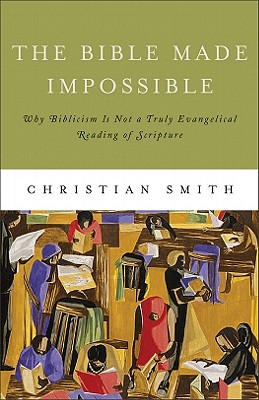
Book Review: The Bible Made Impossible

The Bible Made Impossible: Why Biblicism Is Not A Truly Evangelical Reading of Scripture, by Christian Smith, the William R. Kenan, Jr. Professor of Sociology and Director of the Center for the Study of Religion and Society at the University of Notre Dame, is his effort to understand why the Bible, in his view, does not seem to work as the “sole rule of faith” within his evangelical tradition -- hence the term “impossible.” The book is divided into two parts: the first part a diagnoses of the problem of biblicism and the second part Smith’s proposed solution.

What is Biblicism?

According to Smith, Biblicism is a belief that assumes at least one of the following to be true about the Bible:

1. The Bible is Identical to God’s very words
2. The Bible is the total representation of God’s will for humanity
3. The Bible covers every topic you need to know about anything
3. Democratic Perspicuity- “almost anybody can read the Bible and get it”
4. “Common Sense” Hermeneutic- just take it literal
5. Solo Scriptura
6. Internal Harmony- everything in the Bible fits together
7. Universal Applicability of all direct teachings of the Apostles
8. Inductive Method as the preferable method for understanding the Bible

As to #5, Bryan and Neal have demonstrated how sola reduces to solo here. Smith points to the way Westminster Theological Seminary refers to the Westminster Confession Faith (WCF) as fallible on the one hand, yet treating it as though “the likelihood...of detecting or admitting error or revisions is effectively nil” (p.14). He goes on to point out the way the WCF affirms many of his biblicist criteria. In the end, Smith's criticism virtually includes almost all of Protestantism by implying that both confessional and evangelical Protestant denominations treat the Bible in a biblicist way.

What to think of all of this?

Having defined biblicism, Smith next considers how the belief in the Bible as the rule of faith has fared in history. As evidence of the confusion, he quotes from the founder of Mormonism, Joseph Smith:
“In the midst of this war of words and tumult of opinion, I often said to myself, What is to be done? Who of all these parties are right? Or, are they all wrong together? If one of them is right, which is it, and how shall I know? The teachers of religion of the different sects destroy all confidence in settling the question by an appeal to the Bible. At length I came to the conclusion that I must...ask of God.”
The fact that Joseph Smith’s sentiments reflect the average Christian’s should be startling. Of course, the average Christian doesn’t run out and start a completely new church. The broader question, and the one Smith is asking in the use of this quotation and others he deploys, is how do Christians of good faith sort through all the thousands and thousands (probably millions) of pages of competing interpretations?

You can read the rest of the review where it was originally published at Called to Communion by clicking on this link

August 8, 2011

Myth Busters: Sola Scriptura

Over the next few months, I am going to do a series of posts I'll call "Myth Busters". Like the popular TV show, my job will be to debunk urban legends, myths, and rumor that plague the world with anti-Catholic dribble.

Like the show, we will "test" the ideas out and see if they work.

First up: Sola Scriptura.
The Start of the Church?
Nope, that would have to wait until the Bible was finished
In the history of the Protestant reforbellion (ht: ow), sola scriptura was what would be known as the formal cause of the schism. It was a war-chant, popular among the peasants, and was a kind of pandora's box for the worst of what might be conjured in the minds of men furnished with the raw text of Scripture sans the Church. In the early years, men got so excited about the prospects of Christ without a Church they proposed things like: no need to say the "Our Father" (see Luther's catechism), "who needs baptism" or "I don't need to go to church on Sunday". Of course we can sniff the trail from all of these attitudes right down to the present day ecclesial potpourri.

Sola Scriptura means "scripture alone" and by the phrase the Reformers meant that the Scriptures would be the sole, rule of faith. No Church, Pope or otherwise would infallibly teach the word of God. The Bible and the Bible alone is the direct teacher to the people of God.

Boy this sounds great, doesn't it?

One problem: It's not in the Bible.

Second Problem: It doesn't work.

The First Problem- "Nope, not in my Bible"

To evidence the problem, I've included an excerpt from Protestant apologists James White's website regarding the infamous proof-text for sola scriptura. The verse in question is 2 Timothy 3:16-17, "All Scripture is inspired by God and profitable for teaching, for reproof, for correction, for training in righteousness so that the man of God may be adequate, equipped for every good work." His comments (mine in blue):
They translate [adequate] our passage as, "completely qualified for every good deed."  While Louw and Nida give us two witnesses, I wish to direct you as well to the well-known scholarly resource by Fritz Reinecker and Cleon Rogers, entitled Linguistic Key to the Greek New Testament.  Here, we find the following, in regards to both terms, here in verse 17: "fit, complete, capable, sufficient, i.e., able to meet all demands; ejxartivzw: completely outfitted, fully furnished, fully equipped, fully supplied."

Hence, we see [notice "we see" not because of the Holy Spirit in our hearts but because of a lexical definition by Reinecker and Rogers] the following:

Number 1:  Paul here teaches that the Bible is A rule of faith.  For he says the Church's function of teaching and rebuking and instructing is to be based upon God-inspired Scriptures. First, he doesn't say anything of the sort. I'll give the context of the passage below this quote from Mr. White.

Number 2:  We see that this passage teaches the sufficiency of the Scriptures to function in this way. The passage mentions sufficiency but it does not mention total sufficiency or Scripture alone. In fact, the versus right before it undermine his reading.

And, number 3:  We see that Paul not only does not refer us to another rule of faith, but implicitly denies the necessity of such a rule of faith by his teaching on the ability of Scripture to completely equip the man of God. This assumes what it argues. Namely, that Paul is giving the Christians a rule of faith (proof-text for sola scriptura). What the passage says is that Scripture is sufficient qua scripture. This is what we call material sufficiency not formal sufficiency (hence the whole formal cause of the Reformation).

Therefore, I assert (yep) that the doctrine of sola scriptura is taught plainly in this passage.

Now, one might well ask, "Is this the only place where sola scriptura is taught?"  Most certainly not, though it is the clearest (this is why I included it in this discussion). For example, we find this concept plainly enunciated in the words of the Lord Jesus Christ when coming into conflict with the traditions of the Jewish leaders. Note the words recorded in Matthew's Gospel, Chapter 15: "Then some of the Pharisees and teachers of the law came to Jesus from Jerusalem and asked, 'Why do your disciples break the tradition of the elders? They don't wash their hands before they eat.'  Jesus replied, 'And why do you break the command of God for the sake of your tradition? For God said, "Honor your father and mother" and "Anyone who curses his father or mother must be put to death." But you say that if a man says to his father or mother, "Whatever help you might otherwise have received from me is a gift devoted to God," he is not to "honor his father" with it.  Thus you nullify the word of God for the sake of your tradition.
We can agree on the way he reads this last passage. However, he then applies this passage to Catholic Holy Tradition. Bad move. Instead, we might ask, since Christ founded a Church that is the "ground and pillar of truth", "holds the keys of the kingdom" and the "gates of hell will not prevail against", why do you reject that Church because of your man-made, 500 year-old traditions?

As I mentioned, the preceding texts give undeniable evidence that St. Paul is not teaching what Mr. White and others assert he is teaching. 2 Timothy 3:10-15 says (context):
"Now you followed my teaching, conduct, purpose, faith, patience, love, perseverance, persecutions, and sufferings, such as happened to me at Antioch, at Iconium and at Lystra; what persecutions I endured, and out of them all the Lord rescued me! Indeed, all who desire to live godly in Christ Jesus will be persecuted. But evil men and impostors will proceed from bad to worse, deceiving and being deceived. You, however, continue in the things you have learned and become convinced of, knowing from whom you have learned them, and that from childhood you have known the sacred writings which are able to give you the wisdom that leads to salvation through faith which is in Christ Jesus.
"Who" you receive the Gospel from is paramount to the Gospel. Even more, St. Paul seems to be saying that one is convinced by the Scriptures (Sacred Writings), The Church (whom you have learned) and the Tradition (teaching, conduct, purpose, faith, patience, love, perseverance...). Since we are all in the mood for proof-texting, this is fairly close to the formal definition of the tri-part authority structure of the Catholic Church (Scripture, Tradition, Magisterium).

In addition, St. Paul is making specific reference to the Old Testament (which they knew from their "childhood"). The early Church bathed in the writings of the Old Testament and understood that within them held all the riches of Christ for everything in the O.T. was a foreshadowing and prefiguring of Him. What seemed like riddles and farce tails gained meaning and definitive shape interpreted through the life, death, and resurrection of the Messiah, Jesus Christ. This fact doesn't diminish the rest of Scripture but rather gives this particular passage its proper context and definitive objective referent.

Thus, sola scriptura is not only not in the Bible, but the famous "proof-text" for this belief comes nowhere close to proving it.

Second Problem: It no worky

Over at CTC, a protestant gentlemen named Bradley aptly wrote:
"Phooey with Sola Argument: If Sola is not a Tradition (with a capital T) then it has no authority and I am free, as a Protestant, to say Phooey with Sola! Let’s give authority to whatever extra-biblical doctrine we find to be helpful in spelling out the truth and call people heretics who don’t agree with our extra-biblical Tradition. If it is a Tradition (with a capital T) then it establishes extra-canonical doctrine as authoritative, and I can say Phooey with Sola! We need Tradition (with a capital T) in order for her to be authoritative anyway, which is what we are trying to avoid. Either way, it’s Phooey with Sola"
I like this a lot. On a logical level, it is apparent to men of good will that the Bible isn't perspicuous, it isn't easy to understand, and that a brief reading of Protestant history evidences that on important things like Baptism, Communion, Justification and Ecclesiology, the Bible alone has performed below its sticker promises to be the regula fide of Christianity. To think about it another way, an authority is only as good as its ability to resolve a conflict.

Sola scriptura also appeals to our pride. In a world of might makes right and where authority is earned, it is hard for us to understand a world where authority is correlative to a calling and a gift.

That's not fair! I can read the Bible and study it just like Pope Benedict XVI and the other bishops. Stomp feet. Flail hands.

Some will object and say the problems aren't so bad, and that Catholics force the meaning of unity and authority to mean hierarchal/organizational unity. But I ask, what is the alternative to organizational unity? Dis-organizational unity?

Organizational and hierarchal unity flows from the person of Christ himself. By entering time and space, God redeems matter by reaffirming its goodness in us. True, the buildings will crumble and fall, but Christ's Church continues on in time growing and perfecting in grace through her sons and daughters. Through ecclesial hierarchy, like the proper hierarchy of nature, Christ instills peace and unity amongst men by his divine sovereignty and divine callings

We all have our place. Sola scriptura robs us of our unique dignity. In the Catholic Church, men and women can live out their vocations without feeling compelled to provide their version of the regula fide to their families on a plate of a best try, lots of prayer, and listening to sound "Bible" teachers. This recipe leads to the inevitability of a despair and cynicism that is all too common amongst Bible believers. They get exhausted bouncing from church to church trying to find the "one" that finally preaches "the truth", yet strangely they know this simply is another way of saying that they are looking for a church that sounds the most like them. That's why Christ gave us a Church, and that through the Truth we would be equipped for "every good work".

Like taking out the trash, changing diapers and being good at accounting.

Next myth: Catholics Worship Mary