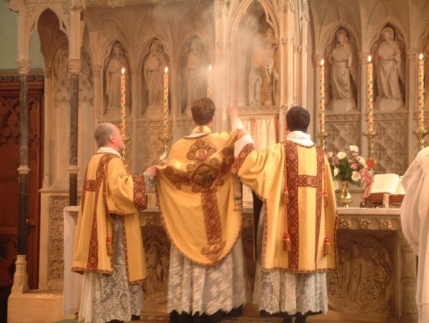
...incompatible with this?

First, let me clear the air by saying that the Catholic Church has never, does not, nor will she ever teach that the Mass sacrifices Christ over again. Don't think that the Catholic Church's position has anything to do with Protestants "finding us out". Instead, Catholics claim that they do not re-sacrifice Christ because some Protestants believe that Catholic teaching must of necessity lead to the logical conclusion that we re-sacrifice Christ. As one example, over at the so called "Christian Apologetics Research and Ministry (CARM)" website, they claim:
We certainly do not want to misrepresent Roman Catholic theology (I bet they stay up at night worried about that), but we must ask how it is possible for the Mass to not be a re-sacrifice of Christ when the Mass is called a divine sacrifice (CCC, 1068) that is done over and over again. We are told that "the sacrifice of Christ and the sacrifice of the Eucharist are one single sacrifice"; (CCC, 1367); that it is an unbloody offering that is propitiatory, (CCC, 1367); that it can make reparation of sins, (CCC, 1414); and is to be considered a true and proper sacrifice (The Catholic Encyclopedia, topic: "Sacrifice of the Mass"). We must conclude that it is a sacrifice that occurs over and over again and since it is said to be a true and proper sacrifice that is propitiatory, then logically it must be a re-sacrifice of Christ. If it is not, then how can it be called a sacrifice of Christ? Also, how could it be propitiatory if it is not a sacrifice of Christ since it is Christ's offering on the cross that is itself propitiatory?The crux of the "logic" of the conclusion is in the question "how is it possible" (and when apparently to CARM it goes unanswered), then logically "it must" follow that Catholics "re-sacrifice Christ". The "logic" goes as follows:
1. Catholics call every Mass a sacrifice
2. There is "one single sacrifice"
3. Since I cannot figure out how #1 and #2 are compatible*
4. Therefore, the Mass because it happens more than once "pretends" (they would have to believe this) to re-sacrifice Christ
Using this same "logic", let's try another Biblical truth:
1. God says that he is not a man (Num 23:19; and it is fairly obvious that since God is outside of creation he is not a man), and Jesus calls himself a man.
2. Christians say that Jesus is God
3. Since I cannot figure out how #1 and #2 are compatible*
4. Therefore, Jesus is not God because God is not a man and Jesus is a man
Notice that the crux of the "logic" in both is #3. It is in our understanding not, per se, in the thing itself. In other words, in both cases, if one could understand how #1 and #2 are compatible, then #4 is not true.
How does any Christian appropriate the body and blood of Christ?
This is an important question because when examined closely, I think I can show that any Christian practice that implies salvation or the remission of sins that is done over and over again (excluding baptism which is done once), using the same "logic" wielded against Catholics, will prove that they either (1) re-sacrifice Christ or (2) do not participate with Christ's sacrifice or (3) are playing pretend. I will then try to show how the logic of the Mass as a sacrifice proves that it (1) does not re-sacrifice Christ, (2) is a real, sacramental and supernatural participation with the one sacrifice of Christ, and (3) is not a pretend show.
"Jesus, forgive me of my sins, come into my heart, be the Lord of my life. Amen"
"What can wash away my sins? Nothing but the blood of Jesus"
"I have faith in Jesus as the only sacrifice for my sins, therefore I am saved"
How, I might ask, does this happen? In the O.T. passover meal, the lamb that was slaughtered, whose blood was put on the lintel, was cooked and the Israelites consumed it. They participated in the sacrifice through partaking of the lamb that was slain. Moreover, the passover was a memorial of the "One Passover", on the night that Israel came out of Egypt. The parallels are obvious, but the analogy is incomplete because the passover only prefigures and foreshadows what Christ truly is: the Lamb of God.
Christian non-Catholics believe that Christ's sacrifice is the only sacrifice that can save them. True. Yet, how do they appropriate this sacrifice, personally?
"By faith, of course," the ready Protestant quickly replies.
Okay, great. So what does your faith appropriate?
"The forgiveness of sins."
How are your sins forgiven?
"By the sacrifice of Christ."
So, let me ask you a question. If your faith appropriates forgiveness, do you receive that forgiveness in the present? In other words, when you ask for forgiveness or appropriate the mercy of God, do you experience today, and then when you appropriate it on another day, do you experience it then?
"Sure"
Here's my problem. To appropriate the sacrifice of Christ daily, necessarily requires that somehow there is a real participation in Christ's sacrifice. However, according to the Protestant "logic", it cannot be known how that is possible. Therefore, every Protestant must be re-sacrificing Christ.
I can literally hear the objections screaming in my ear. So keep reading before you leave a comment. The escape goat for the Protestant is that they do not say that their act of faith is a "sacrifice", therefore and unlike the Catholic, they do not re-sacrifice Christ again. What I say is that if it is a real-participation then it must, in essence, share in nature with what it is participating.
When have you ever participated in something and not been doing what you participated in?
According to the Protestant "logic" they must be re-sacrificing Christ if they are truly participating in His sacrifice. If the "logic" is bad, then they are not truly participating in the sacrifice of Christ. If they are not truly participating in the sacrifice of Christ, then they are just pretending to participate in the sacrifice of Christ.
In order to get this all worked out, we have to demonstrate how these two propositions are compatible (bearing in mind that the Protestant does not believe they are, does not call their participation a sacrifice, and thus the resolution only bears on the necessary conclusion regarding the Mass):
1. Catholics call every Mass a sacrificeLet us return to the Last Supper. I have seen it argued that it is not possible that our Lord was asking them to partake of his body and blood. This, according to the argument, would have been against the "Bible", a pagan practice, and our Lord could have simply cut off a piece of his flesh and given it to them instead. Again, one could make a similar argument against the Incarnation. God becoming man is "against the Bible", more in line with the pagan view of deities, and God could have simply saved us another way. Both arguments fail to understand who Christ is, and instead of submitting to the revelation of God in the person of Christ, both arguments affirm only what makes sense to our natural intuition.
2. There is "one single sacrifice"
Who is Christ? He is truly God. The God who prefigured His Son's coming through a passover meal that was eaten, over and over again, for 1,300 of years. Yet, the blood of lambs and goats could not bring us salvation. Salvation comes through the Lord. His sacrifice on the cross is the definitive, once and for all sacrifice that brings remission of sins. How do we participate in this? Pope Benedict XVI in God is Near Us, says that the Last Supper and Calvary have an inextricable link to each other. At the Last Supper, the cup is the cup of his blood, the blood of the covenant. The bread is his body, which is broken for us. Without Calvary, the Last Supper was simply a meal. Without the Last Supper, Calvary appears for us only an execution.
What was prefigured in shadows in the Passover, is made real in the Last Supper. Christ institutes the new meal, and in that meal we are again asked to eat. However, unlike the lamb in our first exile whose flesh merely pointed forward to the coming King, the new Lamb is given to us in the Eucharistic feast during our exile from earth to heaven, and unlike the Passover's dramatic effect, the Eucharist is a real, supernatural participation with our crucified and risen Lord with a real effect correlative to its eternal and supernatural cause.

As a supernatural participation in that sacrifice, the Eucharist must be a sacrifice. Qua supernatural, Christ's sacrifice is not subjected to the limits of time, but transcends time. Yet when we speak of the Eucharist we use language that is natural and supernatural. We act in time and space, but Christ's action transcends time and space. We speak of it as a singular sacrifice, yet we do it again and again, and therefore we can say there are millions of Eucharistic sacrifices offered throughout the world every year, the cause of which is the One Sacrifice.
The Mass is a sacrifice precisely because it shares essentially in the unique, once-and-for-all Sacrifice of calvary. The "how" is supernatural, and the "why" is explained in our Lord's words at the Last Supper. The cup he held was truly "the blood of the new and everlasting covenant", and the words he gave the Apostles--"it is poured out" (present participle-ἐκχυννόμενον)--existentially links the Eucharistic miracle with the eternal "present" of the sacrifice of Calvary.
As the Catechism teaches:
The Holy Sacrifice makes present the one sacrifice of Christ the Savior and includes the Church's offering. The terms holy sacrifice of the Mass, "sacrifice of praise," spiritual sacrifice, pure and holy sacrifice are also used, since it completes and surpasses all the sacrifices of the Old Covenant. CCC 1330And regarding the Catholic priest, acting in the person of Christ (in persona Christi):
"In the sacrifice of the Mass they make present again and apply, until the coming of the Lord, the unique sacrifice of the New Testament, that namely of Christ offering himself once for all a spotless victim to the Father." From this unique sacrifice their whole priestly ministry draws its strength. CCC 1566Calvary is not a spectator event. We must truly come to the foot of the cross. In the natural, time travel is impossible. Christ, as our lover, is not content with just sending us love notes nor was he interested in instituting another ineffective ritual. He wants to give himself to us, and he does this through his Sacrifice at calvary in the supernatural unbloody sacrament of the Holy Eucharist.
Mass is not theater. It is reality. We come to calvary to drink from his side, and eat from the Tree of Life. The Mass is a true participation in his sacrifice, and therefore must be described as a true sacrifice. Through the Catholic priesthood, Christ enjoins us to himself, allows us to offer--through his Sacrifice--our bodies as a living sacrifice, which is our acceptable act of worship (Rom 12:1). As Catholics, we do not re-sacrifice Christ. Instead, we truly participate in that sacrifice, and proclaim his death until he comes in glory.
"For from the rising of the sun even to the going down, my name is great among the Gentiles, and in every place there is sacrifice, and there is offered to my name a clean oblation: for my name is great among the Gentiles, saith the Lord of hosts."-Malachi 1:11
good articles on the Mass as a Sacrifice:
NewTheologicalMovement
CalledtoCommunion
Catholic Answers