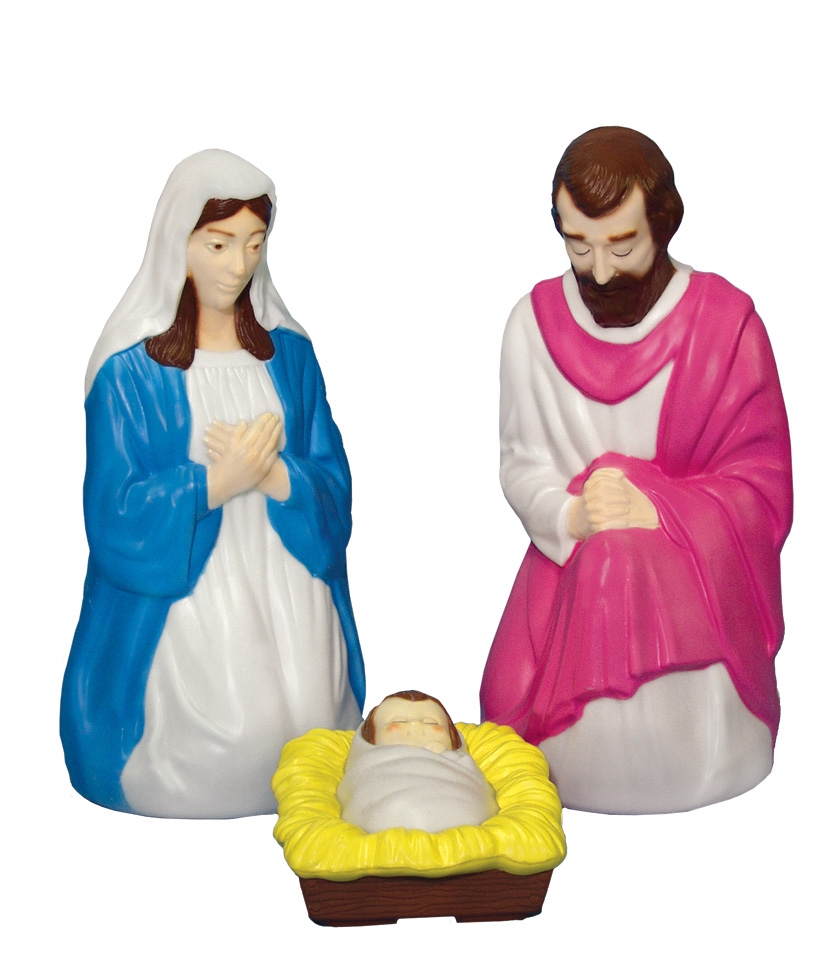
As I stated in my post about Catholics not worshiping Mary, I believe it is fair to start with the assumption that most people know when they are worshiping something. I get it that we can all fall into false idolatry for things like food, sex and money. However, it seems rather odd that it would be claimed of a religion that they worship something that they do not themselves claim to worship. Moreover, even given that some people worship food, sex and money, I have yet to find the first modern Protestant who desires to do away with any of these three in an effort to avoid even the possibility of idolatry. So, it does not follow from the fact that some people may, in fact, worship Catholic statues that we should do away with statues altogether out of some kind of intrepid self-made-piety.
Yet despite all this reasonableness, the objection that Catholics worship statues remains a part of popular lore.
It's time to bust some myths up in this house. First, let me present to the jury as evidence three years of experience:
1. I have never worshiped a statue.
2. I have never felt inclined to worship a statue.
3. Catholicism has never nudged me, even in the slightest, in the direction statue worshipping.
 |
| Protestants, we found you out! |
Yet when you enter into google, "Do Catholics worship ______," the power of auto-complete is quick to spit out "saint", "
idol" or "the pope". Blasted google auto complete!!! Oh separated brother where art thou? Why do thou search with unending joy or mysterious fascination for blog posts and articles on Catholics worshiping statues only to confuse google? Do thou in thou own religion find the
absence of statues such a farce to your religious sentiment that your only consolation is to think ill of those who have them?
Instead, I think google auto-complete reminds us of an old adage:
perception is reality.
 |
"Look at him!" He's, he's whu, whu....
what is he doing?" |
Of course, perception is not reality. Perception
informs our response to reality. One can certainly respond inappropriately to reality. I can have a perception that leads me to act irrationally. I can have a perception that makes me hide in my room all day for fear that a clown with an ice-cream gun is on the loose and may find me and bury me in a pool of butter-pecan. (
that actually doesn't sound too awful) All that to say,
the more my perception corresponds to reality, the more my response will be appropriate to reality.
"Catholics! You worship statues!"
No we don't.
"Catholics! You worship statues!"
No we don't.
In order to write a proper response, I will now turn to Scripture and experience. I think this myth can be dispelled both through a careful study of Scriptural idolatry in relationship to the revelation of God in Christ, and through a phenomenological rumination on the nature of the use of religious images -- statues included -- in Catholic practice.
I. The Bible: Egypt, Idolatry and the Incarnation
In order to put forward their objection, those who claim Catholics worship statues often cite the following verses:
"Thou shalt not make unto thee any graven image, or any likeness of any thing that is in heaven above, or that is in the earth beneath, or that is in the water under the earth. Thou shalt not bow down thyself to them, nor serve them: for I the LORD thy God am a jealous God,visiting the iniquity of the fathers upon the children unto the third and fourth generation of them that hate me." -Exodus 20:4-5
"And ye have seen their abominations, and their idols, wood and stone, silver and gold, which were among them." -Deuteronomy 29:17
"Ye shall make you no idols nor graven image, neither rear you up a standing image, neither shall ye set up any image of stone in your land, to bow down unto it: for I am the LORD your God."-Leviticus 26:1
In turn, they claim that Catholics violate the commandment by both creating and kneeling before statues. At first blush and without any context, this would appear to be a valid objection. However, God clarifies what he means in Exodus 20:23:
"You shall not make gods of silver, nor shall you make to yourselves gods of gold."
I want you to notice how a fundamentalist reading of this passage could ruin it. Does God allow for "gods of butter pecan ice cream" not just gods of silver and gold? No, because as the Scripture declares, "You should have no other gods
before me!" But wait, Mr. Fundamentalist is here to eisegete even that one:
"That must mean I can have other gods
after him!"
.
Thus, it is easy to see how a fundamentalist reading of almost any passage of Scripture is destined for disaster. Getting back to Exodus 20:23, proceeding the passage, God gives the children of Israel explicit instructions on various images and likenesses
He wants them to create (
part of the context). These were
icons and symbols -- some three dimensional -- of heavenly realities; foretastes of the true Temple that was to come (
Christ). Thus, God's disapprobation is very specific and has the exile in Egypt as its object. In fact, the prohibitions in the Mosaic law, even the very language of the commandments, find their proper context -- their linguistic referents -- in Egypt. Why? Because the Egyptians were, even according to the Greek historian
Herodotus, "religious to a higher degree than any other people". This is important for our case, because we should understand that Egyptians built statues for one reason:
They worshiped them as gods.
 |
| Some habits are hard to break |
Set free from the bondage of Egypt, the children of Israel had picked up a few, we could say euphemistically, "bad habits" in the course of their
430 year captivity. That's right, 430 years! Imagine the bad habits you could pick up living in a pagan society, not free to worship your God as you should, all while witnessing idolatry in every home and street corner. You might do silly things like hang national flags behind your pulpits and celebrate the
inauguration of your country more than the Mother of your Savior (
I digress). My point is that good ol' fashioned idolatry is really hard for us to wrap our minds around given that we are not inclined in even the least bit to worship idols in our scientifically enlightened society. Nonetheless, for the ancient Israelites, 430 years of being exposed to extreme idol worship had its effects.
Think about it. God had just dramatically saved them from Egypt, performed numerous mind-boggling miracles in their midst, and they turn around and melt their gold into a baby cow and worship it.
I repeat.
They worshiped a gold baby cow.
Seriously?
Yup. They worshiped a baby cow that they had just made out of their jewelry.
Ergo, it is plain to see that when God tells the children of Israel to not make statues of any kind, He is being specific:
DO NOT WORSHIP false gods.
Come out of Egypt!
Moreover, we can know His prohibition is not against statues in general because He proscribes them in Exodus 25:17-22. In their proper context -- the worship of God
alone -- they are valuable aids that point us to heavenly realities. Notice that God puts statues in a specific context: freedom from Egypt in the tabernacle of His dwelling. Idols represent just the opposite: bondage to the pagan way of living outside of the place of God's dwelling.
Fast forward to the New Testament.
St. Paul describes our salvation as a freedom from the slavery of sin, and the author of the book of Hebrews copiously goes about comparing our salvation to the exile from Egypt. Christ is described as the New Temple (John 2:19) and the Bread from Heaven (John 6:35). His Mother is the
Ark of the New Covenant (Revelation 11:19). All of this culminating in St. Paul's description of Christ as the "image of the invisible God" (Colossians 1:15).
So let's connect the dots. Christ becomes for us the
true image of God. Through the Incarnation, we are given not just explicit instructions on how to build heavenly images, but rather
we are given an explicit encounter with the very Image Himself! Therefore, all Christian religious art is a response to this Divine encounter. Notice that St. John and St. Peter both go un-rebuked in the gospels when they are inclined to build tabernacles at the Transfiguration (Matthew 17, Luke 8, Mark 9). Religious images -- statues included -- reflect a natural response to an encounter with the Revelation of God. The true image of God given to us is no longer found in the shadowiness of type or analogy but rather in the concrete reality of the person of His Son. A Catholic statue, like the one at the top of this post, draws us into a truth that the statue
re-presents to us, grounded in the person of Jesus Christ.
But some will still persist, "But where are the explicit instruction to do so?"
I say in response, that the reason for the explicit instructions in the Old Testament was the implicit assumption that the children of Israel
had not encountered the true image of God. As Christians, the explicit revelation of the true image of God gives us an implicit freedom to respond to the true image in works of art that glorify God. We need no longer explicit instructions from God -- He has given us an explicit encounter with Himself. Alleluia! What the prophets could not see and the burning bush concealed, we are invited to behold in the person of Christ! Every Christian statue is intended to point us to a reality not that we conjure, but a Reality that we
know.

II. A Phenomenology of Worship: God Is The Only Object
At this point, I am comfortable saying that Scripture, when read in its full counsel, does not generally forbid the making of statues -- especially in light of the Incarnation. If so, what then are Catholics doing when they kneel in front of them?
"Worshiping them!"
"No we aren't."
Let me explain. Catholic Churches are full of images and statues of Christ, the saints, and His Mother because we are the people of God who, as I mentioned, received the encounter with His Image -- Christ! We surround ourselves with images of the "great cloud of witnesses", and like a family photo album, relish in our heavenly fraternity.
 |
| image h/t: Taylor Marshall |
These images and statues, especially of Our Lord and Our Lady, serve to
focus our attention "on things that are above," as St. Paul instructs (Colossians 3:2). In other words, they can assist us in obtaining a frame of mind, an attitude, of prayer.
No practicing Catholic is worshiping a statue when they kneel before it. If the statue or image is of a saint, the Catholic might ask the saint to pray for them, but they don't think the saint is in the statue or the statue is the saint. (
If you disagree with communicating with saints, I've got other posts for that. See here, here, here and here) When I stare at an image of Christ, like the one above (
in fact I just stared at a statue of the image above during prayer time this evening), the image merely serves as a tool to direct my mind to Christ. Through the image, I adore the Sacred Heart of Jesus --
the real one -- and meditate on His inestimable Divine Mercy.
Now, if I were truly going to worship a statue or image, somewhere in my experience the object of my adoration would need to shift -- like the golden baby cow -- from Christ to the
thing, but it doesn't. It never has. Even when I
kiss the Holy Cross, like we do on Good Friday, I do not imagine for a moment that the cross I'm kissing is the actual Cross of Christ. However, I don't have access to that Cross. So, instead I kiss the cross at my parish in procession with all the faithful
to show God -- whom I'm worshiping! -- that I love Him. In fact, even if I were venerating the true Cross, I would only be venerating it in virtue of the fact that God had hung on it!
Did you get that?
I'm worshiping God.
Not. The. Statue.
So, leave it alone. The myth that is. Oh yeah, and while you are at it, lay off google and go get yourself a statue or something and stop acting so irreligious.