August 31, 2011

Myth Buster: Constantine Founded the Catholic Church

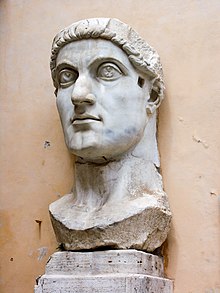
Is this Constantine admiring the Church he founded?
The Catholic Church claims that she was founded by Christ. Some Evangelicals and fundamentalists claim that she was founded by the emperor Constantine (c.272-337).

The idea for this post came from a friend of mine, and funny as it may be, I first thought that this was a rather lame myth (still do).

"Who thought that?" I asked myself. I mean, come on, really, St. Ignatius of Antioch was calling the Church Christ founded the "Catholic Church" in the first century and there is evidence that this verbiage was a unique identifier of the Church all the way back to the mid first century. (Note: the term Christian was a term given to the followers of Christ by unbelievers--they (unbelievers) also called themselves Nazarenes--Acts 24. In other words, believers of Christ called themselves Catholics and the world called them Christians*)


And then I turned on the TV and heard a preacher talking about how Constantine changed the Sabbath day and founded the Catholic Church. Apparently the myth persists (along with dogs can fly). I don't like myths that keep people from the truth.

This myth assumes three things:

1. Christians did not worship on Sunday before Constantine

2. Constantine had a significant sway in the Christian Church

3. The Roman Catholic Church did not exist before Constantine

#3 runs concomitant with the idea that The Council of Sardica established the primacy of the Roman bishop thereby inaugurating the Roman Catholic Church in some sense.

Reply to #1- Christians worshiped on the Lord's day and not the Sabbath day

St. Ignatius to the Magnesians:
"We have seen how former adherents of the ancient customs have since attained to a new hope; so that they have given up keeping the sabbath, and now order their lives by the Lord's Day instead, the day when life first dawned for us, thanks to Him and His death."
Barnabas, The Epistle of Barnabas, 120A.D.:
"Wherefore, also, we keep the eighth day with joyfulness, the day, also, on which Jesus rose again from the dead"
St. Justin Martyr, The First Apology, 155 A..D.:
"Sunday is the day on which we all hold our common assembly, because it is the first day on which God, having wrought a change in the darkness, made the world; and Jesus Christ our savior , on the same day rose from the dead."
There are two creations. In the first creation, the day of rest was the Sabbath. It was the day God's work was completed. When Christ came, he presented himself as the creator (John 1:3) and the synoptic Gospels unanimously recognize him as the "Lord of the Sabbath" (Matt 12:8, Mark 2:28, Luke 6:5).

Christ came to fulfill not abolish the Old Covenant. Through his entire ministry, he came to fulfill "all righteousness" (Matt 3:15). Thus, in the new creation, Christ established a new Sabbath, the day of his rest, or rather the day that he completed his work. Of course, this is Friday and no one believes that the Christian day of worship is Friday. Yet we know that three days latter he rose again, and so the "Lord's Day" would be that day that Christ rose from the grave.

In the Didache, an early record of apostolic teaching (c.60-100), we find evidence that Christians began to meet on the "Lord's day":
"And on the Lord's own day gather yourselves together and break bread and give thanks, first confessing your transgressions, that your sacrifice may be pure. And let no man, having his dispute with his fellow, join your assembly until they have been reconciled, that your sacrifice may not be defiled; for this sacrifice it is that was spoken of by the Lord; In every place and at every time offer me a pure sacrifice; for I am a great king, saith the Lord, and My name is wonderful among the nations."-14:1-3
The teleological ordering of the temple cult and Judaism at large was the first creation, the genesis of God's relation to mankind. Christianity, however, is ordered to the new creation and as such the new, final and definitive revelation of God in Christ Jesus. Those who demand that Christians worship on the first "day of rest" deny the early Christian practice as it relates to the revelation of Jesus Christ, teach the error of the Judaizers who claimed that one had to follow the Jewish customs to be Christian, and more importantly deny one of the greatest proofs of Christ's resurrection.

Pope Benedict XVI in Jesus of Nazareth, Part 2, points out the fact that the cult of the temple would not come to a complete end until after Christ's ascension. Christ prophesied that the temple would be laid to waist, and it was at the hands of the Romans in 70 AD that this would come to pass. Moreover, the sabbath was so deeply imbedded into the culture, psychology and religious practice of Jews it is hard to imagine what could possibly augment this practice. It is precisely because the early Jews ceased to worship on the Sabbath but instead worshiped on the "Lord's Day"--Sunday--that we have evidence that something monumental happened on Sunday, something so great as to literally re-order their entire psychology. So it is, that in Christ, God re-orders the entire cosmos to the new creation, and the rhythm of worship would forever be ordered to his glorious work in His Son.
 
Reply to #2 Constantine's influence was limited but welcome
What did Constantine do in the Edict of Milan? Did Constantine established a new Sabbath?

First, the Edict of Milan established religious tolerance of all religions. The edict reads:
"And thus by this wholesome counsel and most upright provision we thought to arrange that no one whatsoever should be denied the opportunity to give his heart to the observance of the Christian religion, of that religion which he should think best for himself, so that the Supreme Deity, to whose worship we freely yield our hearts) may show in all things His usual favor and benevolence."
Christianity had severely dis-settled the temple economy of the Roman religions. In turn, the second half of the edict discusses the proper way of restoring property to Christians since it was a common practice to extort Christians since their religion had so significantly diminished the Roman economic system of temple sacrifice and feasts.

Considering #1, we should reject that notion that Constantine established Sunday as the day of worship. Instead, the infamous Edict of Constantine (c.321), should be understood as a way Constantine integrated his new and immature Christian faith into his administrative role as emperor. In no way was Constantine the leader of the Christian Church, nor was his edict directed at Christians only. The fact that the Romans worshiped the sun (whether on Sunday or not) can be understood, instead of some pernicious conspiracy, as a way that God was preparing Gentiles for His Son, who would rise again--like the Phoenix--on Sunday.

Reply #3 The Catholic Church existed before Constantine, and the primacy of the Roman Bishop was affirmed before the Council of Sardica

Evidence A- The First Epistle of St. Clement

Written in the second century, the fourth Pope is writing to the Corinthian church founded by St. Paul. Pope St. Clement opens the letter, "The Church of God which sojourns at Rome, to the Church of God sojourning at Corinth". Clearly, both (1) the Church at Rome existed at this time and (2) churches by this time are being identified by location not congregation. 

The entire tone of the letter is authoritative. Why, we should ask, is the pastor of the church in Rome writing instructively to the church in Corinth? Most striking about the overall language, tone and style of the letter is Pope St. Clement's command that those who were in schism in Corinth submit to the bishop, and "[lay] aside the proud and arrogant self-confidence of your tongue. For it is better for you that ye should occupy a humble but honorable place in the flock of Christ, than that, being highly exalted, ye should be cast out from the hope of His people". Pope St. Clement also makes one of the most obvious and direct references to apostolic succession.

Evidence B- St. Ireneaus, St. Clement of Alexandria, Tertullian, Origen, St. Cyprian and St. John of Chrysostom

All of these early churchmen witness to the Petrine office. Against the claim that the primacy of the bishop of Rome is grounded in the proclamations of Sardica, in each of their writings we find direct evidence that the early church understood the preeminence of St. Peter, the perpetuation of the apostolic offices and the primitive transfer of the locus of that chair to Rome. Here are just a few examples:
"Peter, upon whom is built the Church of Christ, against which the gates of hell shall not prevail, left only one epistle of acknowledged genuinity. Let us concede also a second, which however is doubtful." Origen, Commentaries on John 5,3
"[T]he blessed Peter, the chosen, the preeminent, the first among the disciples, for whom alone with himself the Savior paid the tribute [Matt. 17:27], quickly grasped and understood their meaning. And what does he say? ‘Behold, we have left all and have followed you’ [Matt. 19:27; Mark 10:28]" Clement of Alexandria, Who Is the Rich Man That Is Saved? 21:3–5
"For what purpose did He shed His blood? It was that He might win these sheep which he entrusted to Peter and his successors." (St. John of Chysostom, De Sacerdotio, 53
Evidence C- The Bible Teaches it

For this purpose, I will leave you with a few passages of Scripture. The purpose is to simply evidence the possibility of Scripture establishing the primacy of St. Peter and not to prove the papacy:
"And I also, I say unto thee that thou art Peter, and on this rock I will build my assembly, and hades' gates shall not prevail against it." - Matt 16:18
"But I have prayed for thee [Peter], that thy faith fail not: and thou, being once converted, confirm thy brethren." -Luke 22:32
"And when there had been much disputing, Peter, rising up, said to them: Men, brethren, you know, that in former days God made choice among us, that by my mouth the Gentiles should hear the word of the gospel, and believe." -Acts 15:7
In sum, the Roman Catholic Church was alive and kicking 250 years (since the fall of Jerusalem) before Constantine. The bishop in Rome had authority, and the early Church recognized both apostolic succession and in particular the unique succession of the Petrine office. What Constantine did was provide religious asylum in Rome to Christians who had previously been persecuted. In addition, the early Christians worshiped on Sunday well before Constantine because Christianity is ordered to the new creation not the first creation. Therefore, it is obvious and beyond argument that Constantine did not found the Roman Catholic Church through either the Edict of Milan or in his influence on the Council of Sardica. The claim is a myth and should be rejected as propaganda meant to further schismatic religions.

__________________________________________________________


*Bonus myth busted that the term "Catholic" is less authentically Christian than the general term Christian, when in fact, the term Christian was a general and ambiguous term, albeit one giving one great honor if it was the cause of your personal suffering (1 Pet 4:16), whereas the term Catholic was used to distinguish between those who followed the Apostolic teaching that would spread to the entire world versus those who started sects or lived in schism from Christ's Church.

August 29, 2011

Picking Your Nose and Confession

Picking your nose is something no one has to teach you. I know. I have 4 children, ages 5 and under. No one teaches them this craft, they just immediately recognize that if something is in their noes, they should get it. Sense boogie. Get boogie.

At times, I'm worried that one of my sons will actually pull out his brain or pop a nasal sac. Their ferocity, focus and persistence is admirable. Similar determination would likely benefit them if they were ever air-dropped in the middle of the Amazon. I just hope it gets them a scholarship to college.

No one teaches you to pick your nose. In our culture, we teach you not to pick your nose. Culturally it is faux pas and just plain unhygienic. Which made me think about other things we might be inclined to do, but our culture trains us to ignore.

Matthew 7:5 says:
"Hypocrite, cast out first the beam out of thine eye, and then thou wilt see clearly to cast out the mote out of the eye of thy brother."
Isn't it outrageous that the guy misses the fact that he has a beam in his eye? Imagine what this would look like:

To read the rest, check it out at Virtuouspla.net and why you are there, check out other fabulous posts

August 26, 2011

The Catholic Church and Sacred Scripture

I recently read a blog post by Devin Rose, author of If Protestantism if True, where he notes the futility of Bible thumping a Bible thumper. I agree with Devin's basic premise, but I felt like a follow up post was necessary. Devin didn't want to teach a class at his parish about "using the Bible to counter Protestant arguments for their beliefs and defend our Catholic ones."

Devin replied:
"But I don’t plan to teach such a class. Why not? Quite simply, I’ve learned in my ten years as a Catholic that, while it is helpful to present verses and the Catholic interpretation of them, this method of discussion can quickly devolve into a verse-slinging competition. And those go nowhere. That’s why I focus on the meta-level questions: Who has the authority to interpret the Bible in the first place?"
I'm going to agree with Devin that verse slinging is counterproductive. However, I think that the overall point can unintentionally put forward a false dichotomy that puts sound exegesis at odds with Catholicism. At the end of the day, Scripture shouldn't be slung on anyone by anyone; however, there is a place for Catholics to understand just how Catholic their Bible is and to be able to effectively communicate their faith using the Scriptures. Catholics can talk about their faith with their separated brothers and sisters using the Bible without it devolving into verse-slinging. This is important because the Scriptures are something for which we have common reverence, and thus it can serve as a common ground.

My problem with only focusing on the "meta-level" questions (e.g., authority) is that it in a way can imply the Catholic stance on Scripture is only valuable in relationship to the Church's authority to interpret it. In other words, the Catholic position on a doctrine makes sense biblically because the Church has authority. That's not accurate. The Catholic position binds the conscience because of authority, but the Catholic position makes sense because...well...it make sense.

Bare in mind, when I say "makes sense" I mean that it is a reasonable interpretation of Scripture, not that it is a rationally unassailable position. By rationally unassailable, I mean that it is binding on the conscience because the evidence is such that the cause of its conclusiveness can be found in the text. More simply put, a rationally unassailable doctrinal position would have to be found in Scripture in such a way that no other possible interpretation could compel the intellect to assent to it. That is not what I am talking about.

Becoming Catholic isn't counter-intuitive or anti-intellectual, nor does it require you to check your brain in at the door so that Rome can send your mind instant uploads. Submission doesn't imply that. If I don't understand the "how" or "why" of what the Church teaches with regards to the deposit of faith, it is incumbent upon me as a follower of Christ to pursue the Truth that Christ is revealing by the power of the Holy Spirit through His Church. The Anselmian axiom "faith seeking understanding" comes to mind, and it is truly faith, hope and charity that can aid our intellect in obtaining a good will for the truth taught by the Church.

THE BIBLE: GOD'S GIFT TO HIS CHURCH

If I wrote my wife a letter, and some guy picked it up and started interpreting it and getting it all wrong, it would be true that I would have the authority to interpret it correctly. However, my only and sometimes best recourse would be to explain to the misguided why my interpretation makes the most sense given both what is in the text, and what the text implies outside of the text (Sacred Tradition).

I think as Catholics we need to learn how to be conversant about Scripture--which doesn't include slinging texts. Someone who quotes Shakespeare may have simply googled Shakespeare but may have actually never read Shakespeare. Even more, slinging proves that the one who is slinging is unaware of the purpose of that which he is slinging and therefore resorts to misusing whatever it is that is in question--by slinging it. Rocks are meant for slinging, not words.

The Bible works in the Catholic Church because the Bible was meant for the Catholic Church. Like the letter, when understood from the vantage of the writer, who it was intended for, and the tradition in which it was written, the Bible does truly "make sense" in the Catholic paradigm (CCC 109). I emphasize Catholic paradigm, because so much of the Bible just doesn't make sense outside of that paradigm. Again using the letter analogy, some dude would never get the nuances of my letter since the letter was never intended to be read or used by him. That's why the catechism says (97): "Sacred Tradition and Sacred Scripture make up a single sacred deposit of the Word of God in which, as in a mirror, the pilgrim Church contemplates God, the source of all her riches." Thus we see the absolute necessity for Tradition, the Scripture that emerged from it, and the Church Christ established to faithfully lead the pilgrim people of God into all truth (John 16:13; 1 Timothy 3:15).

Here are a few suggestions for talking about Scripture with a separated brother or sister:
  • Know where Catholic dogmas are supported by Scripture: there's no excuse. "My Church has authority"--right or wrong--will not foster brotherly love or gain a sense of respect from a separated brother or sister. It's a good question, but can cause the conversation to devolve just as quickly as verse slinging. If you don't know where it is in the Bible, find out.
  • Don't sling, converse.
  • Listen more than you talk.
  • Only talk about one topic at a time.
  • Remember that sola scriptura is not in the Bible.
  • Your goal should be to get agreement, at the least, that the Catholic position is reasonable.
To the last point, this is a very charitable goal and one that will not likely lead to conflict. I am not trying to get you to agree with me in such a way that you give up your position. However, by getting you to admit that the Catholic Church does seem to be taking into account the full data of Scripture, you are planting a very important seed. As St. Paul says:
"Therefore, neither he that planteth is any thing, nor he that watereth; but God that giveth the increase."-1 Cor 3:7
The goal isn't to win. The goal is to plant seeds or water seeds that are already there, keeping in mind that we are truly nothing compared to the one who can make the seed grow. We must believe that it is Christ who is bringing his Church back together, and that it is His prerogative to do so (Luke 13:34, John 17:21). Moreover, rarely if ever does an argument win a convert. God who sees the heart, wins the heart. It is our job to simply make sure our bucket is full of water or seeds, and as Catholics, we should not be afraid to fill that bucket with the Sacred Scriptures (Luke 8:11).
___________________________________________________________

Note: Today I "saw" Ephesians 5:26-27 in a whole new light regarding baptism:
"That he might sanctify it, cleansing it by the laver of water in the word of life: That he might present it to himself a glorious church, not having spot or wrinkle, or any; such thing; but that it should be holy, and without blemish."
Through Sacrament--Word (Name of the Father, Son and Holy Spirit, Matt 28:19) and Matter (Water, baptizo)--we are renewed as His Bride because "we are members of his body, of his flesh, and of his bones" (Eph 5:30). Just as water (Red Sea) was used by God to bring the children of Israel out of slavery, so too God uses what is ordinary to free us from the bondage of sin and death that we might rise again (Col 2:12).

World Youth Day Video

Because God loves the whole world...

Top 3 Videos of the Week: Journey Home Edition

This week's videos all come from the Journey Home collection. The first video is me (awkward moment). The second video is a panel on sola scriptura, and the last video is a conversion story of a COC pastor. Have a wonderful weekend, and remember to say a prayer for all those who might be effected by the hurricane. Ave Maria!


corrections: Cicero should be Suetonius


August 24, 2011

Deep In Scripture Radio Show

On a bad note, I just had a really long article I wrote early this morning get deleted. It was in response to someone who contacted me and wanted to know what it means "to be absent from the body". I will write about this again, but the feeling I have when I think about losing what I wrote both discourages me and counteracts the charity I need to write good apologetics. On a good note, here is my "Deep in Scripture" radio show via Ustream (if you are viewing this on a reader and cannot view the video, click on the link to view):

Marriage Is Wine

I'm married. Yippee! I've been married for almost nine years. We have four beautiful children here on earth and a little darling angel in heaven.
Me and my kiddos
Marriage is tough. The reality, though, is that anything in life that is really "worth it" is not particularly easy. For example, a good wine is produced by providing inordinate pressure on fruit that takes a half a year to grow, is hard to harvest, and even after you press the fruit, très bon vin requires a lot of time to ferment.

Wine is the perfect analogy for marriage. Thinking about this analogy and my last nine years of marriage, I'll offer a few petits gâteaux of advice to newly married couples or anyone who is considering the vocation of marriage:

Tend to the Fruit of Your Marriage. Like a good farmer, marriage requires a lot of careful, habitual and purposive work. The "honeymoon phase" is when you think you are doing all of it, and you think it is all fun and games. Marriage is about romance, but the beauty of love is best brought out in a marriage through the sometimes tedious ways you look after each other. Through self-sacrifice, each spouse is given an opportunity to till the soil, water and carefully watch over the love that is growing.

Make Sure You Pick It When It's Ripe. I'm a man, and I'll admit that I can get better at this. I miss moments and fail to see when the fruit is ready to be picked. Everyday is an opportunity to become more aware of what is "happening" in your marriage. Sports, work, hobbies and a thousand other things (including blogging) are always there to distract you from the one God has given you for life. A farmer who gains the largest return on his crop picks the harvest at just the right time. Marriage is the art of carpe diem.

Don't Expect Too Much Too Soon. Don't settle for $3 juice when $400 wine is around the corner. At the same time, give each other the opportunity to kick back and enjoy the $3 juice with some Ritz crackers and a block of cheese once in a while...

You can read the rest of this post where it was originally published at Virtuous Planet by clicking on this link....
 

August 23, 2011

Feast Time! St. Rose of Lima

Good morning! Today is the Feast of St. Rose of Lima. I explained here why she is the patroness of my family. You can read about St. Rose of Lima here.
Words to contemplate today from St. Rose of Lima:

"If only mortals would learn how great it is to possess divine grace, how beautiful, how noble, how precious. How many riches it hides within itself, how many joys and delights! No one would complain about his cross or about troubles that may happen to him, if he would come to know the scales on which they are weighed when they are distributed to men."

"Lord, increase my sufferings, and with them increase Your love in my heart."

"Apart from the cross there is no other ladder by which we may get to heaven."

"Our Lord and Savior lifted up his voice and said with incomparable majesty: 'Let all men know that grace comes after tribulation. Let them know that without the burden of afflictions it is impossible to reach the height of grace. Let them know that the gifts of grace increase as the struggles increase. Let men take care not to stray and be deceived. This is the only true stairway to paradise, and without the cross they can find no road to climb to heaven.' " 
 
"When I heard these words, a strong force came upon me and seemed to place me in the middle of a street, so that I might say in a loud voice to people of every age, sex and status: 'Hear, O people; hear, O nations. I am warning you about the commandment of Christ by using words that came from his own lips: We cannot obtain grace unless we suffer afflictions. We must heap trouble upon trouble to attain a deep anticipation in the divine nature, the glory of the sons of God and perfect happiness of soul.'" 

quotes courtesty of viarosa 

GOD BLESS YOU AND YOURS ON THIS WONDERFUL FEAST DAY! 

August 22, 2011

I'm on EWTN Tonight!

Tonight, Monday, August 22, at 8pm EST, my "Journey Home" with Marcus Grodi will air. Maybe you are stopping by because you saw the link on the show. Whether you are new to this blog or not, I thought I might recommend a few decent reads at the bottom of this post.

If you don't have time to click on the links, that's okay. If all you read is this post, that's swell but just don't give up yet. I want to share something with you. 

The pursuit of Christ is to pursue the One who was sent, who came in flesh adorning, and established a new kingdom that would open the covenant promises of Abraham unto all peoples. Meditating upon this, our minds should become shocked with the way this reality breaks into the mundanity of our lives and transforms it. God became like us. What?

And yet somehow at some point this story morphed into a type of mythology. What was concrete, incarnate became like ether, a story blowing around in the wind, neither here nor there, up nor down. You might be born into a family that believes he came, but when you look around your lives there is no evidence, no concrete effects of his existence.

I am in no way implying that Christ is a scientific theory that can be proven through empirical methods. However, what I am saying is that God becoming flesh should have a proper effect on humanity, and moreover, that if he created something it should be incarnate like him, something we can find--even if it takes a star in the sky to lead us to their barn.

So we read that God Incarnate said:
"Peace be to you. As the Father hath sent me, I also send you." -John 20:21
Who are these "sent ones"? Where can we find them?


[Full Stop]

The Catholic Church claims, through an unbroken line of apostolic succession of bishops in union with the Chair of St. Peter, the prince of the apostles, that they are the Church that Jesus Christ established.
"He that hears you hears me; and he that rejects you rejects me; and he that rejects me rejects him that sent me." -Luke 10:16
The Father-->Jesus Christ-->The Apostles-->Who They Sent

To reject one is to reject all of them, and rejection doesn't just imply the rejection of their teachings. Rather, as Christ said:
"And whosoever shall (1) not receive you, (2) nor hear your words: going forth out of that house or city shake off the dust from your feet. Amen I say to you, it shall be more tolerable for the land of Sodom and Gomorrha in the day of judgment, than for that city."-Matthew 10:14-15
What do you believe? If for a moment this claim seems plausible or possible you must investigate it if you claim to "follow Christ". I call these "rubber meets the road" moments in your life. It's all good when Christianity can be reduced to a Jars of Clay concert, a bible study and a banner that says, "Jesus Saves", but this is rather messy. This requires more. This means Christianity is bigger than just what's between your ears, or maybe it means nothing at all.

On the last day, when you stand before God, we will all be accountable for our lives. You will be accountable for what you read in this post. I will be accountable for writing it. If you love Jesus, which I know so many of you do, I beg you to lay down your weapons against the Catholic Church and examine and test the spirits to see if they be of God.

If She is the One (Church) Christ sent, then you know what it means to reject Her. 

August 20, 2011

Book Review: The Bible Made Impossible

The Bible Made Impossible: Why Biblicism Is Not A Truly Evangelical Reading of Scripture, by Christian Smith, the William R. Kenan, Jr. Professor of Sociology and Director of the Center for the Study of Religion and Society at the University of Notre Dame, is his effort to understand why the Bible, in his view, does not seem to work as the “sole rule of faith” within his evangelical tradition -- hence the term “impossible.” The book is divided into two parts: the first part a diagnoses of the problem of biblicism and the second part Smith’s proposed solution.

What is Biblicism?

According to Smith, Biblicism is a belief that assumes at least one of the following to be true about the Bible:

1. The Bible is Identical to God’s very words
2. The Bible is the total representation of God’s will for humanity
3. The Bible covers every topic you need to know about anything
3. Democratic Perspicuity- “almost anybody can read the Bible and get it”
4. “Common Sense” Hermeneutic- just take it literal
5. Solo Scriptura
6. Internal Harmony- everything in the Bible fits together
7. Universal Applicability of all direct teachings of the Apostles
8. Inductive Method as the preferable method for understanding the Bible

As to #5, Bryan and Neal have demonstrated how sola reduces to solo here. Smith points to the way Westminster Theological Seminary refers to the Westminster Confession Faith (WCF) as fallible on the one hand, yet treating it as though “the likelihood...of detecting or admitting error or revisions is effectively nil” (p.14). He goes on to point out the way the WCF affirms many of his biblicist criteria. In the end, Smith's criticism virtually includes almost all of Protestantism by implying that both confessional and evangelical Protestant denominations treat the Bible in a biblicist way.

What to think of all of this?

Having defined biblicism, Smith next considers how the belief in the Bible as the rule of faith has fared in history. As evidence of the confusion, he quotes from the founder of Mormonism, Joseph Smith:
“In the midst of this war of words and tumult of opinion, I often said to myself, What is to be done? Who of all these parties are right? Or, are they all wrong together? If one of them is right, which is it, and how shall I know? The teachers of religion of the different sects destroy all confidence in settling the question by an appeal to the Bible. At length I came to the conclusion that I must...ask of God.”
The fact that Joseph Smith’s sentiments reflect the average Christian’s should be startling. Of course, the average Christian doesn’t run out and start a completely new church. The broader question, and the one Smith is asking in the use of this quotation and others he deploys, is how do Christians of good faith sort through all the thousands and thousands (probably millions) of pages of competing interpretations?

You can read the rest of the review where it was originally published at Called to Communion by clicking on this link

August 18, 2011

Myth Busters: The Impeccability of the Pope


This just in: The Pope can sin.

Does this disprove the Catholic dogma that the Pope, when teaching ex cathedra, is graced by the Holy Spirit so that he cannot teach error--i.e., he can teach infallibly? 

The typical argument has two parts:

1. If the Pope can sin, he cannot be infallible.

2. There is Scriptural evidence that St. Peter (the alleged first Pope) taught error; therefore, since the first Pope taught error, the Pope is not protected from teaching error.

Infallibility is Incompatible with Sin = Bible Fail #1

You can find this argument in the "chick" tracts that were so prevalent at one time, but thank God you don't see them as much. Nonetheless, the argument still persists (because of the Internet) among the ignorant, hence me typing this.

I would agree with the claim, if infallibility had to be able to comport with man unaided by supernatural grace. However, no one is claiming that. The simple premise that by God's grace the Pope, in special moments is able--not in his own ability but through the power of God--to teach infallibly, defeats the objection sufficiently. In addition--and for the benefit of the ignorant objection, the Scriptures bare witness to a direct account of St. Peter exercising a charism that must be distinguished from inspiration and if so can only be described as infallibility. In Acts 2:16, St. Peter says:
"This is that which was spoken of by the prophet Joel."
(1)  In Luke 4:21, Christ starts his earthly ministry doing the same thing: infallibly interpreting Scripture.

(2) In Acts, Luke is inspired to write the record of what St. Peter says. St. Peter is not inspired. If he is not inspired, then we must ask by what charism he is interpreting the O.T.?

(3) We know he must be infallibly interpreting the O.T. because his claim is not metaphorical--baring possible other interpretations--but is concrete and literal. This (today) = that (O.T. passage).

(4) Therefore, in the Scriptures we have direct evidence of St. Peter, the first Pope, infallibly interpreting Scripture and discerning the times, teaching it to the people and beginning the ministry of the Church very much the same way the ministry of Christ began.

"But Brent," my interlocutor might say, "This passage was so obviously fulfilled in their hearing. Everyone would have interpreted Joel that way."

Not so. A careful consideration of Joel's words do not support this reading. St. Peter quotes Joel and says:
"And it shall come to pass, in the last days, (saith the Lord,) I will pour out of my Spirit upon all flesh: and your sons and your daughters shall prophesy, and your young men shall see visions, and your old men shall dream dreams. And upon my servants indeed, and upon my handmaids will I pour out in those days of my spirit, and they shall prophesy. And I will shew wonders in the heaven above, and signs on the earth beneath: blood and fire, and vapor of smoke..." (Acts 2:17-20)
If one were in the crowd that day, I would imagine they could have easily said, "Where are the dreams? The visions? What about prophecy? This man Peter is no man of God, but an opportunist who misinterprets Scripture! [Let's start our own church!]"

Because St. Peter was speaking under the charism of infallibility and because, by this time, it was clear to everyone who was following the cult of Christ that St. Peter was the mouthpiece for the Lord, no one opposed the teaching of St. Peter.

St. Peter Taught Error = Bible Fail #2

There are two parts to this claim: (1) St. Peter, through his actions, taught error regarding the essence of the Gospel and (2) St. Paul confronted him in Galatians 2:11, therefore "look" St. Peter got "punked" or something like that.

First, (1) fails Biblically. St. Peter, nowhere, teaches what is implied in the argument. What is implied, is that St. Peter taught something contrary to what the Scriptures say regarding what is necessary for salvation, but what we have evidence of is that St. Peter acted in a way worthy of confrontation (see Bible Fail #1). Second, the Bible gives direct evidence that St. Peter actually taught explicitly the exact opposite of what is claimed:
"And the apostles and ancients assembled to consider of this matter. And when there had been much disputing, Peter, rising up [don't miss the imagery of everyone reclined in the typical Jewish way and then one of them standing up--this is not the normal way someone talks in this setting-Matt 9:10], said to them: Men, brethren, you know, that in former days God made choice among us, that by my mouth the Gentiles should hear the word of the gospel, and believe. And God, who knoweth the hearts, gave testimony, giving unto them the Holy Ghost, as well as to us; And put no difference between us and them [Jew/Gentile], purifying their hearts by faith. Now therefore, why tempt you God to put a yoke upon the necks of the disciples, which neither our fathers nor we have been able to bear? But by the grace of the Lord Jesus Christ, we believe to be saved, in like manner as they also."
Regarding (2), we have admitted that St. Peter can sin. St. Peter sinning is not incompatible with him being able to teach infallibly. Further, what St. Paul does in Galatians 2:11 is preceded by his concession in Galatians 1 that even upon receiving a Revelation directly from Christ he only saw St. Peter (save James), and "tarried with him 15 days" (v.18). In Galatians 2:9 (just two versus before), he admits that St. Peter is reputed as a "pillar". Therefore, we should not misinterpret or malign St. Paul's confrontation with St. Peter and imagine it more than it is. Simply put, St. Paul is apposing the hypocrisy of St. Peter's actions not correcting his teaching.

End Note:
I will admit that in this post I have not established that the Pope does, in fact, teach infallibly. That is for a different day. However, what I have demonstrated is that the testimony of Scripture and the admitted fact that Pope's sin does not make the teaching regarding the gift of infallibility per impossible.

Peace to you on your journey.

August 17, 2011

Cartography and Conversion


In the evangelical and pentecostal world (where I came from), there is a major emphasis on evangelization. As non-double predestinarians we had a lot of motivation to get out and share the faith. For those of you who are wondering what double predestination is, it is a theological position that asserts that God has predestined some people for heaven and some people hell. The score is settled. Its a theology that, like Stoicism, has a hard time reconciling freedom and God's foreknowledge.

My reasons for becoming Catholic were numerous. There is not just one reason (sort of), nor did the reasons occur to me in some perfectly logical sequence. Rather, I would call it a "convergence of probabilities" (Newman), whereby the mind, when overcome with a large amount of data, has an intuition of where all of the evidence points. I would love to discuss this further, and might at another time, but for now let's proceed to the main thrust of this post.

While some churches hope to someday "reach the world", there is only one Church that has already done so. In the pentecostal world, there is constant talk of the "end time harvest". For example, from 1970 to 2000, the Assemblies of God added about 20 million converts to its ranks. Most don't know that during that same time, the Catholic Church grew by 300 million! Most of the growth happened in Africa (the same place the AG grew).

The map at the top of this post represents the Catholic presence in the world. She truly is a "house of prayer for all peoples" (Isaiah 56:7). Through Abraham, all the world was to be blessed. Has that promise been fulfilled? In my previous tradition, so much of the world was lost. No doubt, there is still much work to be done, but I'll never forget the moment that I saw a map like this for the first time. I remember thinking that someone had lied to me. I had been told that the Christian message had not penetrated so many places, yet I was to find out that the Catholic Church had been there all along.

In the end, that meme was a part of an overall communication campaign to discredit the Catholic Church. Fortunately, when the veil on my eyes had been lifted and I was able to "see" the Church for who she is, that meme served to lead me into the Church that truly is the place that "all the nations will stream to" (Isaiah 2:2).

For a more detailed comment on this topic, I recommend this comment from Bryan Cross at CTC.

August 16, 2011

Top 5 Reasons to Use the "YOUCAT"


Today, I'm excited to tell you about a new website called Virtuous Planet (www.virtuouspla.net). Yours truly is one of the contributors, and I'm joined by an incredible cast of writers. Here's a bit of my first post at the new site:
If you are reading this, maybe you just received your YOUCAT at World Youth Day in Madrid. Maybe you are not in Madrid(sigh), but already have one (like me–sigh again). Likely, you are someone who may have heard about the YOUCAT but don’t have one yet. Once you get one, why should you use it?

#1- Because Papa Says So

When your daddy tells you to do something, you probably ought to do it. Our Holy Father Pope Benedict XVI commissioned this project in an effort to unlock the kingdom of God for generations that have been told there is no hope. As the one who holds those keys of the kingdom received from St. Peter through his successors in the Petrine office, the Pope reminded us that “in hope we are saved”, even that our faith is grounded in a certain and confident hope (Spe Salvi). The YOUCAT is your opportunity to study your faith, so that your faith may not fail you (Lk 22:32).

August 15, 2011

The Feast of the Assumption: 3 Posts


Happy Feast of the Assumption of Mary! In Mary, we see an image of the Church and we grow in confident hope that we too will not simply wither to dust, but will be raised again to new life. Here are three of my posts about the Assumption:


The Assumption of Mary: Is it against Christian sensibilities?


The Assumption in the Bible


The Assumption in Church History


Also check out Brandon Vogt's article here at a place you will want to add to your reader: virtuouspla.net


August 13, 2011

Myth Busters: Catholics Re-Sacrifice Christ

Is this...

...incompatible with this?


First, let me clear the air by saying that the Catholic Church has never, does not, nor will she ever teach that the Mass sacrifices Christ over again. Don't think that the Catholic Church's position has anything to do with Protestants "finding us out". Instead, Catholics claim that they do not re-sacrifice Christ because some Protestants believe that Catholic teaching must of necessity lead to the logical conclusion that we re-sacrifice Christ. As one example, over at the so called "Christian Apologetics Research and Ministry (CARM)" website, they claim:
We certainly do not want to misrepresent Roman Catholic theology (I bet they stay up at night worried about that), but we must ask how it is possible for the Mass to not be a re-sacrifice of Christ when the Mass is called a divine sacrifice (CCC, 1068) that is done over and over again.  We are told that "the sacrifice of Christ and the sacrifice of the Eucharist are one single sacrifice"; (CCC, 1367); that it is an unbloody offering that is propitiatory, (CCC, 1367); that it can make reparation of sins, (CCC, 1414); and is to be considered a true and proper sacrifice (The Catholic Encyclopedia, topic: "Sacrifice of the Mass").  We must conclude that it is a sacrifice that occurs over and over again and since it is said to be a true and proper sacrifice that is propitiatory, then logically it must be a re-sacrifice of Christ.  If it is not, then how can it be called a sacrifice of Christ?  Also, how could it be propitiatory if it is not a sacrifice of Christ since it is Christ's offering on the cross that is itself propitiatory?
The crux of the "logic" of the conclusion is in the question "how is it possible" (and when apparently to CARM it goes unanswered), then logically "it must" follow that Catholics "re-sacrifice Christ". The "logic" goes as follows:

1. Catholics call every Mass a sacrifice
2. There is "one single sacrifice"
3. Since I cannot figure out how #1 and #2 are compatible*
4. Therefore, the Mass because it happens more than once "pretends" (they would have to believe this) to re-sacrifice Christ

Using this same "logic", let's try another Biblical truth:

1. God says that he is not a man (Num 23:19; and it is fairly obvious that since God is outside of creation he is not a man), and Jesus calls himself a man.
2. Christians say that Jesus is God
3. Since I cannot figure out how #1 and #2 are compatible*
4. Therefore, Jesus is not God because God is not a man and Jesus is a man

Notice that the crux of the "logic" in both is #3. It is in our understanding not, per se, in the thing itself. In other words, in both cases, if one could understand how #1 and #2 are compatible, then #4 is not true.

How does any Christian appropriate the body and blood of Christ?

This is an important question because when examined closely, I think I can show that any Christian practice that implies salvation or the remission of sins that is done over and over again (excluding baptism which is done once), using the same "logic" wielded against Catholics, will prove that they either (1) re-sacrifice Christ or (2) do not participate with Christ's sacrifice or (3) are playing pretend. I will then try to show how the logic of the Mass as a sacrifice proves that it (1) does not re-sacrifice Christ, (2) is a real, sacramental and supernatural participation with the one sacrifice of Christ, and (3) is not a pretend show.

"Jesus, forgive me of my sins, come into my heart, be the Lord of my life. Amen"

"What can wash away my sins? Nothing but the blood of Jesus"

"I have faith in Jesus as the only sacrifice for my sins, therefore I am saved"

How, I might ask, does this happen? In the O.T. passover meal, the lamb that was slaughtered, whose blood was put on the lintel, was cooked and the Israelites consumed it. They participated in the sacrifice through partaking of the lamb that was slain. Moreover, the passover was a memorial of the "One Passover", on the night that Israel came out of Egypt. The parallels are obvious, but the analogy is incomplete because the passover only prefigures and foreshadows what Christ truly is: the Lamb of God.

Christian non-Catholics believe that Christ's sacrifice is the only sacrifice that can save them. True. Yet, how do they appropriate this sacrifice, personally?

"By faith, of course," the ready Protestant quickly replies.

Okay, great. So what does your faith appropriate?

"The forgiveness of sins."

How are your sins forgiven?

"By the sacrifice of Christ."

So, let me ask you a question. If your faith appropriates forgiveness, do you receive that forgiveness in the present? In other words, when you ask for forgiveness or appropriate the mercy of God, do you experience today, and then when you appropriate it on another day, do you experience it then?

"Sure"

Here's my problem. To appropriate the sacrifice of Christ daily, necessarily requires that somehow there is a real participation in Christ's sacrifice. However, according to the Protestant "logic", it cannot be known how that is possible. Therefore, every Protestant must be re-sacrificing Christ.

I can literally hear the objections screaming in my ear. So keep reading before you leave a comment. The escape goat for the Protestant is that they do not say that their act of faith is a "sacrifice", therefore and unlike the Catholic, they do not re-sacrifice Christ again. What I say is that if it is a real-participation then it must, in essence, share in nature with what it is participating.

When have you ever participated in something and not been doing what you participated in?

According to the Protestant "logic" they must be re-sacrificing Christ if they are truly participating in His sacrifice. If the "logic" is bad, then they are not truly participating in the sacrifice of Christ. If they are not truly participating in the sacrifice of Christ, then they are just pretending to participate in the sacrifice of Christ.

In order to get this all worked out, we have to demonstrate how these two propositions are compatible (bearing in mind that the Protestant does not believe they are, does not call their participation a sacrifice, and thus the resolution only bears on the necessary conclusion regarding the Mass):
1. Catholics call every Mass a sacrifice
2. There is "one single sacrifice"
Let us return to the Last Supper. I have seen it argued that it is not possible that our Lord was asking them to partake of his body and blood. This, according to the argument, would have been against the "Bible", a pagan practice, and our Lord could have simply cut off a piece of his flesh and given it to them instead. Again, one could make a similar argument against the Incarnation. God becoming man is "against the Bible", more in line with the pagan view of deities, and God could have simply saved us another way. Both arguments fail to understand who Christ is, and instead of submitting to the revelation of God in the person of Christ, both arguments affirm only what makes sense to our natural intuition.

Who is Christ? He is truly God. The God who prefigured His Son's coming through a passover meal that was eaten, over and over again, for 1,300 of years. Yet, the blood of lambs and goats could not bring us salvation. Salvation comes through the Lord. His sacrifice on the cross is the definitive, once and for all sacrifice that brings remission of sins. How do we participate in this? Pope Benedict XVI in God is Near Us, says that the Last Supper and Calvary have an inextricable link to each other. At the Last Supper, the cup is the cup of his blood, the blood of the covenant. The bread is his body, which is broken for us. Without Calvary, the Last Supper was simply a meal. Without the Last Supper, Calvary appears for us only an execution.

What was prefigured in shadows in the Passover, is made real in the Last Supper. Christ institutes the new meal, and in that meal we are again asked to eat. However, unlike the lamb in our first exile whose flesh merely pointed forward to the coming King, the new Lamb is given to us in the Eucharistic feast during our exile from earth to heaven, and unlike the Passover's dramatic effect, the Eucharist is a real, supernatural participation with our crucified and risen Lord with a real effect correlative to its eternal and supernatural cause.

When John is taken up to heaven in the book of Revelation, he sees our Lord "looking as if [he] had been slain" (Rev 5:6). Christ was not "slain again", but rather his once and for all sacrifice perpetually and eternally acts, securing his perpetual and eternal victory over death, hell and the grave (Rev 1:18). 

As a supernatural participation in that sacrifice, the Eucharist must be a sacrifice. Qua supernatural, Christ's sacrifice is not subjected to the limits of time, but transcends time. Yet when we speak of the Eucharist we use language that is natural and supernatural. We act in time and space, but Christ's action transcends time and space. We speak of it as a singular sacrifice, yet we do it again and again, and therefore we can say there are millions of Eucharistic sacrifices offered throughout the world every year, the cause of which is the One Sacrifice.

The Mass is a sacrifice precisely because it shares essentially in the unique, once-and-for-all Sacrifice of calvary. The "how" is supernatural, and the "why" is explained in our Lord's words at the Last Supper. The cup he held was truly "the blood of the new and everlasting covenant", and the words he gave the Apostles--"it is poured out" (present participle-ἐκχυννόμενον)--existentially links the Eucharistic miracle with the eternal "present" of the sacrifice of Calvary.

As the Catechism teaches:
The Holy Sacrifice makes present the one sacrifice of Christ the Savior and includes the Church's offering. The terms holy sacrifice of the Mass, "sacrifice of praise," spiritual sacrifice, pure and holy sacrifice are also used, since it completes and surpasses all the sacrifices of the Old Covenant. CCC 1330
And regarding the Catholic priest, acting in the person of Christ (in persona Christi):
"In the sacrifice of the Mass they make present again and apply, until the coming of the Lord, the unique sacrifice of the New Testament, that namely of Christ offering himself once for all a spotless victim to the Father." From this unique sacrifice their whole priestly ministry draws its strength. CCC 1566
Calvary is not a spectator event. We must truly come to the foot of the cross. In the natural, time travel is impossible. Christ, as our lover, is not content with just sending us love notes nor was he interested in instituting another ineffective ritual. He wants to give himself to us, and he does this through his Sacrifice at calvary in the supernatural unbloody sacrament of the Holy Eucharist.  

Mass is not theater. It is reality. We come to calvary to drink from his side, and eat from the Tree of Life. The Mass is a true participation in his sacrifice, and therefore must be described as a true sacrifice. Through the Catholic priesthood, Christ enjoins us to himself, allows us to offer--through his Sacrifice--our bodies as a living sacrifice, which is our acceptable act of worship (Rom 12:1). As Catholics, we do not re-sacrifice Christ. Instead, we truly participate in that sacrifice, and proclaim his death until he comes in glory.
"For from the rising of the sun even to the going down, my name is great among the Gentiles, and in every place there is sacrifice, and there is offered to my name a clean oblation: for my name is great among the Gentiles, saith the Lord of hosts."-Malachi 1:11

good articles on the Mass as a Sacrifice:
NewTheologicalMovement
CalledtoCommunion
Catholic Answers

August 12, 2011

Top 3 Videos of the Week: Prayer Edition

We must pray every single day. We have record of only a few of Our Lord's prayers, but the one that should always ring in our ears is, "That they may be one!"

This week's videos touch my heart. The first is a convert from Sweden. One of my dearest friends from seminary is from the same town. How I wish that he would come into the Church. He would make a wonderful churchman. May these wicked and perilous times make the beauty of the Fullness of the Truth in the Catholic Church shine like the sun and bring men and women home. Amen.

The second video is from the Pope's visit two years ago to St. Gregory's Cathedral. It is a good reminder that the Catholic Church encompasses more than just the Latin Rite.

Lastly, enjoy this great video about a dog. Why? Because, Catholics and separated brethren can share a laugh together and that's a good thing. Shame on us for not doing it more!


August 10, 2011

Myth Busters: Catholics Worship Mary

Queen Sheba showing honor to King Solomon--NOT WORSHIPING HIM
Let's start with an assumption: most people know when they are worshiping something. Is that fair? 

I get it that we can all fall into false idolatry for things like food, sex and money. However, it seems rather odd that it would be claimed of a religion that they worship something that they do not themselves claim to worship. Dude says, "Hindu, you worship a cow!" Hindu says, "Yeah, so what." = FAIL

Yet, it is a common Protestant objection to Catholicism that Catholics worship Mary. I've been Catholic for 3 years now and have not once worshiped Mary. In fact, the charge seems prima facie and a posteriori false. Nonetheless, the charge against Catholicism still flies around as popularly as the chant "We will rock you" does at a sporting event.

I've been thinking (proceed with caution). Is the problem that some Protestants are equating "(some) Catholics worship Mary" with "Catholicism teaches the worship of Mary"? This is a very charitable distinction and I will grant the former without granting the later. This is not troubling because I could easily argue the following using the same logic:
  • (some) Protestants worship the Bible, but Protestantism doesn't teach worship of the Bible
  • (some) Protestants handle snakes, but Protestantism doesn't teach the handling of snakes
  • (some) Protestants in the South worship football, but Protestantism doesn't teach the worship of the SEC
  • (some) Protestants use contraception that is against 1,900 years of unanimous Christian teaching, but Protestantism doesn't...well almost
These are charitable (90%) and honest ways of looking at the issue. Do some Catholics worship Mary? Yes, but not because they are good Catholics. I had the pleasure of entering the Church in an immigrant parish. The catechist there informed me that the average immigrant from South/Central America that identified themselves as "Catholic" was mostly pagan and had to be approached as someone with little to no knowledge of the faith. Their faith was a syncretistic concoction of parts of Catholicism and lots of their local, pagan religions. These individuals had to have a complete conversion to Christ, something that obviously had never taken place. This is very sad, but cannot be used as evidence of the effects of Catholic teaching. Worship of Mary is in fact the effect of ignoring Catholic teaching.

Similarly, I knew many Baptists who used the theology of "once saved always saved" as an American Express Sin card to purchase their favorite vices every weekend. In the spirit of the local religion of hedonism, these Christians used a part of their faith mixed with the local belief system to make themselves awful witnesses of Jesus Christ. The question is begged, "Do Baptists believe that you should "sin it up" on Saturday and ask for forgiveness on Sunday?" Of course not. But the lack of charity in such a claim is equally found in the claim that "Catholics worship Mary" as if to imply that Mary-worship is Catholic teaching.

A few thoughts about The Blessed Virgin...

1. In order to worship Mary you must worship a false Mary.

She is the Mother of Christ. She will not allow, even for a moment, her children to give her the worship that is due only to God. She eternally says, "Do what he says". If someone begins to worship Mary, they have created a false Mary in their mind. They are not relating to the Blessed Virgin, but rather have concocted a different Mother so as to worship her. Mary would never allow it. As the new Eve, she perpetually points us to the Tree of Life and to the fruit of her womb: Christ Jesus our Lord.

2. Mary is Due the Highest Honor Afforded a Human Being

Honoring Mary recognizes her privileged place in the story of salvation history. As the Catechism (963) states, "Since the Virgin Mary's role in the mystery of Christ and the Spirit has been treated, it is fitting now to consider her place in the mystery of the Church. "The Virgin Mary . . . is acknowledged and honored as being truly the Mother of God and of the redeemer. . . . She is 'clearly the mother of the members of Christ' . . . since she has by her charity joined in bringing about the birth of believers in the Church, who are members of its head." "Mary, Mother of Christ, Mother of the Church."

And also in 2679, "Mary is the perfect Orans (pray-er), a figure of the Church. When we pray to her, we are adhering with her to the plan of the Father, who sends his Son to save all men. Like the beloved disciple we welcome Jesus' mother into our homes, for she has become the mother of all the living. We can pray with and to her. The prayer of the Church is sustained by the prayer of Mary and united with it in hope."

And lastly in 971, "This very special devotion . . . differs essentially from the adoration which is given to the incarnate Word and equally to the Father and the Holy Spirit, and greatly fosters this adoration."

My honor for Mary is directly proportionate to my experience of gratitude for what she offers us all: Our Lord. Making the fundamental distinction between Marian devotion and the worship due to God alone has a lot to do with our understanding of worship and whether or not certain actions can be in essence different.

Some reject the dulia-latria (honor-worship) distinction. If so, they reject that we can show extreme honor for a creature in proportion to their excellence without worshiping the creature. I claim that to reject this distinction is to reject their own experience and practice. Sadly, many of these Christians attend churches that many times have large American flags adorned behind their pulpits and put on outrageous 4th of July events, all in an attempt to show their honor (dulia) of the USA. In fact, these churches will do more to honor George Washington than Christ's Mother. Ouch! The dulia-latria distinction must be accepted because it is coherent with our experience of reality. Christians who reject the Catholic understanding of dulia in relationship to the saints and hyperdulia in relationship to Mary, practice a type dulia all of the time in various "senses", for example:

"Please rise for judge Thompson."
Evil, evil dulia

"Everyone, please take off your ball cap and place your hand on your heart while we sing the National Anthem."

"Kids, remember to not leave the room when Great-Grandma is here. That would be so disrespectful since she is the matriarch of our family."

In none of these examples of honor, is the honor being given the creatures in relationship to their union with Christ. Conversely, it is precisely because the saints are united with Christ, and precisely because of Mary's relationship to Christ that Catholics give them a unique honor. That is why the category of dulia prescinds supernaturally from the ordinary respect we naturally give in the above three scenarios (and in others). Moreover, honor for those who are united to Christ should be greater than the honor we pay a judge, our country or our grandma. Through their union with Christ, the honor we give them gives God glory and fulfills His divine plan to create an eternal family.

In conclusion, Catholics do not worship Mary but rather give her the hyperdulia afforded her excellence as the Mother of Our Savior, Jesus Christ. Any assertion to the contrary is both ignorant of Catholic teaching and fails to "accept the things of the Spirit of God, for they are foolishness to him; and he cannot understand them, because they are spiritually appraised." (1 Cor 2:14).