|
| Me at 2 |

Or this...

to this?

Before I begin, let's think about the pictures above. Should I prefer the child or the small sapling simply because they come first? Obviously not. It would be foolish to desire the former over the later, because it was precisely for the later that the former came into existence."So He was saying, “What is the kingdom of God like, and to what shall I compare it? “It is like a mustard seed, which a man took and threw into his own garden; and it grew and became a tree, and the birds of the air nested in its branches.” Luke 13:18-19
Yet many object to the Catholic faith because of its maturity. They don't exactly say it that way, but generally the objection comes in the form of some type of claim that the first Christians were "Messianic", Jewish, blew shofars, ate matzo balls (exaggeration), met in homes and certainly didn't have all the pageantry, form and "pomp" of Catholicism. They think that this is a sound and solid argument against the Catholic Church. Of course, these same folks cannot deny that in the first century, Christians began to call themselves "Catholic" so as to distinguish the apostolic Church from the sects. However, even that act, of calling themselves Catholic -- on their view, is an example of a departure from the primitive and what is oft implied "pure" nascent church.
To unpack the error of this view, one must first discern whether or not (a) their view of the primitive Church is accurate, (b) whether or not their can be authentic development (i.e., organic growth) in the Church and lastly (c) if their view can be substantiated as a preference either by reason and/or revelation. For pedagogical purposes, I will deal with these points in reverse order.
1. It is against reason to prefer that which is prior correlative to that which caused it.

The myth of "primitivism" is an irrational proclivity toward an awkward synthesis of the ornate and the immature. The primitivist wants what is old -- that's why he asks for the "old time religion", but he also wants what is young. He wants a very small old man, or he wants a six-foot tall infant. However, what makes an old man so valuable is that he is not young, and it is the youthfulness of the infant that makes it so vulnerable. We prefer an infant to nothing, but when making a decision we prefer the counsel of the old man. Nonetheless, some still object that the wise young man can become the stupid old codger.
True.
However, when we consider any object, it is obvious to all that whatever it is we are talking about tends toward some end (teleo). The end is namely that for which it was purposed. In the picture above, we see a certain end, or namely that for which the architect(s) intended. However, as you know, this castle will not remain like this. External causes will act on it, even internal causes intrinsic to the material itself will cause it to decompose and eventually cease to exist.
There are two possible ends: life or death. If the Church is merely a natural object, then we should expect it to decay. If the Church is a supernatural object, founded by Christ, we should expect the reverse. Anything less is what Bryan Cross aptly calls "ecclesial deism".
2. All living things grow. So, too, the Church grows and by the power of the Holy Spirit is maturing into the full stature of Christ (Eph 4:13).
In Luke 13:18-19, Christ gives us a glimpse into the life of the Church. In Blessed Newman's famous Essay on the Development of Christian Doctrine, he examines whether it possible for authentic development to take place. He discusses a number of criteria, and instead of going into all of them (you can read the book for yourself), I will summarize what I believe to be the most germane.
First, before I look at Newman's criteria, one should be aware of the numerous developments in the doctrine of the Catholic Church in the first four centuries:
- Trinity
- Hypostatic Union
- Two natures in one person (Homoousian)
- The canon of Scripture
- Mary as Theotokos
- What comes after does not destroy what comes before
- What comes after finds its raison d'être in what comes before
- What comes after has a kind of DNA relationship to what comes before
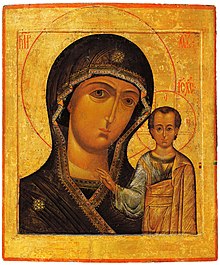 |
| Theotokos |
The plant, when it grows, conserves its uniqueness. It persists in existence through its growth. The non-growing thing decays, and fails to persist in existence precisely because it does not grow.
What about God? Are you advocating for a type of open theism?
No way.
God is completely different than (other) creation, and, the Church is His New Creation.
What about Scripture? It doesn't grow.
In one sense it doesn't, but in another sense it does. Obviously, the Church has closed the canon and there will be no more passages of Scripture added to it. However, in her doctrinal development, the Church recognizes the expansive, potent, and inestimable riches of the deposit of faith found in Sacred Scripture. In fact, a view that closes one off from development of doctrine makes the Sacred Text reductive, less potent, and expendable.
3. The primitive Church (1st century) was already Catholic, and any claim otherwise is the error of the Judaizers.
The error of the Judaizers was to hold to the belief that the Mosaic ceremonial law and customs were to be strictly enforced in the Christian community. It is true that for the first 40-50 years of Christianity, it is was viewed primarily as a sect of Judaism. This fact, however, should not be confused with the idea that Christianity is in fact a sect of Judaism. That view is grossly incomplete and fails to grasp the universal goal of Christ's salvific work (John 1:29). Further, many of the early theological issues dealt with the gradual development of Christianity's clean break with Judaism as a religion. This is evidenced in both Galatians and Acts and portended in Christ's prophecy about the destruction of the temple (Matt 24:2). We might say it wasn't until 70 AD and the destruction of the temple that the Church could truly established her identity separate from the cult of the temple; not because she was always separate from that cult but that culturally, the temple dominated the mind share of the people.
When we examine Matthew's account more closely, it is not just a coincidence that Christ says, "not one stone here will be left upon another, which will not be torn down" and that earlier in his ministry, St. Matthew recounts that Christ called St. Peter "the rock" (Matt 16:18), that the Church is built upon stones, the cornerstone of which is Christ (Eph 2:20). In a sense, we should expect that the "old stones" of the temple were still being cast down between our Lord's ascension and the destruction of the temple.
At this point, I could really just rehash another one of my posts. Instead, I will turn your attention to my post:
Myth Buster: Constantine Founded the Catholic Church
Considering the first two paragraphs (above) and the post about Constantine, it should be clear to see how, what, and why the Church emerges as she does in the late first century. The Old Temple, and its cult, has been destroyed. The New Temple has been built, whose cornerstone is Christ, and whose steward is a rock for whom the Church will lean upon for unity until His return. Of course, we know that the great scandal of unity and the Petrine See is that it has caused many times just the opposite. But, we should not be surprised. Our Lord told us it would be so.
In conclusion, primitivism is only preferable for natural objects. However, even for natural objects that are animate, many times we prefer what is after to what is before because it is precisely in the process of the passing of time that the value of the thing comes to the fore. However, for supernatural objects, we should never prefer what is before simply because it is before.
That is irrational, unbiblical and a-historical.