Showing posts with label Luther. Show all posts

February 14, 2012

There is a Luther inside all of us...

...not this Luther
...not this one either (dang!)

...but this one!

[insert potty word]
Sorry, I know you wanted me to tell you that we all had an inner dude or dudette inside us. I wish we did. That would make us way cooler. It's a simple equation: Vandross + King, Jr = a better world. In fact, in a previous life, I had hoped that when I got to heaven I would have the voice of a soul-full black man. Maybe something like this:


That guy has an instrument in his mouth. If only we were all so lucky...

[note: please ignore the Oneness heretic at minute 1:44]

I've been Catholic for 3.5 years now. In that span of time, I have witnessed more than a few converts who went back to Protestantism. I have also witnessed more than my fair share of those who would never darken her doors. There is a common theme and by now given my title, I am sure you know where this is headed.

Worms.

What?
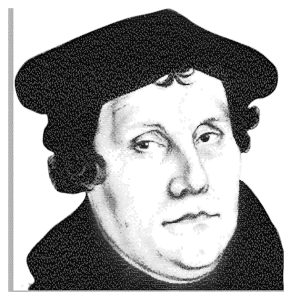
Mr. Verms
A steady diet of worms.

Real worms?

No, not real worms.

If you are a student of history, you know that I am referring to the Diet of Worms (pro-nounced "v-e-r-m-s" to make you sound way, like, in the know). At the Diet of Worms, Luther was pronounced a heretic and told he was getting the smack-down if he didn't come back to the fold. What happened? Looking at a phone book under the heading "churches" gives you a quick insight into how history played out. Bummer.

Though we think we are above it, we all have our wormy moments. What I mean, of course, is that we all come to a place in our lives where either the Church is right or we are right.

Church? Me? Church? Me? Church? Me?

Some leave over small things, while others over major theological issues. In almost every case for the Protestant who becomes Catholic and goes back to Protestantism, it appears that he or she imagined the Church as just the greatest protestant denomination of all time. Then, when the mental placeholder in their head was replaced by the reality of the Church, they take their toys and go home.

What do you mean there are pathetic priests?

What do you mean we only take communion under one species?

What do you mean by faith informed by agape?

The list could go on, and it does go on everyday, throughout the world, in the minds of countless who find the Church passé, outmoded or just plain wrong, dangit! But at the end of the day, all you or I or anyone is facing is their inner Luther. It is a crisis of faith. I have had it, I will admit.

I was in the Basilica in St. Louis, and Cardinal Burke was processing in. To my Protestant sensibilities the whole thing seemed a bit off, if just for a moment. Then, coming to my spiritual wits, I whispered to the Lord:

"Where can I go, you have the words of eternal life."

And so I settled down remembering that the YouTube video above would seem kind of "off " as well--as a substitute for worship--to a cradle Catholic

If the Catholic Church is the Church Jesus personally founded, then you should come into full communion with Her. Further, you should not leave her. If you leave Her, while understanding who she is, you leave Christ. Moreover, as a son of the Church, you should listen to her as your teacher. You should submit when you have your "Luther-an" moment.

Church? Me? Church? Me? Church? Me?

A: Church

Or you might end up like Luther saying things like:

"Who would have begun to preach, if we had known beforehand that so much unhappiness, tumult, scandal, blasphemy, ingratitude, and wickedness would have been the result?" [Walch. VIII. 564]

or

"Under the Pope, people were very fervent in building churches . . . Now that the true religion is taught, and that the people are properly instructed concerning good works, everybody is cold, so much so that we cannot help being surprised at it." [Walch. VI. 1211]

(ht: D. Armstrong)

You might also like:

Don't Be Catholic...


Consider subscribing to Almost Not Catholic. Click here to make it happen.

March 28, 2011

The Assumption in Church History

No woman is like you. You are more than Eve or Sarah, blessed above all nobility, wisdom, and sanctity. (Sermon, Feast of the Visitation, 1537). -Martin Luther


"So then, the great Mother of God, so mysteriously united to Jesus Christ from all eternity by the same decree of predestination, immaculately conceived, an intact virgin throughout her divine motherhood, a noble associate of our Redeemer as he defeated sin and its consequences, received, as it were, the final crowning privilege of being preserved from the corruption of the grave and, following her Son in his victory over death, was brought, body and soul, to the highest glory of heaven, to shine as Queen at the right hand of that same Son, the immortal King of Ages." -Venerable Pope St. Pius XII, Munificentissimus Deus (The most bountiful God)

In order to understand the historical precedent for the doctrine of the Assumption, we have to look back into the early liturgical life of the Church. In the Biblical record, we certainly do not have any direct statement saying that Mary was assumed into heaven. Can the Church know something after the Biblical narrative? Is the Book of Acts open to future "acts" and are those "acts" worthy of Christian assent? Orthodox and Catholic Christians celebrate the assumption of Mary into heaven (the Orthodox call it "Dormition") since, well, it happened. As Taylor Marshall has pointed out in the link above, Catholics believe in the Assumption of Mary "as, say, the fact that Abraham Lincoln was assassinated or the fact that the St. Louis Cardinals won the 2006 World Series. One day Mary's body lay in a tomb. The next day it did not."

Of course there is the possibility that Mary's body was taken by someone to make credible the miraculous claim. However, this claim is not historically plausible in much the same way that a similar story regarding Christ would be false. There is theory and then there is historical evidence.

The actual celebration of the Assumption dates to St. Cyril of Alexandria in the 5th century.  The earliest western account of the Assumption of Mary can be found in Gregory of Tours work Glory of the Martyrs. In Glory, it is recounted that the Blessed Virgin died, her body was taken away by the Apostles with much fare, and then 3 days later her body was assumed into heaven. It should be noted that the Church was just newly emerging from persecution and it is reasonable to assume that her liturgical calendar would evolve slowly.

Do we know the exact date of the Assumption? Historian Warren Carrol in his work The Founding of Christendom places the date of the Assumption of Mary approximately A.D. 49. Taylor Marshall suggests that A.D. 63 is the best candidate from the tradition.

The question that still begs is why wait so long to define the Assumption as dogma (1950)? Why have a defined dogma, wouldn't it just work as a myth of Christian piety? The Church has always only defined a dogma that she holds once it is sufficiently challenged by heresy. The Church also, generally, in these acts of defining dogma upholds other doctrines insomuch that by defining a new dogma, she strengthens the others. The Assumption acts like this.
Take into consideration the opening quote from Luther regarding the Blessed Virgin. Does this sound like the sentiment of most Protestants today? No. So, clearly there was a general degradation of the understanding of Mary amongst protestants from the reformation through the four centuries that would pass before the Assumption was defined as dogma. Conversely, the doctrine of the Assumption redeems Mary's dignity that was lost over those 400 years, reaffirms the Christocentricity of Marian dogmas, and thereby fortifies, even more, the humanity of Christ and thus our salvation.

However, this was not just a Protestant problem. Pope St. Pius XII had just recently written in his encyclical Humani Generis about the prevailing tide of modernism in the culture; even calling to attention the scientism which sought to discredit all supernatural phenomena. These philosophical novelties in the culture at large were certainly in the spirit of the attitude that would discredit the historical reality of the Assumption. I do not think it was an accident that the three months later Pope St. Pius XII would solemly define Mary's assumption as dogma.

As Pope St. Pius XII says , "(Mary) defeated sin and its consequences, received, as it were, the final crowning privilege of being preserved from the corruption of the grave and, following her Son in his victory over death, was brought, body and soul, to the highest glory of heaven." Keeping these facts in mind, I believe we can say the dogma of the Assumption:

(1) Affirms Mary's conquering of sin (and thereby affirms the perpetual virginity of Mary)
(2) Connects her Assumption to the victory won by her Son
(3) Reaffirms her unique privilege in salvation history
(4) Confronts the radical modernism prevalent in culture and beginning to pervade religion
(5) And, "Looses" (Matt 16:19) what is in heaven for the sake of bringing the "kingdom come on earth as it is in heaven"(Matt 6:10)

(Next: The Assumption in Sacred Scripture)