Showing posts with label Church Fathers. Show all posts

April 4, 2011

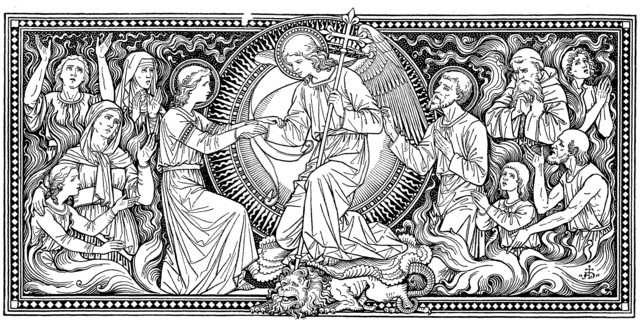
Purgatory in Church History


When I was studying the doctrine of purgatory, one of the most interesting facts that astounded me was just how explicit this notion was in the early Church Fathers. More than infant baptism or original sin, the notion of a coming purgation for the elect was eminent in their writings both East and West. 

In my previous post I explored whether or not this doctrine made sense generally as a Christian. Despite what I will convey here and my growing conviction of the apostolicity and orthodoxy of the doctrine during my studies, I still couldn't make the heart movement which I explained in my previous post. Before that movement, I had given assent to the doctrine per my understanding of (a) the authority of the Catholic Church to teach it and (b) the witness I noticed in Church history and Scripture that attested to it. 

In the The Passion of Perpetua and Felicity we are introduced to a "place of punishment". St. Clement of Alexandria in the dawning of the third century describes this place saying:
"Accordingly the believer, through great discipline, divesting himself of the passions, passes to the mansion which is better than the former one, viz., to the greatest torment, taking with him the characteristic of repentance from the sins he has committed after baptism. He is tortured then still more--not yet or not quite attaining what he sees others to have acquired. Besides, he is also ashamed of his transgressions. The greatest torments, indeed, are assigned to the believer. For God's righteousness is good, and His goodness is righteous. And though the punishments cease in the course of the completion of the expiation and purification of each one, yet those have very great and permanent grief who are found worthy of the other fold, on account of not being along with those that have been glorified through righteousness."-Stromata
St. Cyril of Jerusalem in the fourth century about five hundred miles away from Alexandria writes:
"For I know that many say, what is a soul profited, which departs from this world either with sins, or without sins, if it be commemorated in the prayer? For if a king were to banish certain who had given him offense, and then those who belong to them should weave a crown and offer it to him on behalf of those under punishment, would he not grant a remission of their penalties? In the same way we, when we offer to Him our supplications for those who have fallen asleep, though they be sinners, weave no crown, but offer up Christ sacrificed for our sins, propitiating our merciful God for them as well as for ourselves.”-Catechetical Lectures 23:9,10
St. Augustine of Hippo a few decades after St. Cyril writes:
"For our part, we recognize that even in this life some punishments are purgatorial,--not, indeed, to those whose life is none the better, but rather the worse for them, but to those who are constrained by them to amend their life. All other punishments, whether temporal or eternal, inflicted as they are on every one by divine providence, are sent either on account of past sins, or of sins presently allowed in the life, or to exercise and reveal a man's graces. They may be inflicted by the instrumentality of bad men and angels as well as of the good. For even if any one suffers some hurt through another's wickedness or mistake, the man indeed sins whose ignorance or injustice does the harm; but God, who by His just though hidden judgment permits it to be done, sins not. But temporary punishments are suffered by some in this life only, by others after death, by others both now and then"-City of God 21:13
 At the Twenty Fifth Session of the Council of Trent, the Church affirmed:
"The Catholic Church, instructed by the Holy Ghost, has, from the sacred writings and the ancient tradition of the Fathers, taught, in sacred councils, and very recently in this oecumenical Synod, that there is a Purgatory, and that the souls there detained are helped by the suffrages of the faithful, but principally by the acceptable sacrifice of the altar; the holy Synod enjoins on bishops that they diligently endeavour that the sound doctrine concerning Purgatory, transmitted by the holy Fathers and sacred councils, be believed, maintained, taught, and every where proclaimed by the faithful of Christ. But let the more difficult and subtle questions, and which tend not to edification, and from which for the most part there is no increase of piety, be excluded from popular discourses..."
The Catholic Church continues to proclaim this doctrine of purgation that affirms the dignity of the individuality of the human person and that is copiously present in the writings of the Church Fathers. What I found is that a lot of the historical and theological objections to purgatory had to do with the "difficult and subtle questions, which tend not to edification (or)...increase of piety." The Church certainly had in mind some of the late medieval nominalism that was marked by the most peculiar and subtle questions regarding theology. For example, "If the Eucharist falls on the ground and a mouse picks it up, does the mouse consume the Sacramental species of Christ?" The answers did little more than satiate the inordinate obsession of nominalists with the unending possibility of making language a game. Nevertheless, when the doctrine is understood in its Biblical, historical, and sensible context, it is quite manageable to understand.

Moreover, as the Council of Trent illumines, the doctrine of Purgatory compels us to a life of holiness and penance here on earth. When we sin we not only injure our relationship with God but also our relationship with ourselves and others. Purgation is the process whereby we make right the later two and will make it right either in this world or the next (Matt 12:32).

(Next: Purgatory in Scripture)

March 28, 2011

The Assumption in Church History

No woman is like you. You are more than Eve or Sarah, blessed above all nobility, wisdom, and sanctity. (Sermon, Feast of the Visitation, 1537). -Martin Luther


"So then, the great Mother of God, so mysteriously united to Jesus Christ from all eternity by the same decree of predestination, immaculately conceived, an intact virgin throughout her divine motherhood, a noble associate of our Redeemer as he defeated sin and its consequences, received, as it were, the final crowning privilege of being preserved from the corruption of the grave and, following her Son in his victory over death, was brought, body and soul, to the highest glory of heaven, to shine as Queen at the right hand of that same Son, the immortal King of Ages." -Venerable Pope St. Pius XII, Munificentissimus Deus (The most bountiful God)

In order to understand the historical precedent for the doctrine of the Assumption, we have to look back into the early liturgical life of the Church. In the Biblical record, we certainly do not have any direct statement saying that Mary was assumed into heaven. Can the Church know something after the Biblical narrative? Is the Book of Acts open to future "acts" and are those "acts" worthy of Christian assent? Orthodox and Catholic Christians celebrate the assumption of Mary into heaven (the Orthodox call it "Dormition") since, well, it happened. As Taylor Marshall has pointed out in the link above, Catholics believe in the Assumption of Mary "as, say, the fact that Abraham Lincoln was assassinated or the fact that the St. Louis Cardinals won the 2006 World Series. One day Mary's body lay in a tomb. The next day it did not."

Of course there is the possibility that Mary's body was taken by someone to make credible the miraculous claim. However, this claim is not historically plausible in much the same way that a similar story regarding Christ would be false. There is theory and then there is historical evidence.

The actual celebration of the Assumption dates to St. Cyril of Alexandria in the 5th century.  The earliest western account of the Assumption of Mary can be found in Gregory of Tours work Glory of the Martyrs. In Glory, it is recounted that the Blessed Virgin died, her body was taken away by the Apostles with much fare, and then 3 days later her body was assumed into heaven. It should be noted that the Church was just newly emerging from persecution and it is reasonable to assume that her liturgical calendar would evolve slowly.

Do we know the exact date of the Assumption? Historian Warren Carrol in his work The Founding of Christendom places the date of the Assumption of Mary approximately A.D. 49. Taylor Marshall suggests that A.D. 63 is the best candidate from the tradition.

The question that still begs is why wait so long to define the Assumption as dogma (1950)? Why have a defined dogma, wouldn't it just work as a myth of Christian piety? The Church has always only defined a dogma that she holds once it is sufficiently challenged by heresy. The Church also, generally, in these acts of defining dogma upholds other doctrines insomuch that by defining a new dogma, she strengthens the others. The Assumption acts like this.
Take into consideration the opening quote from Luther regarding the Blessed Virgin. Does this sound like the sentiment of most Protestants today? No. So, clearly there was a general degradation of the understanding of Mary amongst protestants from the reformation through the four centuries that would pass before the Assumption was defined as dogma. Conversely, the doctrine of the Assumption redeems Mary's dignity that was lost over those 400 years, reaffirms the Christocentricity of Marian dogmas, and thereby fortifies, even more, the humanity of Christ and thus our salvation.

However, this was not just a Protestant problem. Pope St. Pius XII had just recently written in his encyclical Humani Generis about the prevailing tide of modernism in the culture; even calling to attention the scientism which sought to discredit all supernatural phenomena. These philosophical novelties in the culture at large were certainly in the spirit of the attitude that would discredit the historical reality of the Assumption. I do not think it was an accident that the three months later Pope St. Pius XII would solemly define Mary's assumption as dogma.

As Pope St. Pius XII says , "(Mary) defeated sin and its consequences, received, as it were, the final crowning privilege of being preserved from the corruption of the grave and, following her Son in his victory over death, was brought, body and soul, to the highest glory of heaven." Keeping these facts in mind, I believe we can say the dogma of the Assumption:

(1) Affirms Mary's conquering of sin (and thereby affirms the perpetual virginity of Mary)
(2) Connects her Assumption to the victory won by her Son
(3) Reaffirms her unique privilege in salvation history
(4) Confronts the radical modernism prevalent in culture and beginning to pervade religion
(5) And, "Looses" (Matt 16:19) what is in heaven for the sake of bringing the "kingdom come on earth as it is in heaven"(Matt 6:10)

(Next: The Assumption in Sacred Scripture)


March 24, 2011

Emerging Heresy

St AugustineRob Bell

St. Augustine fighting Rob Bell?

If you haven't heard yet, Rob Bell, pastor of 10,000 member Mars Hill and proxy pastor to thousands via his media presentations, has written a new book espousing the idea that the traditional Christian notion of heaven/hell is "misguided and toxic and ultimately subverts the contagious spread of Jesus' message of love, peace, forgiveness and joy that our world desperately needs to hear." Here's the skinny:
  • Christianity has historically claimed the necessity of belief in the necessity of Christ for eternal beatitude
  • According to this claim, the road to heaven was narrow and few found it (Jesus)
  • According to Rob Bell, this has made Christianity a less than savory religion
  • So, we need to get the yummy back into Christianity, make Christ more about the love thing
  • Part of our problem is the hell thing. Yuck!
  • So, let's get rid of that problem: there is no eternal damnation, just purgative fire
Why have this problem? A couple possibilities:
  • Protestants don't have purgatory. They feel this tension in Sacred Scripture about a purgation coming in the afterlife, but just don't know its for the home team. Novel doctrine #2974: Purgatory for everyone!
  • Heresy breeds heresy; just saying
  • Protestant can't figure out how Christianity got so popular for the first 1,500 years of Christendom. Parting remarks:
Pope St. Clement of Rome:
If we do the will of Christ, we shall obtain rest; but if not, if we neglect his commandments, nothing will rescue us from eternal punishment (Second Clement 5:5 [A.D. 150]).

St. Polycarp
Fixing their minds on the grace of Christ, [the martyrs] despised worldly tortures and purchased eternal life with but a single hour. To them, the fire of their cruel torturers was cold. They kept before their eyes their escape from the eternal and unquenchable fire (Martyrdom of Polycarp 2:3 [A.D. 155]).

St. Ireneaus:
The penalty increases for those who do not believe the Word of God and despise his coming. . . . It is not merely temporal, but eternal. To whomsoever the Lord shall say, "Depart from me, accursed ones, into the everlasting fire," they will be damned forever (Against Heresies 4:28:2 [A.D. 189]).

St. Cyprian:
An ever-burning Gehenna and the punishment of being devoured by living flames will consume the condemned; nor will there be any way in which the tormented can ever have respite or be at an end. Souls along with their bodies will be preserved for suffering in unlimited agonies. . . . The grief at punishment will then be without the fruit of repentance; weeping will be useless, and prayer ineffectual. Too late will they believe in eternal punishment, who would not believe in eternal life (To Demetrian 24 [A.D. 252]).

St. Cyril of Jerusalem:
We shall be raised therefore, all with our bodies eternal, but not all with bodies alike; For if a man is righteous, he will receive a heavenly body, that he may be able worthily to hold converse with angels; but if a man is a sinner, he shall receive an eternal body, fitted to endure the penalties of sins, that he may burn eternally in fire, nor ever be consumed. And righteously will God assign this portion to either company; for we do nothing without the body. We blaspheme with the mouth, and with the mouth we pray. With the body we commit fornication, and with the body we keep chastity. With the hand we rob, and by the hand we bestow alms; and the rest in like manner. Since then the body has been our minister in all things, it shall also share with us in the future the fruits of the past (Catechetical Lectures 18:19 [A.D. 350]).

Rob who?

They Aren't Drunk As You Suppose

I just started reading this excellent book by Father Raniero Cantalamessa. He's charismatic. He's a learned theologian. He's a preacher. He's Catholic.

Love it. I call that the quadfecta.

St. Ambrose, St. Cyril, and St. Augustine all made allusions to the idea of the Holy Spirit soberly intoxicating us. This instruction was given to new converts who were preparing for baptism and reception into the Church. Before they partook of the Eucharist for the first time, each Church Father listed above prepared communicants with this vital insight.

Have you ever seen someone drunk? There are typically two effects. First, they normally lose control of themselves. The other effect can vary person to person. Some may withdraw, while others become more outgoing. Either way, typically someone acts different than they normally would act.

Father Cantalamessa points out that the Holy Spirit grounds us more deeply into the truth of our personhood or in other words, we become sober. The word sober denotes seriousness, temperance, and clear headedness. It is the opposite of being inebriated. So, how does the Spirit wrought this paradox of both being inebriated and sober?

I think the rub is in understanding the nature of the first effect. We lose control when we are inebriated. In the Eucharist, Christ makes us more human, more Christian, more thoughtful--sober--but this is not by our own effort. Normally speaking, we must put down the drink to get sober. In this case we must pick it up, and it is by the drink of the Blood of Christ that God renews and restores the original image of God in us that has been damaged by sin. Not by our own efforts but by his grace in the Eucharist, Christ offers the gift of sobriety of thought and serenity of the soul through the action of the Third Person of the Holy Trinity. In this way, every Mass is Pentecost.