Showing posts with label Virgin Mary. Show all posts

December 23, 2012

Protestant Idolatry

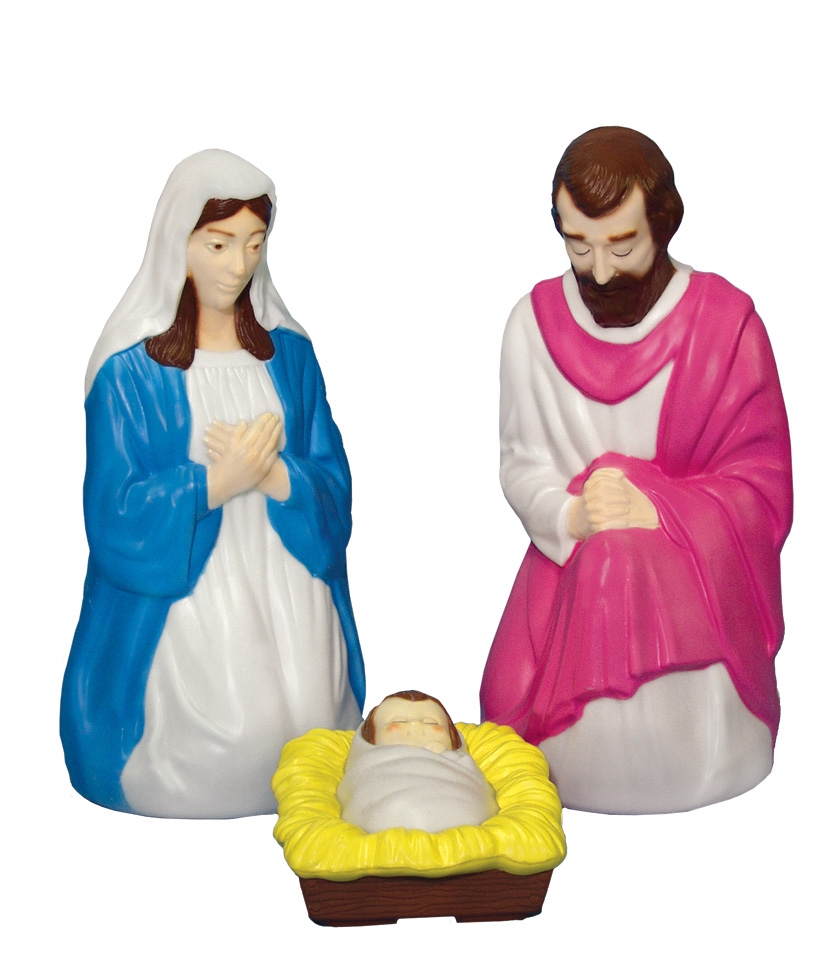
No, I'm not talking about Bibliolatry. I'm talking about that time of the year when almost every Protestant goes into the woodshed and retrieves this:
"It's Christmass. The time of year
when we all get to act like Catholics."
And this collection of plastic statues will be placed directly in front of the protesters home or place of worship. Some even put them in their place of worship. And, to all shock and astonishment, this is less offensive to the Protestant sensibility than this:
Scary Catholic Statue
Think about it.

God -- Creator, Healer, Omnipotent, Holy... -- came to earth in the womb of the Blessed Virgin Mary. In your view, which of the two portrayals is more fitting? I know, I know. Catholics, also, whip out these plastic renditions of the Holy Family. Sure, we do. But, ignoring those criticism for a moment, the point is what we keep up all year, and what is not kept up all year. 

Why, pray tell, is it okay to banish all statuaries, but during Christmas accept a plastic nativity of our Lord, His Mother, and St. Joseph? It is like passing over crème brûlée for a Twinkie and then lying on your weight-watchers e-report that you were "disciplined". It is not so much the plastic in general that bothers me, but rather the plastic in total. In other words, and in the slightly altered words of the cashier at Walmart, "(why) is plastic okay?"

Please understand that this small rant does not come from a foreign place, but rather a place I, too, have lived. At Christmas, before I was Catholic, I somehow glossed over my disdain for statuaries -- my sensibilities slightly dulled by the proximity of the Incarnation to my mind. I allowed the Holy Family to join me en sculpture, and I was never the worst for it. In fact, I hope you did not just miss my words there. "The proximity of the Incarnation to my mind" is precisely what changes everything. The prohibition against "graven images" had to do with the Image-not-yet-come. It was about keeping us reliant upon His salvation, not ours (see: golden calf). But when He did, send The Image, the world was forever marked, our imagination forever incapable of not copying the Masterpiece that dwelt among us. 

Why?

Because we beheld His glory. 

And so, in the form of our art, we declare that Image until the end of time. 

Amen.


September 28, 2012

Marian Dogma: Kiddie Style

Dear Protestant Friends,

Today, I would like to ask of you a favor. I would like for you to ask your child -- or some child -- the question, "Who is Jesus?" After you listen to the answer, I'm sure you will respond with many wonderful things for which we agree. I would request that you would only be careful to mention that Jesus is our brother (Hebrews 2).

This news should delight the child. Then I would only ask for you to remind the child that Jesus's mother is Mary. After which, ask the child, "Is Mary our Mother?"

The child's response should tell it all.

St. Paul tells us that God confounds the wise with the simple things. Ironically, the complexity of Catholic Marian dogma can be reduced to this most simple, basic intuition: Theotokos. It sounds very greek, and that is because it is, but one shouldn't confuse it for a complex theological insight. The complexity of Catholic dogma works in reverse: God reveals Himself to us in what appears at first blush little, simple ways.

A baby.

A tree.

Water.

Then we realize it is God we are dealing with and not a small child. Thus, as soon as we begin to meditate upon what it is that God reveals, we realize that the baby is God, the tree is eternal life, and that the water will soak through our skin. Revelation doesn't mean simplicity, it just means that God makes apprehensible what otherwise would not be apprehensible. 

If you are struggling with Marian dogma, I would encourage you to take two steps back and make sure you understand the first intuition. Look. There.

Here.
See. I told you it wasn't so bad.

Peace to you on your journey

August 14, 2012

The Assumption in 29 Words

If Mary was not assumed into heaven, she was lost.

She was not lost.

She was Assumed.

It is only fitting. 

And there is no evidence to the contrary.

__________________
Also see:

The Assumption of Mary: Is it against Christian sensibilities?

The Assumption in the Bible

The Assumption in Church History


June 20, 2012

Total Consecration to Who?


That's right.

Jesus through Mary. Or in the lingua ecclesiae: Ad Jesum Per Mariam. 

Do it. In fact, let's do it together.

My friend, Marc Bad-arsenic Barnes, challenged me (while he was working on this site) to do it. And you know what? I need to step up to the plate. About two months ago, I got St. Louis de Montfort's book. Oh yeah, and I had read this book too. So, the hand writing was on the wall, and when a finger is writing on the wall, and it's not your finger, nor anyone else's finger in the room, you best not disrespect that finger.

Seriously, don't disrespect the finger.

Do the consecration.

May 13, 2012

Will All Be Saved?

No.

The Immaculate Conception
Faith. Hope. Charity. These are the three theological virtues. These three virtues cannot be in conflict with each other. To understand and to possess faith perfectly is to understand and possess hope and charity. One cannot have a hope that is not informed by faith or that is deprived of charity. Well, you could, but then it would not be hope given to you by the Holy Spirit. It would be wishing or something like wishing.

Let us remember the vision Our Lady of Fátima gave to the small children in Portugal, the ones our Lord called "for such is the kingdom of heaven":
"Our Lady showed us a great sea of fire which seemed to be under the earth. Plunged in this fire were demons and souls in human form, like transparent burning embers, all blackened or burnished bronze, floating about in the conflagration, now raised into the air by the flames that issued from within themselves together with great clouds of smoke, now falling back on every side like sparks in a huge fire, without weight or equilibrium, and amid shrieks and groans of pain and despair, which horrified us and made us tremble with fear...You have seen hell where the souls of poor sinners go. To save them, God wishes to establish in the world devotion to my Immaculate Heart. If what I say to you is done, many souls will be saved and there will be peace. (source)
Of course, as is always the case, Our Lady was only reminding them of the words of Her Divine Son:
"Enter ye in at the narrow gate: for wide is the gate, and broad is the way that leadeth to destruction, and many there are who go in thereat. How narrow is the gate, and strait is the way that leadeth to life: and few there are that find it! -Matthew 7:13-14
Many will find hell. Few will find heaven. These are the plain words of Our Lord.

Should we wish this to be the case?

Of course not. It is the will of God that none should perish, but it is not the will of most men to not perish. Instead, they wish for their own way, the way that seems right unto them that leads to death. So if we desire that none should perish, why should we not hope for all to be saved?

They knew that all would not
be saved.
Because our faith informs us that all will not be saved. Hope deferred makes the heart sick (Proverbs 13:12). We should not hope for what is supernaturally impossible, and while all things are possible with God, the salvation of all is as impossible as God creating a rock too big for Him to pick up. To hope for what is against the Divine foreknowledge, or namely that all would be saved -- despite our Lord explicitly telling us the contrary -- is contrary to God. In fact, it is a false, humanistic view of hope that leads to pining for this impossibility. Why? Because faith is the evidence of things hoped for, the substance of things not seen (Hebrews 11:1). Faith informs hope. Not the other way around. We should not hope for that which our faith does not inform. It is like hoping for female priests, no purgatory, or the end of the papacy.

So instead of hoping for that which is contrary to faith, we should do penance, be converted, and make reparation for sinners so that those on the road to hell would find the Way -- Christ Jesus -- to heaven. If only but one soul escapes eternal fire, it was worth it.

"It" meaning this:


March 25, 2012

Traditions of Men: NOT HONORING MARY


He answered them, "And why do you transgress the commandment of God for the sake of your tradition? For God commanded, 'Honor your father and your mother,' and, 'He who speaks evil of father or mother, let him surely die.' But you say, 'If any one tells his father or his mother, What you would have gained from me is given to God, he need not honor his father.' So, for the sake of your tradition, you have made void the word of God. 
-Matthew 15:3-6

God commands that we honor our mother. -Exodus 20:12

Jesus gave us His Mother as our Mother at the Cross.  -John 19:27

This is also understood implicitly since Christ is our brother. -Hebrews 2:17

Therefore, we must honor our Mother. 

The Blessed Virgin prophesied that all generations would called her "Blessed". -Luke 1:48

Yet...

Some say that to honor the Blessed Virgin takes away from God. They say (something like), "What Mary would have gained from you or I is (ought to be) given to God, therefore, you need not honor your Mother." 

So, for the sake of their tradition, they make void the word of God.

Just say "No!" to traditions of men.
Honor Your Mother.

January 1, 2012

Ad Jesum Per Mariam

1st-Century Theotokos
Why do Catholics talk about Mary so much? As I meditated upon this question this morning, the answer became obvious. Instead of putting it in my words, I offer you this poem entitled "Mary the Dawn" which is a part of the Morning Prayer in the Divine Office, today, January 1, 2012, on The Solemnity of Mary, The Mother of God.
Mary the dawn, Christ the Perfect Day;
Mary the gate, Christ the Heavenly Way!
Mary the root, Christ the Mystic Vine;
Mary the grape, Christ the Sacred Wine!
Mary the wheat, Christ the Living Bread;
Mary the stem, Christ the Rose blood-red!
Mary the font, Christ the Cleansing Flood;
Mary the cup, Christ the Saving Blood!
Mary the temple, Christ the temple's Lord;
Mary the shrine, Christ the God adored!
Mary the beacon, Christ the Haven's Rest;
Mary the mirror, Christ the Vision Blest!
Mary the mother, Christ the mother's Son
By all things blest while endless ages run. Amen.


If the history of Christianity proves anything--the history of humanity even--is that we would prefer a ghost to save us. We give-up Christ in favor of Santa Claus. We swap the Holy Spirit for "close encounters". We prefer "spirituality" to religion. 

Enter Mary. 


Do not forget! We are saved because God became flesh! A true devotion to Mary constantly draws us into the humanity of Christ--which is the gate by which we can share in His divinity. It is the gate that Mary gave Him! Let all the earth praise the Lord, for by the New Eve we are offered the fruit of the Tree of Life! No longer can we blame the woman for our great folly. God has provided The Woman, whose heel bruised the serpent; an enemy who spent millennia waiting for this blow (Gen 3:15). May we rejoice in its succor!

Mary, Mother of the Word Incarnate who is God from all eternity, pray for us, that we would be made worthy of the promises of Christ. Amen.

December 30, 2011

Why the "Holy Family"?

When I was a Protestant, we did not have the concept of the "Holy Family". The idea was just glaringly absent. Why? I suppose that it was because, on the Protestant view I was inculcated, they were not holy. No one but Jesus, that is. Jesus was holy. Mary and Joseph, not so much.

What about "father" Abraham?

Holy

What about Joseph in the Old Testament?

Holy

What about Moses?

Holy

What about...

Moses: A Much More
Seemingly Fantastic Story
You get the picture. There were the heroes of the faith, or what we might call those "set apart" (the greek meaning of the word "holy"). They were the great "cloud of witnesses", whom we held in high esteem, respected for their faith, virtue and courage. In some weird kind of western, post-"enlightened" vantage, we imagined that press-time in the Bible equaled importance for God and so we re-arranged our priorities. Moses got about 10 out of the 22 weeks of Sunday school, Mary 1/4 of a day. Then again, the cult of the Bible was bound to lead to such conclusions. Why would God give so little page space to Mary but so much to Moses? Is not Moses more important than Mary?

This kind of quantitative reductionism, besides being less than erudite, is spiritually blind and inept. It fails to consider that the Scripture is a telling of salvation history--not a catechism--written in almost strictly narrative form, and that the climax of any story should always get more attention than the rest. It is the point of a story, right? The climax.

The climax of salvation history begins with the Holy Family. It is the complete undoing of the sin of the garden. If in creation we learn one thing, we learn that God desired a family--and so we exist. Subsequently, he granted us a share in the divine life and allowed us to "make man in our image in likeness"--so to speak (I got 4 of them so far!). Yet from the beginning, even without children, we were making complete fools out of ourselves. Conspiracy, murder, devilry, you name it, the first family was a picture of disfunction. This disfunction unfolds in our own history, and replays, sometimes getting worse, while at other times acquiescing to that which is still noble in us. Yet, the story is still the same: failure, sin and grabs for inordinate power that lead to ordinary powerlessness.

The New First Family
So enters the Holy Family. On this feast, as a Catholic, I am reminded that the garden is not to be my fixed point of reference. No. The Second Adam came to re-fix my gaze. He not only heals the blind eyes, He gives them a new picture of life! Where shall we find this life? None other than in the Holy Family! A father--nobel, courageous, quiet and strong, a mother--spotless, listening, praying, full of nurture, and a Son--who draws heaven and earth together in the ineffable mystery of the unicity of His nature. It is a great tragedy to miss this family--especially for those who love the Savior. It is likened unto one who is healed by Him, only to fix one's eyes back on the first garden. For we will always have but one of two choices: the garden or Nazareth.

We like the garden because it reminds us so much of ourselves.

Yet in the stable, fleeing to Egypt, and at the temple, we see the Holy Family. The entire story climaxes in this famille petite. We want something big, something epic, and so we fix our eyes on Moses, Elijah, or someone else. Do not get me wrong, they are important, but if you do not understand how in The Story this small family huddled around a babe in swaddling clothes is the raison d'etre, you have yet to fix your eyes beyond the garden--which is ultimately to say that you have not stopped gazing at your own navel. Even more, while your gaze was there--at the garden, you did not hear the Lord say:
"I will put enmities between thee and the woman, and thy seed and her seed: she shall crush thy head, and thou shalt lie in wait for her heel."-Genesis 3:15
The entire story between this moment and the moment the Holy Family appears can be summed in this verse. It was merely a lying in wait. Wait and see for what?

I think you know the answer.

It all started with a family set a part for the climax of His-tory. 

Holy Family, pray for us!

December 21, 2011

Co-Mediatrix!!! What Gives?

When I was Protestant and studying the Catholic faith, I happened upon the word "co-mediatrix" in Scott Hahn's book Hail Holy Queen. Despite what you may think about my long-term papist leanings, this word sent me into a Zwinglian down-ward spiral. I was Martin Luther for at least four days after reading that book. With all the reformation furor I could muster, I marched around my house saying (to myself):
"Co-mediatrix! Mediatrix! Meeediiiaaatrix! Who do these Catholics think they are? There is one mediator between God and man and that is Jesus. I stand with Luther!"
Bible Abuse #259292:
"All Things To All People"
Setting aside the kill-joy of that closing remark, I was dogged in my opposition to Roman Catholic additions to Christian theology (what were in my mind) --as I would have put it (notice how I added "Roman": it is a Protestant way of making anything Catholic sound bad because the word "Roman" is so abused in their world. Don't tell them a book of the Bible is named "Roman(s)".) During one of my evenings of reformation solidarity, I went to my ecclesial community to lead people in song on my electric guitar (accompanied by band). The song was a Third Day version of a hymn which was kind of a Protestant war-cry for me. I would not stand for "co-mediatrix" for even a minute, and so I belted out the chorus imagining I was bringing down the Catholic religion with the reverberation of every power chord. Sound waves are powerful, you know.

If Luther could not do it, maybe I could on an Ibanez, S-series.

Q: How did I get over this theological pot hole?

A: I stopped and asked myself what "co" meant.

That was my real objection. Right? What does "co" mean, doesn't it mean "equal"? For starters, it is a latin pre-fix for "together". Unfortunately, the modern ear (which has been bastardized by abuses of the English language) hears "equal". However, you cannot get from "together" to "equal" without some serious bastardization. As examples, let us consider common words where we use the pre-fix "co":

Cooperation

Coordinate

In both of these examples, "co" simply implies that something is "together" with the root word. If someone is cooperating with me, I would not think they are being "equal" with me. In fact, their cooperation might imply just the opposite. The only time we think of the pre-fix "co" in terms of equality is when we say someone is "co-equal" or the "co-winner". In these cases, the root word does all the work, but somehow "co" gets the credit. Thus, in the case of an action, it is not necessary to imply equality nor is it natural to do so.

Why co-meeediiiatrix!!!! (emphasis is mine to demonstrate just how scary this word is to a Protestant ear--it was to mine) Il est très simple.

As an example (not proof-text), in 2 Corinthians 6:1, we are described as "co-laborers", "co-workers" or those "helping" him (not to mention the entire theme of "In Christ" throughout all of St. Paul's writings). What are we helping him do? Or rather, what is He doing that we are helping accomplish? Does Jesus need help washing His car? Building widgets? Walking little old ladies across the road? ("yes" to the last one) Of course not (almost). What is Jesus doing?
"For there is one God, and one mediator of God and men, the man Christ Jesus" -1 Timothy 2:5

"My little children, these things I write to you, that you may not sin. But if any man sin, we have an advocate with the Father, Jesus Christ the just" -1 John 2:1
Jesus is the One Mediator--tru dat. How does this work? Would not our participation in His mediation take away from His mediation? Not if our work as co-mediators is grounded in our union with Him. That is exactly what St. Paul goes on to talk about in 2 Corinthians--he revels before those in Corinth in the panoply of ways he has shared in the ministry of Christ (poverty, suffering, affliction, joy, etc.). What does this have to do with Mary as Co-Mediatrix?

"Don't worry. We have these in the youth hall."
For starters, Mary is the greatest of creatures. Why? Because she was Mother of the Word Incarnate, duh. When you spend your entire life ignoring the Mother of the Word Incarnate in a failed attempt of "giving Jesus all your attention" while sharing that attention with NASCAR, TLC, and Wii, then it makes sense that you would have no problem dismissing her importance in between games of NASCAR kart racing. The point is that if non-Catholic Christians can teach their children that "Father Abraham had many sons" and "Zaccheus was a wee little man, and a whee little man was he" while dragging Mary begrudgingly out at Christmas only to have her hit the curb as fast as an evangelical Christmas tree on December 27th, than there is going to be a Marian disconnect on a visceral level. Are you Protestant? Do you have no affections for Mary? That makes sense.

Having affections for Mary and her being co-Mediatrix are two different things. I get that. But, the minor objection(s) many times fuel the major objection, and in this case the minor objection is pure emotion--or rather the lack there of. Setting aside any callousness to Mary, we can see from the Biblical witness understood through the Tradition of the Church that Mary is truly the "New Eve". As such--qua creature--she is the greatest. She receives every possible reward we can receive first and in the greatest degree. Thus, she is--like us--a co-laborer with Christ. Her union with Christ allows her to participate in the ministry of mediation that you and I also enjoy in a much more diminished capacity. We give cups of cold water from our vantage. She does her work from hers.


This post is not a full-blown apologia for the title "co-mediatrix". You can read some great stuff to that effect here here, or here. You can also read Scott Hahn's book Hail Holy Queen, if and only if you can set aside your Marian callousness that has accumulated through years of NASCAR kart racing. My point was merely to peel back a few layers of what can appear, at first blush, a very scary onion. What I hope you see now, at the least, is that the title has both a Biblical and historical precedent, and can make much more sense in a world where the Blessed Virgin Mary is displayed like this all year:


Instead of like this (once a year):


WANT MORE ALMOST NOT CATHOLIC? JOIN THE JOURNEY...

September 21, 2011

Reason #3781 Why I'm Catholic

We Celebrate Mary's Birthday


If Christ had a Church, I would imagine that they would--like him--throw some kind of celebration on Mary's birthday. This just makes sense. What does not make sense, at all, is that the Church of Jesus Christ would ignore Mary's birthday. No. That does not make sense at all. 

I'm Catholic because, well, it just make sense on so many levels. September 8th is my wife's birthday. I would not miss her birthday for the world. People celebrate the nativities of those whom they love. Moreover, they celebrate the nativity's of the mothers of whom they really love. Even an evil husband will celebrate his mother-in-law's birthday out of love for his wife. Do you object because nowhere in the Bible does Christ command us to do it? Try, "Honor your mother" (Matt 15:4). Moreover, Jesus expected that common sense would lead you to an appropriate response to God and employed this kind of obvious common sense logic in the gospels (Matt 7:11, Luke 11:13).

So I ask, how much more would a Christian--a lover and follower of Christ--celebrate the birthday of the Mother of our Savior? Does it not make sense, that His Church would forever keep the memory of the birthday of His Mother?

Some questions are too rhetorical to even answer.

September 17, 2011

Did Mary Write the Bible?


Was Mary an author of Scripture? In one sense, we can obviously say "no". However, in another sense, we can affirm that she is the sole source for a significant portion of Scripture. Why? St. Luke starts off his gospel by saying:
"Inasmuch as many have undertaken to compile an account of the things accomplished among us, just as they were handed down to us by those who from the beginning were eyewitnesses and servants of the word, it seemed fitting for me as well, having investigated everything carefully from the beginning, to write it out for you in consecutive order, most excellent Theophilus; so that you may know the exact truth about the things you have been taught."
In the second chapter of St. Matthew's gospel, we are given an account of the magi's flight and the entire predicament with Herod. The level of detail accords an intimate knowledge of the situation.

Why are both of these accounts important?

The accounts are important because the Gospels aren't theological novelties. They are eye-witness accounts, theological accounts, but accounts of witnesses to the events nonetheless. St. Luke compares his task to that of the Old Testament writers ("those who from the beginning"), that the "lover(s) of God" (Theophilus) would know the exact truth about the things [they[ have been taught. Yet the question is still begged as to how St. Matthew and St. Luke acquired their knowledge of the infancy narratives of Christ.

There are only two options: Mary or Joseph.

The problem with St. Joseph being the source is that by the time the Apostles are on the scene, Joseph is out of the picture. We have no evidence that he was a confidant of the Apostles. However, we have copious evidence that the Blessed Virgin was in the confidence of the Apostles.

Why is this important?

This is important because it helps us understand Mary's role in the Church. From Scripture, on the one hand, we get the idea that the Virgin Mary is quietly behind the scenes: silently pondering the mystery of the Incarnation in her heart (Luke 2:19), a sword inconspicuously piercing her soul (Luke 2:35), her quietly releasing her Son into ministry (John 2:5), her discrete solicitude for our Lord throughout his life, her private anguish at the foot of the cross (John 19:23), and St. Luke's subtle mention of her in the upper room at the outpouring of the Holy Spirit (Acts 1:14).

Christ Giving Us Everything
On the other hand, we can notice something happening in the background of Scripture that gives us quite another view of the Blessed Virgin. Unlike the synoptic gospels, St. John's gospel exposes us more intimately to the interior life of Christ than any of the other gospel accounts. Of course we know that St. John was the beloved disciple of our Lord, but who would know better the interior life of Christ than his mother? It is not mere coincidence that the Blessed Virgin was put in the care of St. John, nor is it merely a coincidence that St. John unpacks the mystery of the Incarnation better than any other (see John 1)--something Mary had "pondered in her heart" for possibly seven decades before the composition of St. John's gospel (see Blessed Pope JPII reflection here on this fact).

Yet the main thrust of this post is that there is really no good explanation for the account of Christ's first 12/13 years other than the Blessed Virgin. During these early years, we could expect that Jesus spent most of his time with Mary, and we should pause and ask why we do not get more information about Christ for the span of 18 years after his Jewish coming of age.

Moreover, when comparing the Greek word choice and syntax in the infancy narratives of Luke as compared to other parts of Luke's gospel account, his word choice belies a different source. Scholarship by Joachim Jeremias has demonstrated that while Luke's hand is all over the infancy narratives, the word choice and vocabulary reflects his reliance upon an earlier semitic (jewish) source, and subsequent scholarship continues to affirm Jeremias's analysis. So while some of the infancy narratives of Luke are written in St. Luke's style and syntax, most of the infancy narratives are written in a slavish style to a source that does not follow Lukan conventions. This is underscored by the fact that scholarship has generally arrived at the conclusion that St. Mark's gospel is the primary source of the other gospels. Luke, in various places, copiously uses certain Markan language and/or treats Markan language certain ways that he oddly resists in the infancy narratives (e.g., of the 8 times Luke comes across a certain word, he chooses to change it 6 times; when that word appears in the infancy narratives he resists the word-substitution; for Jeremias see Die Sprache des Lukasevangeliums: Redaktion und Tradition im Nicht-Markusstoff des dritten Evangeliums, for an examination of the pre-Gospel infancy narrative tradition see Birth of the Messiah by Raymond E. Brown and The Gospel According to Luke I-IX by Joseph A. Fitzmyer).

Could this pre-Gospel, semitic tradition be from the Virgin Mary? I think common sense says "yes". Evidently, the Greek agrees.

Practically, the fact that an entire portion of Scripture is indebted to the witness of Mary should demonstrate her central role in the life of the early Church. She was no surrogate Mother, and we should take careful note that St. Luke is still calling her the Mother of Jesus (Acts 1:14) after His glorious ascension! The fact that the Apostles--each of them in their own way--were indebted to Mary for their inspired and inerrant witness to the life of Christ, should cause us pause to consider her central role in the development of the New Testament.

Think about it. The canticle of Mary was her interior prayer to God. How would St. Luke know it other than that Mary told him what she said? We should reject the idea, that some propose, that the Magnificat was some kind of Lukan innovation of "Hannah's Song" (1 Sam 2:1-10), but rather that it was the appropriate response of a well trained Jewish girl who had just recently encountered the angel of the Lord and had come into union with the third person of the Blessed Trinity. She was not only filled with the Spirit, but literally filled with the Word Incarnate.

Thus, it is seemingly apparent that upon the ascension of our Lord, the Apostles attended to Mary, seat of wisdom, as an infallible guide to penetrate the reality of our Risen Lord. At the cross, our Lord gave the Church gifts: His Spirit, His Body and Blood, and His Mother.

So next time you read the Bible:

"Behold, thy Mother"
John 19:27
The First Family Reunion

Did you like what you read? Add me to your RSS feed or "join the journey" in the sidebar to your right.

August 15, 2011

The Feast of the Assumption: 3 Posts


Happy Feast of the Assumption of Mary! In Mary, we see an image of the Church and we grow in confident hope that we too will not simply wither to dust, but will be raised again to new life. Here are three of my posts about the Assumption:


The Assumption of Mary: Is it against Christian sensibilities?


The Assumption in the Bible


The Assumption in Church History


Also check out Brandon Vogt's article here at a place you will want to add to your reader: virtuouspla.net


August 10, 2011

Myth Busters: Catholics Worship Mary

Queen Sheba showing honor to King Solomon--NOT WORSHIPING HIM
Let's start with an assumption: most people know when they are worshiping something. Is that fair? 

I get it that we can all fall into false idolatry for things like food, sex and money. However, it seems rather odd that it would be claimed of a religion that they worship something that they do not themselves claim to worship. Dude says, "Hindu, you worship a cow!" Hindu says, "Yeah, so what." = FAIL

Yet, it is a common Protestant objection to Catholicism that Catholics worship Mary. I've been Catholic for 3 years now and have not once worshiped Mary. In fact, the charge seems prima facie and a posteriori false. Nonetheless, the charge against Catholicism still flies around as popularly as the chant "We will rock you" does at a sporting event.

I've been thinking (proceed with caution). Is the problem that some Protestants are equating "(some) Catholics worship Mary" with "Catholicism teaches the worship of Mary"? This is a very charitable distinction and I will grant the former without granting the later. This is not troubling because I could easily argue the following using the same logic:
  • (some) Protestants worship the Bible, but Protestantism doesn't teach worship of the Bible
  • (some) Protestants handle snakes, but Protestantism doesn't teach the handling of snakes
  • (some) Protestants in the South worship football, but Protestantism doesn't teach the worship of the SEC
  • (some) Protestants use contraception that is against 1,900 years of unanimous Christian teaching, but Protestantism doesn't...well almost
These are charitable (90%) and honest ways of looking at the issue. Do some Catholics worship Mary? Yes, but not because they are good Catholics. I had the pleasure of entering the Church in an immigrant parish. The catechist there informed me that the average immigrant from South/Central America that identified themselves as "Catholic" was mostly pagan and had to be approached as someone with little to no knowledge of the faith. Their faith was a syncretistic concoction of parts of Catholicism and lots of their local, pagan religions. These individuals had to have a complete conversion to Christ, something that obviously had never taken place. This is very sad, but cannot be used as evidence of the effects of Catholic teaching. Worship of Mary is in fact the effect of ignoring Catholic teaching.

Similarly, I knew many Baptists who used the theology of "once saved always saved" as an American Express Sin card to purchase their favorite vices every weekend. In the spirit of the local religion of hedonism, these Christians used a part of their faith mixed with the local belief system to make themselves awful witnesses of Jesus Christ. The question is begged, "Do Baptists believe that you should "sin it up" on Saturday and ask for forgiveness on Sunday?" Of course not. But the lack of charity in such a claim is equally found in the claim that "Catholics worship Mary" as if to imply that Mary-worship is Catholic teaching.

A few thoughts about The Blessed Virgin...

1. In order to worship Mary you must worship a false Mary.

She is the Mother of Christ. She will not allow, even for a moment, her children to give her the worship that is due only to God. She eternally says, "Do what he says". If someone begins to worship Mary, they have created a false Mary in their mind. They are not relating to the Blessed Virgin, but rather have concocted a different Mother so as to worship her. Mary would never allow it. As the new Eve, she perpetually points us to the Tree of Life and to the fruit of her womb: Christ Jesus our Lord.

2. Mary is Due the Highest Honor Afforded a Human Being

Honoring Mary recognizes her privileged place in the story of salvation history. As the Catechism (963) states, "Since the Virgin Mary's role in the mystery of Christ and the Spirit has been treated, it is fitting now to consider her place in the mystery of the Church. "The Virgin Mary . . . is acknowledged and honored as being truly the Mother of God and of the redeemer. . . . She is 'clearly the mother of the members of Christ' . . . since she has by her charity joined in bringing about the birth of believers in the Church, who are members of its head." "Mary, Mother of Christ, Mother of the Church."

And also in 2679, "Mary is the perfect Orans (pray-er), a figure of the Church. When we pray to her, we are adhering with her to the plan of the Father, who sends his Son to save all men. Like the beloved disciple we welcome Jesus' mother into our homes, for she has become the mother of all the living. We can pray with and to her. The prayer of the Church is sustained by the prayer of Mary and united with it in hope."

And lastly in 971, "This very special devotion . . . differs essentially from the adoration which is given to the incarnate Word and equally to the Father and the Holy Spirit, and greatly fosters this adoration."

My honor for Mary is directly proportionate to my experience of gratitude for what she offers us all: Our Lord. Making the fundamental distinction between Marian devotion and the worship due to God alone has a lot to do with our understanding of worship and whether or not certain actions can be in essence different.

Some reject the dulia-latria (honor-worship) distinction. If so, they reject that we can show extreme honor for a creature in proportion to their excellence without worshiping the creature. I claim that to reject this distinction is to reject their own experience and practice. Sadly, many of these Christians attend churches that many times have large American flags adorned behind their pulpits and put on outrageous 4th of July events, all in an attempt to show their honor (dulia) of the USA. In fact, these churches will do more to honor George Washington than Christ's Mother. Ouch! The dulia-latria distinction must be accepted because it is coherent with our experience of reality. Christians who reject the Catholic understanding of dulia in relationship to the saints and hyperdulia in relationship to Mary, practice a type dulia all of the time in various "senses", for example:

"Please rise for judge Thompson."
Evil, evil dulia

"Everyone, please take off your ball cap and place your hand on your heart while we sing the National Anthem."

"Kids, remember to not leave the room when Great-Grandma is here. That would be so disrespectful since she is the matriarch of our family."

In none of these examples of honor, is the honor being given the creatures in relationship to their union with Christ. Conversely, it is precisely because the saints are united with Christ, and precisely because of Mary's relationship to Christ that Catholics give them a unique honor. That is why the category of dulia prescinds supernaturally from the ordinary respect we naturally give in the above three scenarios (and in others). Moreover, honor for those who are united to Christ should be greater than the honor we pay a judge, our country or our grandma. Through their union with Christ, the honor we give them gives God glory and fulfills His divine plan to create an eternal family.

In conclusion, Catholics do not worship Mary but rather give her the hyperdulia afforded her excellence as the Mother of Our Savior, Jesus Christ. Any assertion to the contrary is both ignorant of Catholic teaching and fails to "accept the things of the Spirit of God, for they are foolishness to him; and he cannot understand them, because they are spiritually appraised." (1 Cor 2:14).

July 23, 2011

Pope Leo XIII and the Holy Rosary

The Rosary is the summary of the Gospel. That statement alone tends to confound non-Catholics because when they hear the Rosary all they hear is Mary. I can sympathize since I would have concurred not too long ago. But, ignorance doesn't justify ignorance. If you break up the words of the Rosary into 4 parts (not to mention the part where you meditate on the life of Christ) you get: (1) acknowledgement of salvation coming to men and the presence of God, (2) the unique and singular glory of Christ and His ark, (3) an affirmation of Christ's divinity and (4) an acknowledgement of the victory of the mystical Body of Christ in heaven. The Rosary is truly Christotelic.


Pope Leo XIII, of pious memory, wrote eleven encyclicals about the Holy Rosary. I've listed them below with links and I wanted to share with you what I thought were some great quotes with some comments.

1. Iucunda Semper Expectatione (On the Rosary)

 "It is certain, therefore, that she suffered in the very depths of her soul with His most bitter sufferings and with His torments. Moreover, it was before the eyes of Mary that was to be finished the Divine Sacrifice for which she had borne and brought up the Victim."

2. Laetitiae Sanctae (Commending Devotion to the Rosary) 

"There are three influences which appear to Us to have the chief place in effecting this downgrade movement of society. These are -- first, the distaste for a simple and laborious life; secondly, repugnance to suffering of any kind; thirdly, the forgetfulness of the future life...For We are convinced that the Rosary, if devoutly used, is bound to benefit not only the individual but society at large."

What more can restore the dignity of simple tasks (the simplicity of the prayer), suffering (meditating on Christ's life), and the future ("at the hour of our death") than praying the Holy Rosary?

3. Magnae Dei Matris (On the Rosary)

"It pleased Christ to take upon Himself the Son of Man, and to become thereby our Brother, in order that His mercy to us might be shown most openly; for "it behooved him in all things to be made like unto his brethren that he might become a merciful and faithful high priest before God."[Heb 2:17] Likewise because Mary was chosen to be the Mother of Christ, our Lord and our Brother, the unique prerogative was given her above all other mothers to show her mercy to us and to pour it out upon us."

4. Octobri Mense (On the Rosary)

"The Eternal Son of God, about to take upon Him our nature for the saving and ennobling of man, and about to consummate thus a mystical union between Himself and all mankind, did not accomplish His design without adding there the free consent of the elect Mother, who represented in some sort all human kind, according to the illustrious and just opinion of St. Thomas, who says that the Annunciation was effected with the consent of the Virgin standing in the place of humanity...Thus as no man goeth to the Father but by the Son, so no man goeth to Christ but by His Mother...We adore the beloved Savior, lavish of His blood and of His life; we dread the inexorable Judge...[Mary] is the mighty Mother of the Almighty; but-what is still sweeter -- she is gentle, extreme in tenderness, of a limitless loving-kindness. As such God gave her to us."

5. Superiore Anno (On the Recitation of the Rosary) 

"May our Heavenly Patroness, invoked by us through the Rosary, graciously be with us and obtain that, all disagreements of opinion being removed and Christianity restored throughout the world, we may obtain from God the wished for peace in the Church."

Even as divisions within the Church plague us, may we implore the one who drew the disciples together with her in the upper room, who constantly seeks to watch over her Son's prayer, "that they all may be one" (John 17:21).

6. Supremi Apostolatus Officio (On Devotion to the Rosary) 

"We have deemed it most opportune for similar reasons to institute solemn prayers and to endeavor by adopting those addressed to the Blessed Virgin in the recital of the Rosary to obtain from her son Jesus Christ a similar aid against present dangers. You have before your eyes, Venerable Brethren, the trials to which the Church is daily exposed; Christian piety, public morality, nay, even faith itself, the supreme good and beginning of all the other virtues, all are daily menaced with the greatest perils...That great saint indeed, divinely enlightened, perceived that no remedy would be more adapted to the evils of his time than that men should return to Christ, who "is the way, the truth, and the life," by frequent meditation on the salvation obtained for Us by Him, and should seek the intercession with God of that Virgin, to whom it is given to destroy all heresies. He therefore so composed the Rosary as to recall the mysteries of our salvation in succession, and the subject of meditation is mingled and, as it were, interlaced with the Angelic salutation and with the prayer addressed to God, the Father of Our Lord Jesus Christ."

7. Vi E Ben Noto (On the Rosary and Public Life)

"Let it be your work, venerable brethren, to revive this Christian feeling among your people, an interest in the Catholic cause, a confidence in Our Lady' help, and a spirit of prayer. It is certain that the august Queen, invoked thus well by her man sons, would deign to hear their prayer, console Us in Our sorrow, and crown Our efforts for the Church...by granting better times."

8. Adiutricem (On the Rosary) 

"It is mainly to expand the kingdom of Christ that We look to the Rosary for the most effective help. On many occasions We have declared that the object which at the present time engrosses Our most earnest attention, is the reconciliation to the Church of nations which have become separated from her. We recognize, at the same time, that the realization of Our hopes must be sought chiefly in prayer and supplication addressed to almighty God...The mystery of Christ's immense love for us is revealed with dazzling brilliance in the fact that the dying Saviour bequeathed His Mother to His disciple John in the memorable testament: "Behold thy son." Now in John, as the Church has constantly taught, Christ designated the whole human race, and in the first rank are they who are joined with Him by faith. It is in this sense that St. Anselm of Canterbury says: "What dignity, O Virgin, could be more highly prized than to be the Mother of those to whom Christ deigned to be Father and Brother!"

9. Augustissimae Virginis Mariae (On the Confraternity of the Holy Rosary)

"God predestined her from all eternity to be the Mother of the Incarnate Word, and for that reason so highly distinguished her among all His most beautiful works in the triple order of nature, grace and glory, that the Church justly applies to her these words: "I came out of the mouth of the Most High, the first-born before all creatures" (Ecclus 24:5).

10. Diuturni Temporis (On the Rosary)

"Impelled, therefore, by a constant desire that Christians should ever be convinced of the efficacy and dignity of the Rosary of Our Lady, We first of all pointed out that the origin of this form of prayer is divine rather than human, showing it to be an admirable garland woven from the Angelic Salutation, together with the Lord's Prayer, joined to meditation, and that this form of prayer was most powerful and particularly efficacious for attaining eternal life. For besides the special excellence of the prayers, it affords a powerful protection to faith and conspicuous models of virtue in the mysteries proposed for contemplation. We showed also how easy the devotion is and how suited to the people, offering an absolutely perfect model of domestic life in meditation on the Holy Family at Nazareth, and that therefore Christendom had never failed to experience its salutary effects."

11. Fidentem Piumque Animum (On the Rosary)

"The Fathers and Doctors in subsequent times have taught that this is a matter of such grave necessity, that if men neglect it they hope in vain for eternal salvation. Every one who prays finds the door open to impetration, both from the very nature of prayer and from the promises of Christ. And we all know that prayer derives its chief efficacy from two principal circumstances: perseverance, and the union of many for one end. The former is signified in those invitations of Christ so full of goodness: ask, seek, knock (Matt 7:7), just as a kind father desires to indulge the wishes of his children, but who also requires to be continually asked by them and as it were wearied by their prayers, in order to attach their hearts more closely to himself. The second condition Our Lord has born witness to more than once: If two of you shall consent upon earth concerning anything whatsoever they shall ask, it shall be done to them by My Father who is in heaven. For where there are two or three gathered in My name, there am I in the midst of them (Matt 18:19-20)."

______________________________________________

Is it any wonder that Our Lady would appear in Fatima in 1917, fourteen years after the passing of Pope St. Leo XIII? As a point of interest, there was not one encyclical letter written about the Holy Rosary between 1903 and 1936. Did anything happen between those years? (ahem...World War I)

In summary:

PRAY THE ROSARY!

July 20, 2011

Mary's Song: The Verse I Never Saw


On August 3 at 2pm est, my interview from Marcus Grodi's radio show Deep in Scripture will air. The theme of the show is "The Verse(s) I Never Saw", and I've selected three scripture passages that I would like to discuss with Marcus. As a preview of the show, one of the passages I've selected is Luke 1:46-55, or what we refer to as the Magnificat or Canticle of Mary. The passage reads:
And Mary said: "My soul doth magnify the Lord. And my spirit hath rejoiced in God my Savior. Because he hath regarded the humility of his handmaid; for behold from henceforth all generations shall call me blessed. Because he that is mighty, hath done great things to me; and holy is his name. And his mercy is from generation unto generations, to them that fear him. He hath showed might in his arm: he hath scattered the proud in the conceit of their heart. He hath put down the mighty from their seat, and hath exalted the humble. He hath filled the hungry with good things; and the rich he hath sent empty away. He hath received Israel his servant, being mindful of his mercy: As he spoke to our fathers, to Abraham and to his seed for ever."
More than a year before I ever considered the Catholic Church, in a time of prayer and Scripture reading, I came across this passage. Immediately, the Lord convicted me.

How could I be so callous to the mother of Jesus? I claimed to love him, have a relationship with him, but thought very little of his mother. Moreover, at the most important point in the history of salvation up until this time, Mary was declaring that "all generations will call me blessed". I had a background in the Hebrew language from my undergraduate, and so I knew that this word blessed didn't mean "awesome job" or "nice one" or "Mary, you sure are a great incubator". No this implied a prophetic reality, and unfortunately last I remembered there was no place in my tradition where we call her blessed, or more specifically invoked the blessing of the Lord upon her.

What is the blessing of the Lord on her?

Just a few verses above in Luke 1:28, we get a record of the heavenly blessing delivered by the Angel Gabriel from heaven to earth so that no one could dispute it:

"Hail, full of grace, the Lord is with thee: 
blessed art thou among women."

Whoa nellie. We definitely DID NOT say that phrase. We did not return to Mary the blessing declared by Gabriel's mouth, the word that brought salvation to the world, the word that revealed the one "set apart" as the Woman prophesied about in Genesis. We were not a part of the prophetic fulfillment of Mary's song. Sadly, Her chorus had fallen on deaf ears.

Further, how was it that Mary could rejoice in God her savior (past tense) and what were the great things he had done for her? At this point in my journey, that was just food for thought.

At the word on the lips of the Blessed Virgin, recorded in Holy writ, my theology changed that day. As a Protestant, I loved Mary from that moment forward. I could not resist the conviction of the Holy Spirit. Even more, I knew that I had to find that Church that returned to Mary, in every generation, the blessing delivered through the angelic oracle. Actually, I had yet to come to that conclusion, but I knew at the least that my tradition, nowhere, called her blessed in every generation, and that was a problem I should probably look into.

Hat tip to the czar for the pic

July 10, 2011

Reason #2584-Why I'm Catholic

Answers to Questions

From the Czar at
www.patrickvandapool.com
The Catholic Church doesn't claim to have ALL the answers. However, she does answer a lot of questions. In fact, there isn't a single verse in the Bible that is ostensibly important that she glosses. She also doesn't gloss the witness of the Church Fathers. On my journey to the Church I became forlorn with a particular phenomenon. Whenever I would begin to take up a particular Church teaching, I would go online in search of the best arguments against that teaching. I would look in scholarly journals, books, and occasionally I would go into the "combox"--that place at the end of a blog post where all of us get a little pulpit time--looking for a rebuttal to the Catholic position. The distressing thing about that experience was that the dialogue always went something like this:
Protestant: The Catholic Church teaches X

Catholic: The Catholic Church does not teach X, she teaches Y

Protestant: The Catholic Church teaches X

Catholic: Like I said, The Church does not teach X, she teaches Y

play/rewind/play/rewind/play...
For an example, let's take one hot-button subject. Some Christians claim that Catholics worship Mary. Let's look at a few their reasons:

1. The Rosary- The Rosary is a Marian prayer. Mary is said "x" times more than Jesus, therefore, Jesus is less important then Mary, therefore Catholics worship Mary.

Catholic: The Rosary is a meditation on the life, death, resurrection and merits of Christ. The words act as a background chant whereby the Christian, with Mary, contemplates the person of Jesus Christ. The prayer comes directly from Scripture and the recommendation of the Council of Ephesus.

Reply: But, Catholics worship Mary....I know they do!

Catholic: No, we don't.

Reply: Yes, you do.

play/rewind/play/rewind/play...
__________________________________________________________________

2. The Immaculate Conception- You say Mary was without sin. That means she is equal with Jesus, which means you believe she is a deity. Gotcha! You worship Mary!

Catholic: Actually, the Immaculate Conception says as much about Christ as it does about Mary. In fact, it speaks specifically to the holiness of Christ. God did save Mary, but not like you and I. He saved her at  the moment of her conception. To sanctify, to make holy, means to "set-apart", and in the case of Mary she was uniquely set-apart to be the ark of the new covenant for the glory of God revealed in the person of Jesus Christ. In Revelation 11:19, the ark of the covenant is on display in heaven. What could that be? It certainly couldn't be the ark of the old covenant, could it? So, if not, what or rather who is it? 

Reply: Jesus said all have sinned and fallen short of the glory of God. You don't believe in the Bible because of your man-made traditions. Err... and let me check my Bible on that Revelation passage and get back with you--probably some Romish addition.

Catholic: Does a handicapped child sin?

Reply: Well, um, (hem-haw-hem-haw)...

Catholic: Well since we can think of exceptions to what Christ is saying, we know He is using hyperbole to drive home a point. Taking into consideration the rest of Scripture, I'm fairly certain that you and I don't fall under any exception, but since there can be exceptions we cannot say de facto that Mary sinned. Did you get a chance to look at Revelation?

Reply: (internal dialogue: my Geneva commentary Bible glossed Rev 11:19) You worship Mary and are clearly deceived by the errors of Rome.

Catholic: Huh?

play/rewind/play/rewind/play...
__________________________________________________________________

3. Other Marian Prayers- Catholics have a lot of different prayers to Mary. It's like they are obsessed with her. That obsession is idolatrous and therefore they worship her.

Catholic: When you were a child did you ever write notes to your mother--long notes, expressing your love and admiration for her?

Reply: Yes, but I never worshiped her like you worship Mary.

Catholic: No, we don't worship her, we just love her a lot because she is the one predestined to be the Mother of the Savior of the World. She gave God her very flesh, and while in her womb, Jesus and Mary shared the same blood coursing through each other's veins.

Reply: Come on! Anyone could have been Jesus' mother...you guys just spend way too much time loving Mary. You can't possibly love Jesus enough and therefore Mary has become an idol to you. If she is an idol, you worship her, therefore you worship Mary.

Catholic: No, we don't worship her. We can love Mary because God's love has been shed in our heart by the Holy Spirit. Sin causes us to close in on ourselves, to make love small, to selfishly imagine a God who is like us. However, since God is love, we know that love gives. All of creation is a testament to God's incredible gratuity to you and me. God sent his son Jesus so that we could share in the life of the Holy Trinity. When we get to heaven, we participate in the love of the Trinity as the Body of Christ. To love Mary isn't to detract form Christ, but rather, when done properly, confirms our love for Christ and affirms that we believe in the very mission he came to accomplish--to make a family that can call God Abba. 

Reply: But, but...you worship Mary, I know you do.

Catholic: No, we don't. 

play/rewind/play/rewind/play...
__________________________________________________________________

If you aren't Catholic and are reading this, stop doing this. It doesn't win converts with long attention spans. It isn't honest to the human heart that longs for truth. play/rewind/play/rewind/play...is a propaganda technique and not suitable for dialogue.

Outside of the combox, I found wonderful articles and books that tried to more carefully deal with Catholic doctrine. Though, what I found troubling about those sources was that they either (a) continued to misrepresent the Catholic position in some way or (b) failed to consider that their conclusions actually would lead you to the Catholic Church.

A great example of this can be found online for your viewing pleasure over at www.calledtocommunion.com. You certainly do get what I described above at times, but at other times you get really thoughtful responses. I recently was speaking with Bryan Cross, one of the main contributors at CTC, and told him that I actually believed the level of confusion in the comboxes could be helpful for some to see the truth of Catholicism. Let me explain.

If the Catholic position isn't true, then it would seem obvious that it would be universally not true. In other words, there should be a universal argument that defeats the Catholic position. What the comboxes prove is just the opposite. Thousands upon thousands of comments opining as to this reason or that why the Catholic position on a subject is not true. This is interesting for two reasons:

1. What one barks the most and loudest at is the most real threat. The Catholic Church's claims, unlike other claims, have more dissenters than comprehensible. Why? Could it be that what we are most afraid of might be true?

You think so?
Watch what happens next...
2. Most of the dissenting opinions from Catholic doctrine contradict each other. In other words, if one of the opinions is true, then the others aren't. What that entails, many times, is a kind of domino effect. If one dissenting opinion is true on one issue, it excludes another opinion which entails the exclusion of something that is true. If affirming "X" implies an untruth, than it cannot be true. That was a lot of abstract language, let me make it concrete. Some people claim that Mary as Theotokos is an error of Rome that leads to Mary worship. However, if we affirm that the Council erred, then we have no principled way of saying that other councils did not err. If other councils could err, then we cannot trust them. If we cannot trust them, then we cannot trust our understanding of the Trinity or Christology. So, you can see, by assuming one position there is a domino effect of assuming other positions that would necessarily, even form the dissenter's vantage be heterodox.

How do I get the post to end?

Not sure, other than to say, I'm glad the Catholic Church has answers, and it is imperative as Catholics that we learn them because the human heart is made for truth...not sound bites or sophistry.
St. Francis de Sales, pray for us!