Showing posts with label Called to Communion. Show all posts

January 9, 2013

Bye-Bye Trinity

I want to bring to your attention an interesting conversation over at Called to Communion. If you think certain dogmas are "too central" to Christianity to be disregarded by "mainstream Christians", think again.

Without the Church, provincial versions of Christianity are headed for dogmatic nihilism (i.e., you can "know nothing for certain"). Or to put it more softly, mere Christianity will get a whole lot more mere  and whole lot less Christian. 

Also, I think David Anders brings it home and says something I've experienced too since becoming Catholic.

Peace to you on your journey.

June 2, 2012

Do We Need Certainty Regarding Dogma?


This post is a slight adaptation of a comment I recently left at the website Called to Communion. If you have not already, I highly recommend making the site a regular part of your reading diet.
_______________________________________

The question of "epistemic certainty" was germane to my own spiritual journey. Albeit, I did not dip my toe in the Tiber because of it, but I certainly did begin to question the basic framework of my ecclesial home which eventually led me to Rome.

Mixer-upper of ontology
and epistemology
Let me just say, that in epistemology there are distinguishable features of “knowing”. For any type of knowledge we have, we can recognize and distinguish (1) the knower, (2) the thing known and (3) the method by which we know a thing. On 1 and 2, we agree with our Protestant friends. I make this point because often questions of epistemology in Catholic and Protestant dialog quickly devolve into conversations about “total depravity” or “the nature of revelation”. I am willing to grant the one who holds to “total depravity” that, in fact, they know stuff despite their theological commitment to a position that seems to undermine the possibility of any kind of certainty with regards to the function of their fallen cognitive faculty. That is besides the point, because I can move that fact to the bottom and top of the fraction for both of us and redact it out of the formula.

We also agree that the deposit of faith comes to us from God, and thus is a supernatural object of knowledge. Therefore, we agree fundamentally as to the nature of the knower and the nature of the thing known. However, we disagree fundamentally on the methodology by which we know the thing. This, I think, is the onus of Michael Liccione's article, and the reason the Protestant should click over to it, read and wrestle with it; keeping in mind the distinct epistemological contention he raises.

In short, the distinction between opinion and dogma, which outside of theology just means opinion or fact, should shed light on what is at stake. In short, the credibility of Christianity is at stake. Think about it. It would appear that for all species of knowledge accessible to the human faculty, there is a principled method by which humans can agree, if used, will result in certain knowledge (e.g., observation, historical study, abstraction, etc. — and in theology, dogma). “Certain” here not meaning the removal of all doubt (for we are irrationally prone to it), but rather meaning a certain trust in the credibility of a method that produces results worthy of assent. The ball drops twice. George Washington is always the first president. A=A. Then comes theology.

The Catholic position does not thrust upon theology something external to itself. It is not, as some have alluded, a wanting for more than God would have us have. It is, in fact, simply asking of theology what is requisite itself for attaining something more than just opinion in general, and since theology is a supernatural object, it is fitting that it would require a supernatural methodology (of courses in harmony with natural processes). This just means we are being human as God has made us. If God did not want us to have certainty regarding theology, then he would have created us without rational minds. If we did not have rational minds, then we would be fine if the ball drops and does not drop, that there is no rational principle in the world or in the mind of God, and that it does not matter what baptism really does as long as you believe something (an approach to the world more resembling Islam than Christianity).

To hold to this principle, the principle of what I will call “theological nihilism”, flavored with a positivism imbued by an evangelical vigor, is to act less than human. It is to look at the image of God in you and to reject it in favor, ironically, of your own opinion. This, of course, is the sin of Adam: to become less than human by becoming the autonomous man. The primacy of the individual conscience bit Adam in his soul, for between the fruit and his mouth was a decision that he knew better — that somehow his latest interpretation of the commandment was more enlightened than his previous interpretation.

The Church, the ground and pillar of truth, is the principled method by which we can distinguish between opinion and fact. I can “tell it to the church” (Matthew 18:17), and get an answer that if I reject, I become as a tax collector or pagan.

That is the “difference”.

The Chair of St. Peter

February 20, 2012

The Canon Made Impossible...

Most Protestants love Jesus. These Protestants are “Jesus people,” and this love for Jesus gives them something in common with Catholics. Catholics, as the people who partake of Jesus’ body, blood, soul and divinity, cannot help but be endeared to them. Enter Bart Ehrman. A seeming enemy of both Jesus-loving Protestants and Catholics alike, Ehrman and his associates attempt to “debunk” the Sacred writings that we both hold in high regard...

You can read the rest here at Called to Communion...

August 20, 2011

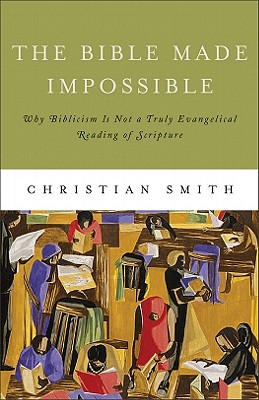
Book Review: The Bible Made Impossible

The Bible Made Impossible: Why Biblicism Is Not A Truly Evangelical Reading of Scripture, by Christian Smith, the William R. Kenan, Jr. Professor of Sociology and Director of the Center for the Study of Religion and Society at the University of Notre Dame, is his effort to understand why the Bible, in his view, does not seem to work as the “sole rule of faith” within his evangelical tradition -- hence the term “impossible.” The book is divided into two parts: the first part a diagnoses of the problem of biblicism and the second part Smith’s proposed solution.

What is Biblicism?

According to Smith, Biblicism is a belief that assumes at least one of the following to be true about the Bible:

1. The Bible is Identical to God’s very words
2. The Bible is the total representation of God’s will for humanity
3. The Bible covers every topic you need to know about anything
3. Democratic Perspicuity- “almost anybody can read the Bible and get it”
4. “Common Sense” Hermeneutic- just take it literal
5. Solo Scriptura
6. Internal Harmony- everything in the Bible fits together
7. Universal Applicability of all direct teachings of the Apostles
8. Inductive Method as the preferable method for understanding the Bible

As to #5, Bryan and Neal have demonstrated how sola reduces to solo here. Smith points to the way Westminster Theological Seminary refers to the Westminster Confession Faith (WCF) as fallible on the one hand, yet treating it as though “the likelihood...of detecting or admitting error or revisions is effectively nil” (p.14). He goes on to point out the way the WCF affirms many of his biblicist criteria. In the end, Smith's criticism virtually includes almost all of Protestantism by implying that both confessional and evangelical Protestant denominations treat the Bible in a biblicist way.

What to think of all of this?

Having defined biblicism, Smith next considers how the belief in the Bible as the rule of faith has fared in history. As evidence of the confusion, he quotes from the founder of Mormonism, Joseph Smith:
“In the midst of this war of words and tumult of opinion, I often said to myself, What is to be done? Who of all these parties are right? Or, are they all wrong together? If one of them is right, which is it, and how shall I know? The teachers of religion of the different sects destroy all confidence in settling the question by an appeal to the Bible. At length I came to the conclusion that I must...ask of God.”
The fact that Joseph Smith’s sentiments reflect the average Christian’s should be startling. Of course, the average Christian doesn’t run out and start a completely new church. The broader question, and the one Smith is asking in the use of this quotation and others he deploys, is how do Christians of good faith sort through all the thousands and thousands (probably millions) of pages of competing interpretations?

You can read the rest of the review where it was originally published at Called to Communion by clicking on this link

May 6, 2011

Mass 201: It's Not About You and It's Really that Simple

As a follow up to my post "Mass 101: It's Jesus and It's Really that Simple", and in response to a thread over at the blog Called to Communion about ecclesial consumerism, I feel compelled to talk about worship. As Catholics, we call this "The Mass" or we often refer to it as the Eucharistic "Celebration".

Maybe the term "celebration" got us confused. It's not The Mass's fault, but rather the poor devolution of the term celebration in our society. If you look at the etymology of the word celebration, you can plainly see the religious connotation. However, today the word celebration typically implies something we are doing for ourselves. We celebrate birthdays, super bowls, or a graduation. We mail out cards, plan games, buy drinks, etc. These are really fun times, times when we feel close to the people around us, times of real community.

Then there is The Mass. Some say The Mass can be kind of boring, or that people don't feel connected, or that priests can be too focused on what they are doing or that in general it could use some updating.

I'm thinking balloons and a good DJ.

Let the worship begin!
So, what is worship anyway? The Hebrew word for worship is transliterated avodah. It literally means work or service. Doesn't sound like a backyard barbecue does it?

Let me point this out, The Mass is a lot of things, for starters it's about Jesus and it's really that simple, but secondly it's not about you and it's really that simple.

It is a celebration, but not for you or I. We do celebrate but not with us in mind. The veil has been torn, the throne of grace is available to us, and in the Mass we celebrate that salvation has come to men. Or rather, we celebrate that God became man, dwelt among men, and we can now behold the face of God. That's why we do all those "boring" readings. It gives us an opportunity to enter into the historical and existential reality of God coming to us--his movement and condescension.

Then there is this turning. Where nothing we can do could make it truly come to pass. Only by the gift of Christ, the power of the Holy Spirit and through the authority vested in the Church can we receive the gift. I am, of course, speaking of the Holy Eucharist. It is there that we enter into the mystery of Calvary, that we partake of the divine nature as St. Cyril of Jerusalem instructs, it is the Body and Blood of God. He becomes our paschal lamb and we partake of him not as in a type or shadow of salvation but for our salvation (John 6:53). We are not a part of a cosmic foreshadowing like the Israelites in Egypt as the death angel passes over, but rather we experience what that was anticipating. The Creator of the universe stoops so low as to allow us: creature, fool, sinner, beggar, finite, pathetic partake of uncreated, wisdom, sinless, omnipotent, and infinite. And so we begin this work with "Kryie Eleison!"

If you don't get anything out of that, if you find the local pub, party, or picnic more spiritually nurturing than The Mass, if you can't help but nod off during the readings, roll your eyes at the incensing, or check an email during the homily, I suggest you re-read the above paragraph, pray, and ask the Lord to help you experience His descent, His condescension to us and resist that age old tendency to want to ascend, like at the Tower of Babel, brick by brick in our own way to God. Let us not be confused that we will only meet ourselves at the summit of that journey. He has given us the way in the Holy Liturgy, let us simply work at allowing it to envelope us with His infinite mercy.


March 24, 2011

What church should I go to?


Click on the title to go to an excellent article written by Bryan Cross at the website Called to Communion.

Question:

Why did you choose your church?